

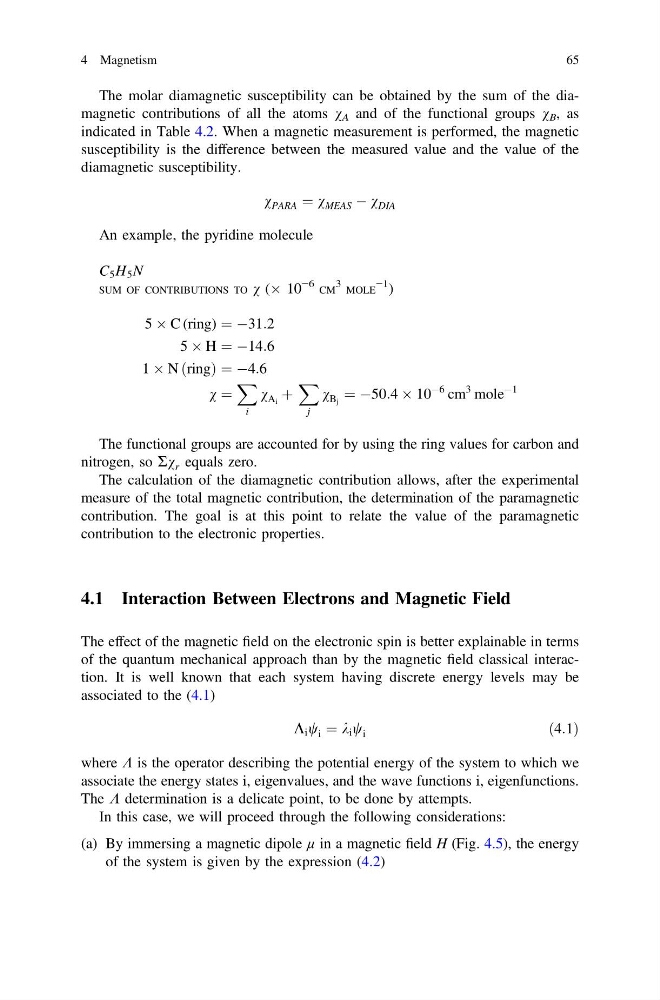
The molar diamagnetic susceptibility can be obtained by the sum of the diamagnetic contributions of all the atoms v A and of the functional groups v B , as
indicated in Table 4.2. When a magnetic measurement is performed, the magnetic
susceptibility is the difference between the measured value and the value of the
diamagnetic susceptibility.
v PARA ¼ v MEAS À v DIA
An example, the pyridine molecule
C 5 H 5 N
SUM OF CONTRIBUTIONS TO v (Â 10
−6 CM
3 MOLE
−1 )
5 Â C (ring) ¼ À31:2
5 Â H ¼ À14:6
1 Â N ðringÞ ¼ À4:6
v ¼
X
i
v A i þ
X
j
v B j ¼ À50:4 Â 10
À6 cm
3 mole
À1
The functional groups are accounted for by using the ring values for carbon and
nitrogen, so Rv r equals zero.
The calculation of the diamagnetic contribution allows, after the experimental
measure of the total magnetic contribution, the determination of the paramagnetic
contribution. The goal is at this point to relate the value of the paramagnetic
contribution to the electronic properties.
4.1 Interaction Between Electrons and Magnetic Field
The effect of the magnetic field on the electronic spin is better explainable in terms
of the quantum mechanical approach than by the magnetic field classical interaction. It is well known that each system having discrete energy levels may be
associated to the (4.1)
K i w i ¼ k i w i
ð4:1Þ
where K is the operator describing the potential energy of the system to which we
associate the energy states i, eigenvalues, and the wave functions i, eigenfunctions.
The K determination is a delicate point, to be done by attempts.
In this case, we will proceed through the following considerations:
(a) By immersing a magnetic dipole µ in a magnetic field H (Fig. 4.5), the energy
of the system is given by the expression (4.2)
4 Magnetism
65
indicated in Table 4.2. When a magnetic measurement is performed, the magnetic
susceptibility is the difference between the measured value and the value of the
diamagnetic susceptibility.
v PARA ¼ v MEAS À v DIA
An example, the pyridine molecule
C 5 H 5 N
SUM OF CONTRIBUTIONS TO v (Â 10
−6 CM
3 MOLE
−1 )
5 Â C (ring) ¼ À31:2
5 Â H ¼ À14:6
1 Â N ðringÞ ¼ À4:6
v ¼
X
i
v A i þ
X
j
v B j ¼ À50:4 Â 10
À6 cm
3 mole
À1
The functional groups are accounted for by using the ring values for carbon and
nitrogen, so Rv r equals zero.
The calculation of the diamagnetic contribution allows, after the experimental
measure of the total magnetic contribution, the determination of the paramagnetic
contribution. The goal is at this point to relate the value of the paramagnetic
contribution to the electronic properties.
4.1 Interaction Between Electrons and Magnetic Field
The effect of the magnetic field on the electronic spin is better explainable in terms
of the quantum mechanical approach than by the magnetic field classical interaction. It is well known that each system having discrete energy levels may be
associated to the (4.1)
K i w i ¼ k i w i
ð4:1Þ
where K is the operator describing the potential energy of the system to which we
associate the energy states i, eigenvalues, and the wave functions i, eigenfunctions.
The K determination is a delicate point, to be done by attempts.
In this case, we will proceed through the following considerations:
(a) By immersing a magnetic dipole µ in a magnetic field H (Fig. 4.5), the energy
of the system is given by the expression (4.2)
4 Magnetism
65