

Chapter 4
Magnetism
The magnetic properties play a fundamental role in the understanding of the
electronic structure of ions and molecules. In fact starting from the energy of
interaction between the electrons and the magnetic field, it becomes possible to
locate the unpaired electrons of the ground state and to hypothesize the energy trend
of the remaining electronic states. The magnetic data are obtained from measurements of magnetic susceptibility and from the electron spin resonance spectra.
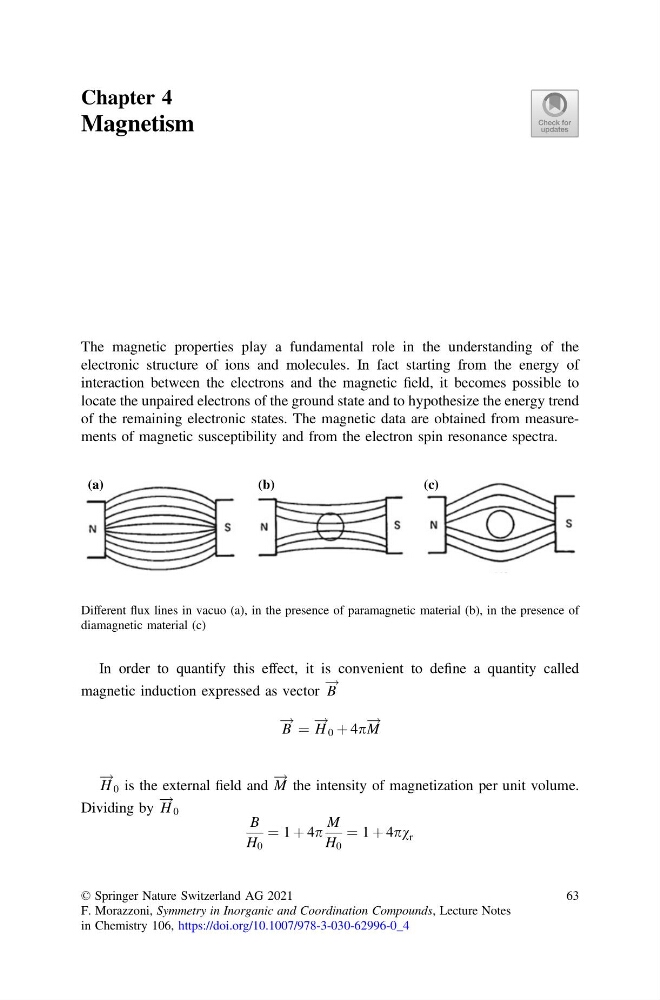
In order to quantify this effect, it is convenient to define a quantity called
magnetic induction expressed as vector B
!
B
! ¼ H
!
0 þ 4pM
!
H
!
0 is the external field and M
! the intensity of magnetization per unit volume.
Dividing by H
!
0
B
H 0
¼ 1 þ 4p
M
H 0
¼ 1 þ 4pv r
(a)
(b)
(c)
Different flux lines in vacuo (a), in the presence of paramagnetic material (b), in the presence of
diamagnetic material (c)
© Springer Nature Switzerland AG 2021
F. Morazzoni, Symmetry in Inorganic and Coordination Compounds, Lecture Notes
in Chemistry 106, https://doi.org/10.1007/978-3-030-62996-0_4
63
Magnetism
The magnetic properties play a fundamental role in the understanding of the
electronic structure of ions and molecules. In fact starting from the energy of
interaction between the electrons and the magnetic field, it becomes possible to
locate the unpaired electrons of the ground state and to hypothesize the energy trend
of the remaining electronic states. The magnetic data are obtained from measurements of magnetic susceptibility and from the electron spin resonance spectra.
In order to quantify this effect, it is convenient to define a quantity called
magnetic induction expressed as vector B
!
B
! ¼ H
!
0 þ 4pM
!
H
!
0 is the external field and M
! the intensity of magnetization per unit volume.
Dividing by H
!
0
B
H 0
¼ 1 þ 4p
M
H 0
¼ 1 þ 4pv r
(a)
(b)
(c)
Different flux lines in vacuo (a), in the presence of paramagnetic material (b), in the presence of
diamagnetic material (c)
© Springer Nature Switzerland AG 2021
F. Morazzoni, Symmetry in Inorganic and Coordination Compounds, Lecture Notes
in Chemistry 106, https://doi.org/10.1007/978-3-030-62996-0_4
63