

Instead the crystal field trend (based on the magnitude of 10 Dq) for different
metal ions is
MnðIIÞ\NiðIIÞ\CoðIIÞ\FeðIIÞ\VðIIÞ\FeðIIIÞ\CrðIIIÞ\VðIIIÞ
\CoðIIIÞ\MnðIVÞ\MoðIIIÞ\RhðIIIÞ\PdðIVÞ\IrðIIIÞ\ReðIVÞ
\PtðIVÞ
By this way, we change the crystal field theory in ligand field theory.
3.6 Effect of Distortion from Cubic Symmetry
The group theory allows an easy indication of the crystal field effects on the atomic
states, and we reported the examples in the previous chapters. However, the
extensive treatment has been done for cubic symmetry. It is expected that in the
case of lower symmetry, or distortion from the cubic one, the perturbation field
effects on the ion states would be different. In fact for a d
1 ion in a distorted
octahedral symmetry (elongated tetragonal), the pristine O h states split as shown in
the Scheme (upper part). For a low spin Co(III) d
6 , the pristine O h ground state
changes as in the Scheme (lower part).
A 1g *
T 1u *
A 1u
T 1u
T 2g
t 1
e 1
a 1
t 2g
E g *
e g
4p
4s
3d
t 1u
a 1g
∆
E
N
E
R
G
Y
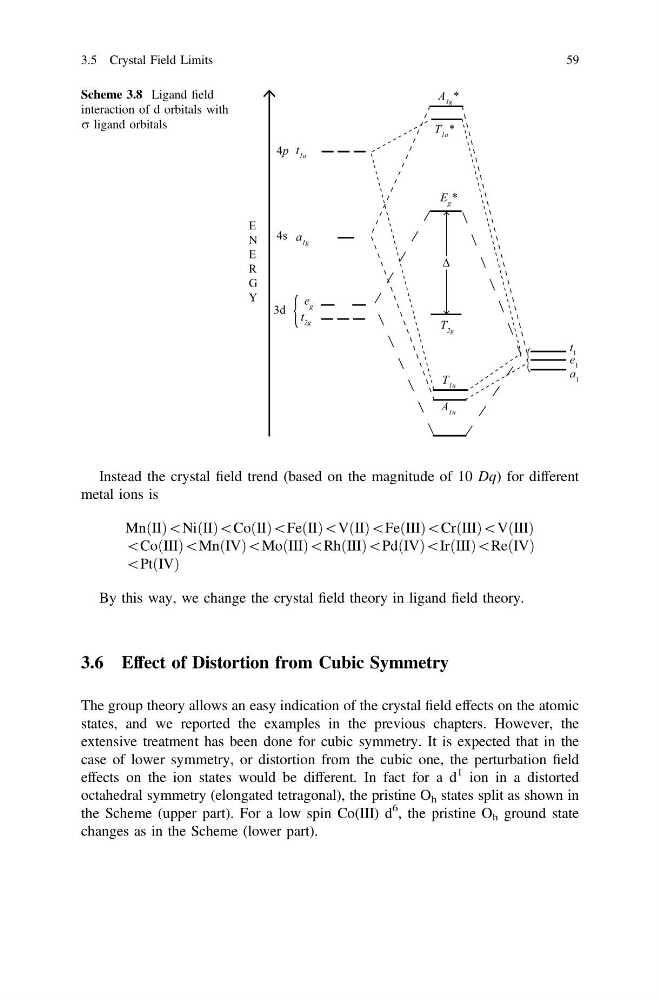
Scheme 3.8 Ligand field
interaction of d orbitals with
r ligand orbitals
3.5 Crystal Field Limits
59
metal ions is
MnðIIÞ\NiðIIÞ\CoðIIÞ\FeðIIÞ\VðIIÞ\FeðIIIÞ\CrðIIIÞ\VðIIIÞ
\CoðIIIÞ\MnðIVÞ\MoðIIIÞ\RhðIIIÞ\PdðIVÞ\IrðIIIÞ\ReðIVÞ
\PtðIVÞ
By this way, we change the crystal field theory in ligand field theory.
3.6 Effect of Distortion from Cubic Symmetry
The group theory allows an easy indication of the crystal field effects on the atomic
states, and we reported the examples in the previous chapters. However, the
extensive treatment has been done for cubic symmetry. It is expected that in the
case of lower symmetry, or distortion from the cubic one, the perturbation field
effects on the ion states would be different. In fact for a d
1 ion in a distorted
octahedral symmetry (elongated tetragonal), the pristine O h states split as shown in
the Scheme (upper part). For a low spin Co(III) d
6 , the pristine O h ground state
changes as in the Scheme (lower part).
A 1g *
T 1u *
A 1u
T 1u
T 2g
t 1
e 1
a 1
t 2g
E g *
e g
4p
4s
3d
t 1u
a 1g
∆
E
N
E
R
G
Y
Scheme 3.8 Ligand field
interaction of d orbitals with
r ligand orbitals
3.5 Crystal Field Limits
59