

3.5 Crystal Field Limits
Several limitations affect the crystal field theory, due to the simplified model which
considers the ligands as negative spheres, and the interaction between the valence
electrons and the negative ligands charges a mere Coulomb repulsion. No covalent
interaction is admitted.
For this reason, the experimental Dq value results different from those expected
from the simple crystal field approximation. The diagrams show the variations of
Dq when the overlap between r or p ligand orbitals and d orbitals is taken into
account.
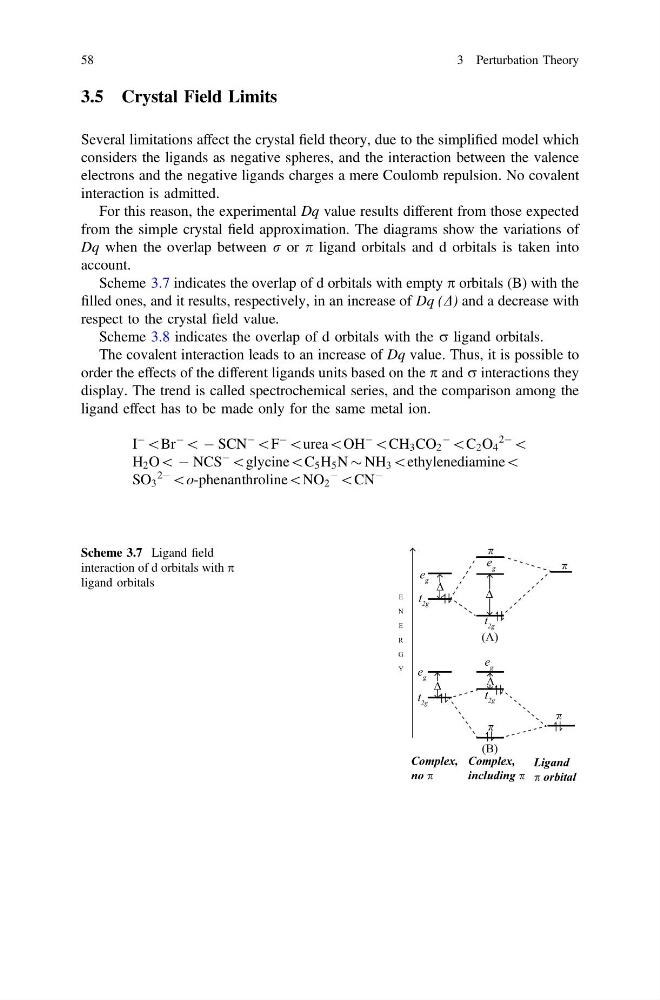
Scheme 3.7 indicates the overlap of d orbitals with empty p orbitals (B) with the
filled ones, and it results, respectively, in an increase of Dq (D) and a decrease with
respect to the crystal field value.
Scheme 3.8 indicates the overlap of d orbitals with the r ligand orbitals.
The covalent interaction leads to an increase of Dq value. Thus, it is possible to
order the effects of the different ligands units based on the p and r interactions they
display. The trend is called spectrochemical series, and the comparison among the
ligand effect has to be made only for the same metal ion.
I
À
\Br
À
\ À SCN
À
\F
À
\urea\OH
À
\CH 3 CO 2
À
\C 2 O 4
2À
\
H 2 O\ À NCS
À
\glycine\C 5 H 5 N $ NH 3 \ethylenediamine\
SO 3
2À
\o-phenanthroline\NO 2
À
\CN
À
∆
e g
e g
e g
e g
t 2g
(A)
Complex,
no
Complex,
including
Ligand
orbital
(B)
t 2g
t 2g
t 2g
∆
∆
∆
E
N
E
R
G
Y
Scheme 3.7 Ligand field
interaction of d orbitals with p
ligand orbitals
58
3 Perturbation Theory
Several limitations affect the crystal field theory, due to the simplified model which
considers the ligands as negative spheres, and the interaction between the valence
electrons and the negative ligands charges a mere Coulomb repulsion. No covalent
interaction is admitted.
For this reason, the experimental Dq value results different from those expected
from the simple crystal field approximation. The diagrams show the variations of
Dq when the overlap between r or p ligand orbitals and d orbitals is taken into
account.
Scheme 3.7 indicates the overlap of d orbitals with empty p orbitals (B) with the
filled ones, and it results, respectively, in an increase of Dq (D) and a decrease with
respect to the crystal field value.
Scheme 3.8 indicates the overlap of d orbitals with the r ligand orbitals.
The covalent interaction leads to an increase of Dq value. Thus, it is possible to
order the effects of the different ligands units based on the p and r interactions they
display. The trend is called spectrochemical series, and the comparison among the
ligand effect has to be made only for the same metal ion.
I
À
\Br
À
\ À SCN
À
\F
À
\urea\OH
À
\CH 3 CO 2
À
\C 2 O 4
2À
\
H 2 O\ À NCS
À
\glycine\C 5 H 5 N $ NH 3 \ethylenediamine\
SO 3
2À
\o-phenanthroline\NO 2
À
\CN
À
∆
e g
e g
e g
e g
t 2g
(A)
Complex,
no
Complex,
including
Ligand
orbital
(B)
t 2g
t 2g
t 2g
∆
∆
∆
E
N
E
R
G
Y
Scheme 3.7 Ligand field
interaction of d orbitals with p
ligand orbitals
58
3 Perturbation Theory