

B 1 dx
2
-y
2
dx
2
dzy
dyz
1 d zz
E g
E
N
E
R
G
Y
Gaseous
ion
Tetragonal
O h
2
D
T 2g
A 1
B 2
E
E
N
E
R
G
Y
1 T 2g
1
B 2g
1
E g
1 E g
1
A 2g
1 A 1g
Tetragonal Rhombic
1
A 1g
∆E 1
1 T 1g
O h
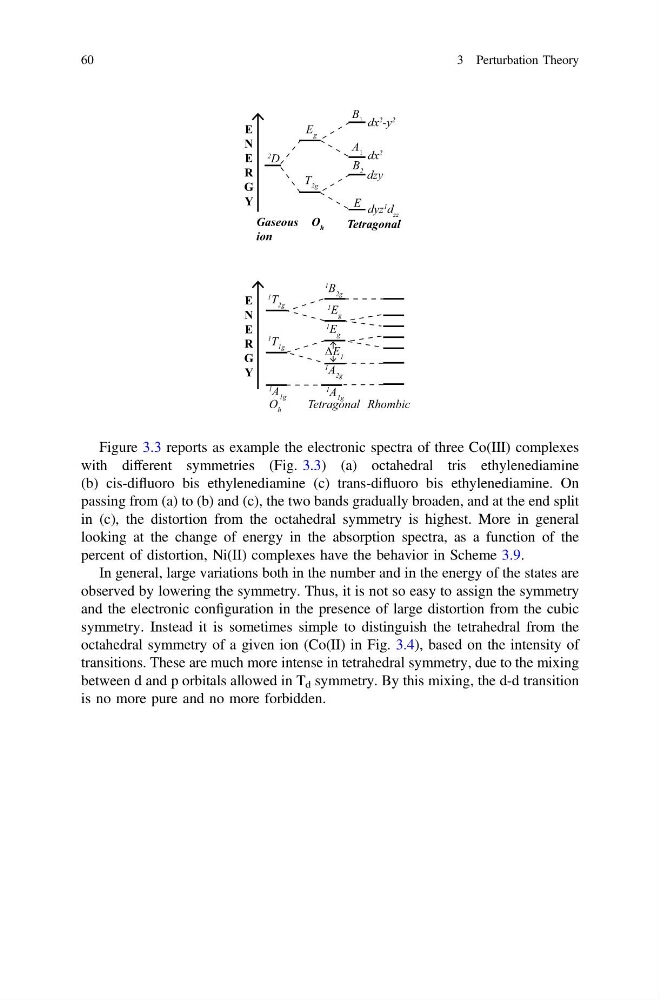
Figure 3.3 reports as example the electronic spectra of three Co(III) complexes
with different symmetries (Fig. 3.3) (a) octahedral tris ethylenediamine
(b) cis-difluoro bis ethylenediamine (c) trans-difluoro bis ethylenediamine. On
passing from (a) to (b) and (c), the two bands gradually broaden, and at the end split
in (c), the distortion from the octahedral symmetry is highest. More in general
looking at the change of energy in the absorption spectra, as a function of the
percent of distortion, Ni(II) complexes have the behavior in Scheme 3.9.
In general, large variations both in the number and in the energy of the states are
observed by lowering the symmetry. Thus, it is not so easy to assign the symmetry
and the electronic configuration in the presence of large distortion from the cubic
symmetry. Instead it is sometimes simple to distinguish the tetrahedral from the
octahedral symmetry of a given ion (Co(II) in Fig. 3.4), based on the intensity of
transitions. These are much more intense in tetrahedral symmetry, due to the mixing
between d and p orbitals allowed in T d symmetry. By this mixing, the d-d transition
is no more pure and no more forbidden.
60
3 Perturbation Theory
2
-y
2
dx
2
dzy
dyz
1 d zz
E g
E
N
E
R
G
Y
Gaseous
ion
Tetragonal
O h
2
D
T 2g
A 1
B 2
E
E
N
E
R
G
Y
1 T 2g
1
B 2g
1
E g
1 E g
1
A 2g
1 A 1g
Tetragonal Rhombic
1
A 1g
∆E 1
1 T 1g
O h
Figure 3.3 reports as example the electronic spectra of three Co(III) complexes
with different symmetries (Fig. 3.3) (a) octahedral tris ethylenediamine
(b) cis-difluoro bis ethylenediamine (c) trans-difluoro bis ethylenediamine. On
passing from (a) to (b) and (c), the two bands gradually broaden, and at the end split
in (c), the distortion from the octahedral symmetry is highest. More in general
looking at the change of energy in the absorption spectra, as a function of the
percent of distortion, Ni(II) complexes have the behavior in Scheme 3.9.
In general, large variations both in the number and in the energy of the states are
observed by lowering the symmetry. Thus, it is not so easy to assign the symmetry
and the electronic configuration in the presence of large distortion from the cubic
symmetry. Instead it is sometimes simple to distinguish the tetrahedral from the
octahedral symmetry of a given ion (Co(II) in Fig. 3.4), based on the intensity of
transitions. These are much more intense in tetrahedral symmetry, due to the mixing
between d and p orbitals allowed in T d symmetry. By this mixing, the d-d transition
is no more pure and no more forbidden.
60
3 Perturbation Theory