

For the correlation between terms and d orbitals, see the beginning of this
paragraph.
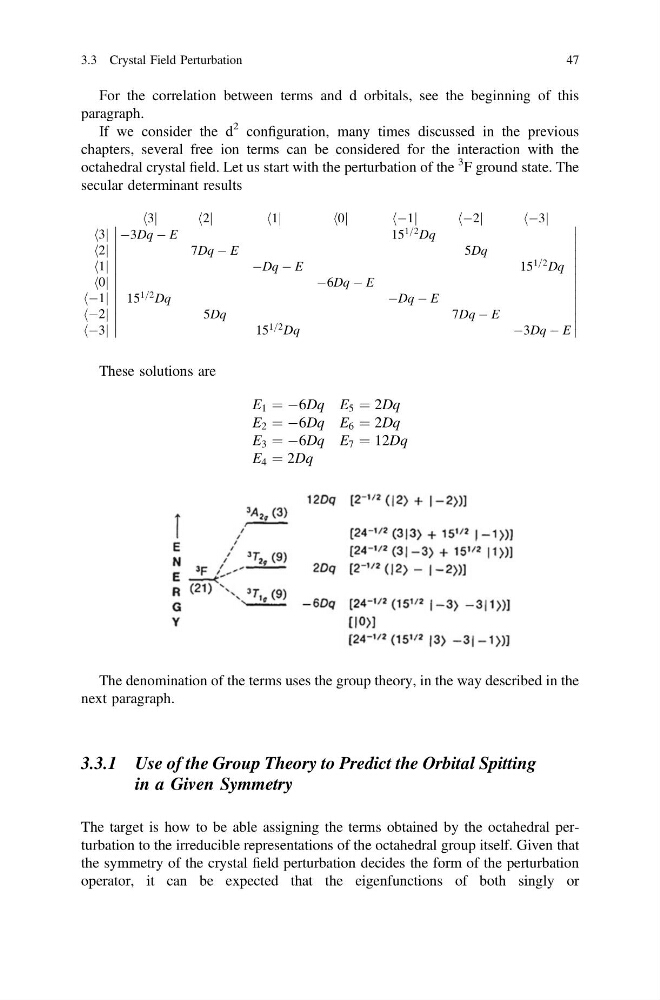
If we consider the d
2 configuration, many times discussed in the previous
chapters, several free ion terms can be considered for the interaction with the
octahedral crystal field. Let us start with the perturbation of the
3 F ground state. The
secular determinant results
3
h j
2
h j
1
h j
0
h j
À1
h j
À2
h j
À3
h j
3
h j
2
h j
1
h j
0
h j
À1
h j
À2
h j
À3
h j
À3Dq À E
15
1=2 Dq
7Dq À E
5Dq
ÀDq À E
15
1=2 Dq
À6Dq À E
15
1=2 Dq
ÀDq À E
5Dq
7Dq À E
15
1=2 Dq
À3Dq À E
These solutions are
E 1 ¼ À6Dq E 5 ¼ 2Dq
E 2 ¼ À6Dq E 6 ¼ 2Dq
E 3 ¼ À6Dq E 7 ¼ 12Dq
E 4 ¼ 2Dq
The denomination of the terms uses the group theory, in the way described in the
next paragraph.
3.3.1 Use of the Group Theory to Predict the Orbital Spitting
in a Given Symmetry
The target is how to be able assigning the terms obtained by the octahedral perturbation to the irreducible representations of the octahedral group itself. Given that
the symmetry of the crystal field perturbation decides the form of the perturbation
operator, it can be expected that the eigenfunctions of both singly or
3.3 Crystal Field Perturbation
47
paragraph.
If we consider the d
2 configuration, many times discussed in the previous
chapters, several free ion terms can be considered for the interaction with the
octahedral crystal field. Let us start with the perturbation of the
3 F ground state. The
secular determinant results
3
h j
2
h j
1
h j
0
h j
À1
h j
À2
h j
À3
h j
3
h j
2
h j
1
h j
0
h j
À1
h j
À2
h j
À3
h j
À3Dq À E
15
1=2 Dq
7Dq À E
5Dq
ÀDq À E
15
1=2 Dq
À6Dq À E
15
1=2 Dq
ÀDq À E
5Dq
7Dq À E
15
1=2 Dq
À3Dq À E
These solutions are
E 1 ¼ À6Dq E 5 ¼ 2Dq
E 2 ¼ À6Dq E 6 ¼ 2Dq
E 3 ¼ À6Dq E 7 ¼ 12Dq
E 4 ¼ 2Dq
The denomination of the terms uses the group theory, in the way described in the
next paragraph.
3.3.1 Use of the Group Theory to Predict the Orbital Spitting
in a Given Symmetry
The target is how to be able assigning the terms obtained by the octahedral perturbation to the irreducible representations of the octahedral group itself. Given that
the symmetry of the crystal field perturbation decides the form of the perturbation
operator, it can be expected that the eigenfunctions of both singly or
3.3 Crystal Field Perturbation
47