

b
V ¼
X 6
i¼1
eZ i =r ij
where e is the electron charge, Z i the effective ligand charge, and r ij the distance
between electron and ligand. The form of the integrals in the perturbation determinant is M L V
j jM
0
L
. When the integration is done, many quantities related to the
radial part of the matrix elements appear in the determinant and have the form 1/6
(Ze
2 r
−4 a
−5 ) where r is the average radius of the d electrons of the central ion, and
a the metal-ligand distance.
This quantity is referred to as 10 Dq and is an energy. With these considerations,
the determinant for an octahedral complex having a d
1 central ion is
2
j i
1
j i
0
j i
À1
j i
À2
j i
2
j i
1
j i
0
j i
À1
j i
À2
j i
Dq À E
5Dq
À4Dq À E
6Dq À E
À4Dq À E
5Dq
Dq À E
¼ 0
This gives roots
E 1
j i
ð Þ ¼ À4Dq
E À1
j i
ð
Þ¼À4Dq
E 0
j i
ð Þ ¼ 6Dq
2
j i
À2
j i
2
j i
À2
j i
Dq À E
5Dq
5Dq
Dq À E
¼ 0
The residual determinant still has the roots −4Dq + 6Dq.
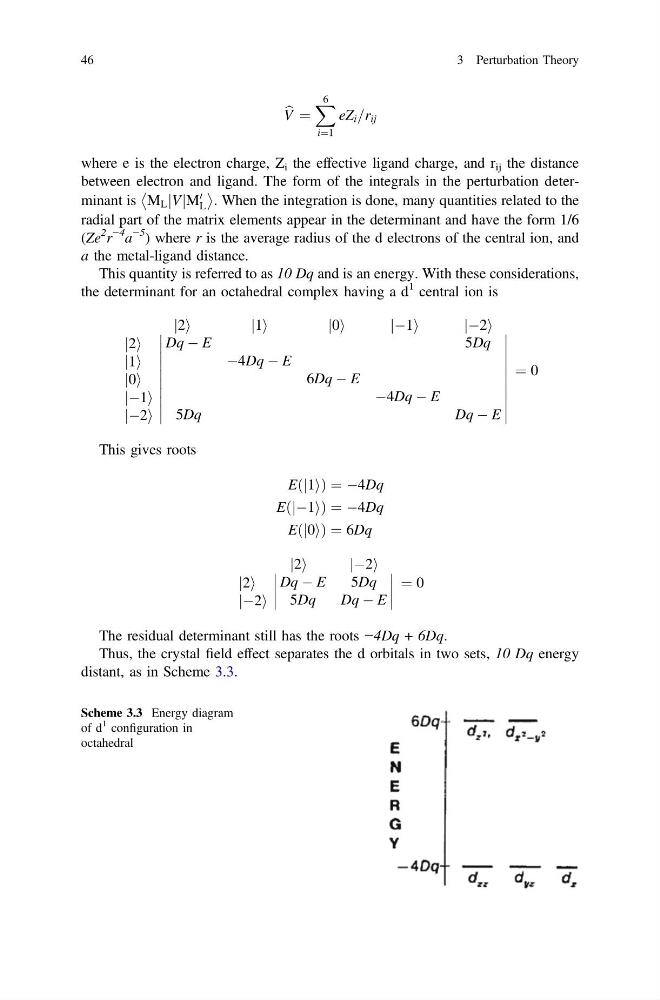
Thus, the crystal field effect separates the d orbitals in two sets, 10 Dq energy
distant, as in Scheme 3.3.
Scheme 3.3 Energy diagram
of d
1 configuration in
octahedral
46
3 Perturbation Theory
V ¼
X 6
i¼1
eZ i =r ij
where e is the electron charge, Z i the effective ligand charge, and r ij the distance
between electron and ligand. The form of the integrals in the perturbation determinant is M L V
j jM
0
L
. When the integration is done, many quantities related to the
radial part of the matrix elements appear in the determinant and have the form 1/6
(Ze
2 r
−4 a
−5 ) where r is the average radius of the d electrons of the central ion, and
a the metal-ligand distance.
This quantity is referred to as 10 Dq and is an energy. With these considerations,
the determinant for an octahedral complex having a d
1 central ion is
2
j i
1
j i
0
j i
À1
j i
À2
j i
2
j i
1
j i
0
j i
À1
j i
À2
j i
Dq À E
5Dq
À4Dq À E
6Dq À E
À4Dq À E
5Dq
Dq À E
¼ 0
This gives roots
E 1
j i
ð Þ ¼ À4Dq
E À1
j i
ð
Þ¼À4Dq
E 0
j i
ð Þ ¼ 6Dq
2
j i
À2
j i
2
j i
À2
j i
Dq À E
5Dq
5Dq
Dq À E
¼ 0
The residual determinant still has the roots −4Dq + 6Dq.
Thus, the crystal field effect separates the d orbitals in two sets, 10 Dq energy
distant, as in Scheme 3.3.
Scheme 3.3 Energy diagram
of d
1 configuration in
octahedral
46
3 Perturbation Theory