

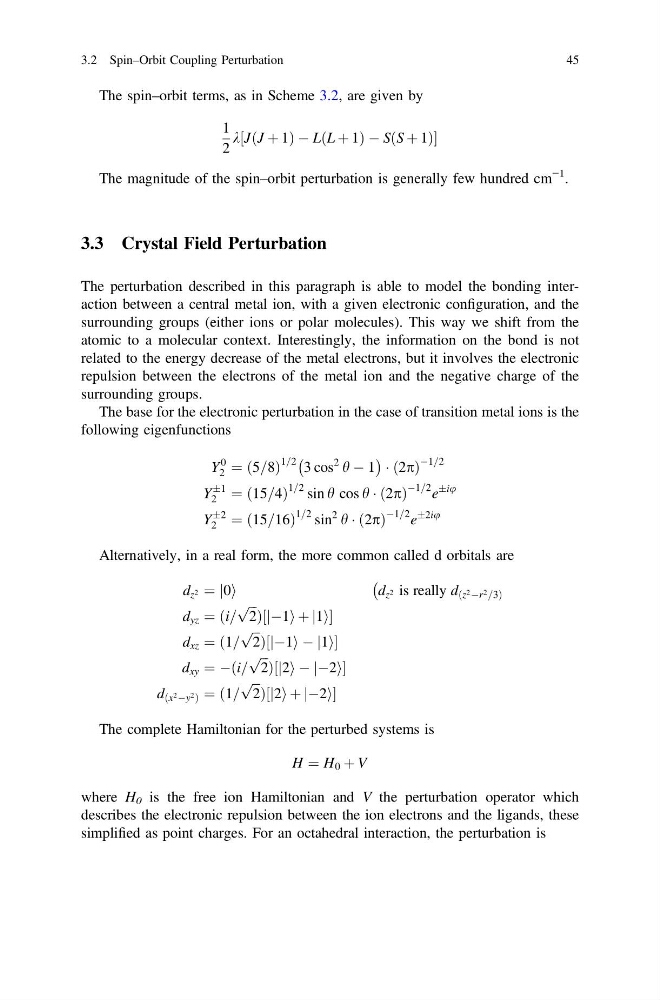
The spin–orbit terms, as in Scheme 3.2, are given by
1
2
k JðJ þ 1Þ À LðL þ 1Þ À SðS þ 1Þ
½
The magnitude of the spin–orbit perturbation is generally few hundred cm
−1 .
3.3 Crystal Field Perturbation
The perturbation described in this paragraph is able to model the bonding interaction between a central metal ion, with a given electronic configuration, and the
surrounding groups (either ions or polar molecules). This way we shift from the
atomic to a molecular context. Interestingly, the information on the bond is not
related to the energy decrease of the metal electrons, but it involves the electronic
repulsion between the electrons of the metal ion and the negative charge of the
surrounding groups.
The base for the electronic perturbation in the case of transition metal ions is the
following eigenfunctions
Y
0
2 ¼ ð5=8Þ
1=2 3 cos
2
h À 1
À
Á Á ð2pÞ
À1=2
Y
Æ1
2 ¼ ð15=4Þ
1=2 sin h cos h Á ð2pÞ
À1=2 e
Æiu
Y
Æ2
2 ¼ ð15=16Þ
1=2 sin
2
h Á ð2pÞ
À1=2 e
Æ2iu
Alternatively, in a real form, the more common called d orbitals are
d z 2 ¼ 0
j i
d z 2 is really d ðz 2 Àr 2 =3Þ
À
d yz ¼ ði=
ffiffi ffi
2
p Þ À1
j iþ 1
j i
½
d xz ¼ ð1=
ffiffi ffi
2
p Þ À1
j iÀ 1
j i
½
d xy ¼ Àði=
ffiffi ffi
2
p Þ 2
j i À À2
j i
½
d x 2 Ày 2
ð
Þ ¼ ð1=
ffiffi ffi
2
p Þ 2
j i þ À2
j i
½
The complete Hamiltonian for the perturbed systems is
H ¼ H 0 þ V
where H 0 is the free ion Hamiltonian and V the perturbation operator which
describes the electronic repulsion between the ion electrons and the ligands, these
simplified as point charges. For an octahedral interaction, the perturbation is
3.2 Spin–Orbit Coupling Perturbation
45
1
2
k JðJ þ 1Þ À LðL þ 1Þ À SðS þ 1Þ
½
The magnitude of the spin–orbit perturbation is generally few hundred cm
−1 .
3.3 Crystal Field Perturbation
The perturbation described in this paragraph is able to model the bonding interaction between a central metal ion, with a given electronic configuration, and the
surrounding groups (either ions or polar molecules). This way we shift from the
atomic to a molecular context. Interestingly, the information on the bond is not
related to the energy decrease of the metal electrons, but it involves the electronic
repulsion between the electrons of the metal ion and the negative charge of the
surrounding groups.
The base for the electronic perturbation in the case of transition metal ions is the
following eigenfunctions
Y
0
2 ¼ ð5=8Þ
1=2 3 cos
2
h À 1
À
Á Á ð2pÞ
À1=2
Y
Æ1
2 ¼ ð15=4Þ
1=2 sin h cos h Á ð2pÞ
À1=2 e
Æiu
Y
Æ2
2 ¼ ð15=16Þ
1=2 sin
2
h Á ð2pÞ
À1=2 e
Æ2iu
Alternatively, in a real form, the more common called d orbitals are
d z 2 ¼ 0
j i
d z 2 is really d ðz 2 Àr 2 =3Þ
À
d yz ¼ ði=
ffiffi ffi
2
p Þ À1
j iþ 1
j i
½
d xz ¼ ð1=
ffiffi ffi
2
p Þ À1
j iÀ 1
j i
½
d xy ¼ Àði=
ffiffi ffi
2
p Þ 2
j i À À2
j i
½
d x 2 Ày 2
ð
Þ ¼ ð1=
ffiffi ffi
2
p Þ 2
j i þ À2
j i
½
The complete Hamiltonian for the perturbed systems is
H ¼ H 0 þ V
where H 0 is the free ion Hamiltonian and V the perturbation operator which
describes the electronic repulsion between the ion electrons and the ligands, these
simplified as point charges. For an octahedral interaction, the perturbation is
3.2 Spin–Orbit Coupling Perturbation
45