

L = 1 S = 1 L − S = 0 L + S = 2 J = 0, 1, 2 the term is
3 P 0 being the shell less
than half filled.
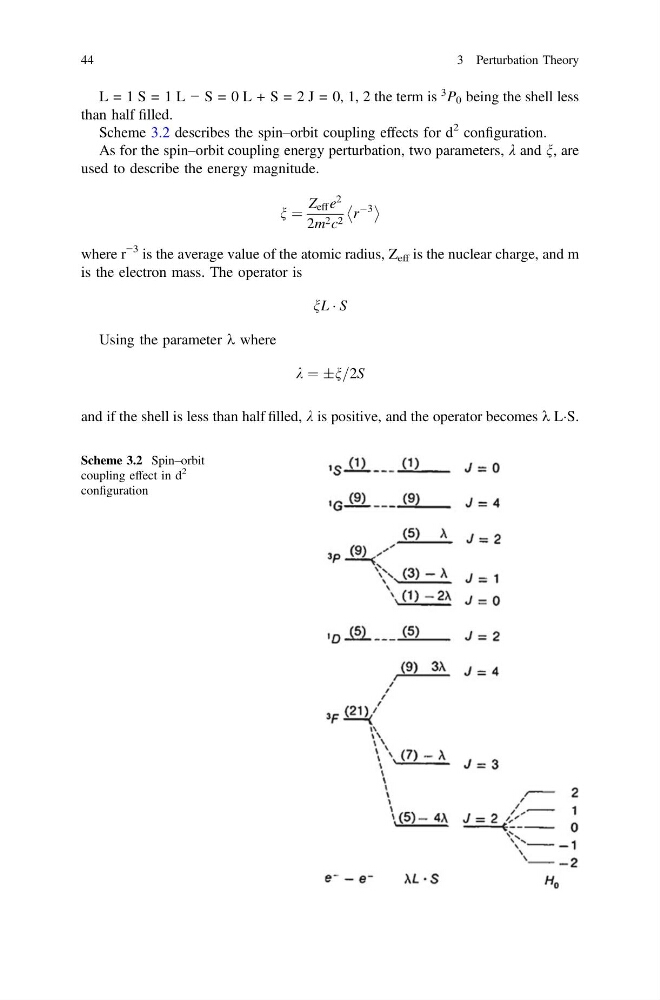
Scheme 3.2 describes the spin–orbit coupling effects for d
2 configuration.
As for the spin–orbit coupling energy perturbation, two parameters, k and n, are
used to describe the energy magnitude.
n ¼
Z eff e
2
2m 2 c 2 r
À3
where r
−3 is the average value of the atomic radius, Z eff is the nuclear charge, and m
is the electron mass. The operator is
nL Á S
Using the parameter k where
k ¼ Æn=2S
and if the shell is less than half filled, k is positive, and the operator becomes k LÁS.
Scheme 3.2 Spin–orbit
coupling effect in d
2
configuration
44
3 Perturbation Theory
3 P 0 being the shell less
than half filled.
Scheme 3.2 describes the spin–orbit coupling effects for d
2 configuration.
As for the spin–orbit coupling energy perturbation, two parameters, k and n, are
used to describe the energy magnitude.
n ¼
Z eff e
2
2m 2 c 2 r
À3
where r
−3 is the average value of the atomic radius, Z eff is the nuclear charge, and m
is the electron mass. The operator is
nL Á S
Using the parameter k where
k ¼ Æn=2S
and if the shell is less than half filled, k is positive, and the operator becomes k LÁS.
Scheme 3.2 Spin–orbit
coupling effect in d
2
configuration
44
3 Perturbation Theory