

multi-electronic ions belong to the symmetry group of the complex. We begin by
examining the effect of an octahedral field on the total representation whose d
orbitals form the basis. Since all d orbitals have symmetry center, no new information arises from the symmetry inversion operation. Thus, it is easier to use the
simple rotational group, called O group, which contains only the rotations present in
the O h group.
e
2iu
e
iu
e
0
e
Àiu
e
À2iu
2
6
6
6
6
4
3
7
7
7
7
5
!
rotate
by a
e
2iðu þ aÞ
e
iðu þ aÞ
e
0
e
Àiðu þ aÞ
e
À2iðu þ aÞ
2
6
6
6
6
4
3
7
7
7
7
5
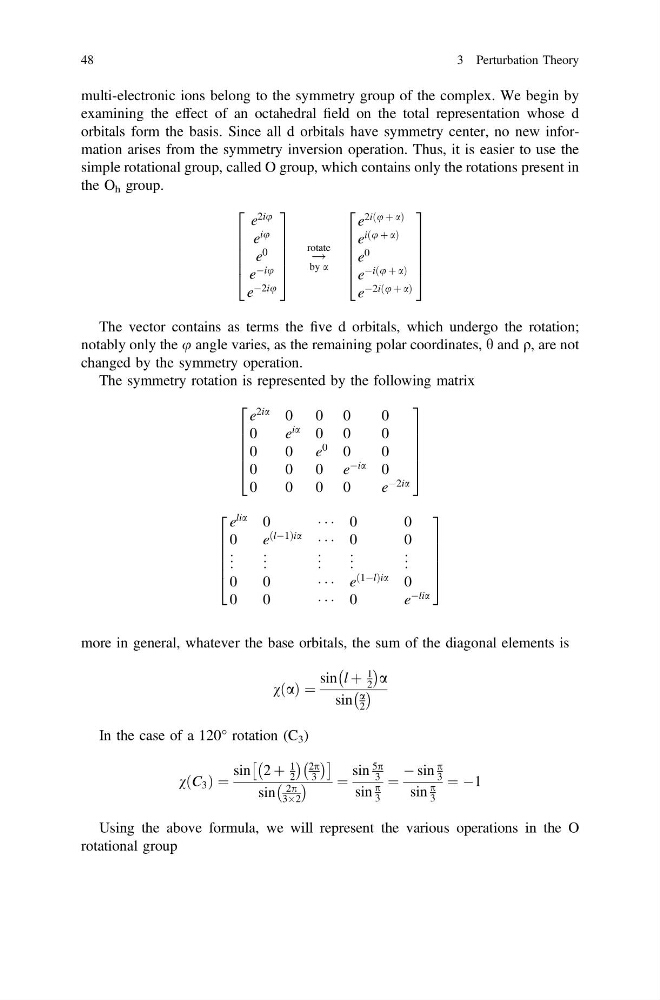
The vector contains as terms the five d orbitals, which undergo the rotation;
notably only the u angle varies, as the remaining polar coordinates, h and q, are not
changed by the symmetry operation.
The symmetry rotation is represented by the following matrix
e
2ia 0
0 0
0
0
e
ia 0 0
0
0
0
e
0 0
0
0
0
0 e
Àia 0
0
0
0 0
e
À2ia
2
6
6
6
6
4
3
7
7
7
7
5
e
lia 0
Á Á Á 0
0
0
e
ðlÀ1Þia
Á Á Á 0
0
. .
.
. .
.
. .
.
. .
.
. .
.
0
0
Á Á Á e
ð1ÀlÞia
0
0
0
Á Á Á 0
e
Àlia
2
6
6
6
6
4
3
7
7
7
7
5
more in general, whatever the base orbitals, the sum of the diagonal elements is
vðaÞ ¼
sin l þ
1
2
À
Á a
sin
a
2
À Á
In the case of a 120° rotation (C 3 )
v C 3
ð Þ ¼
sin 2 þ
1
2
À
Á 2p
3
À Á
Â
Ã
sin
2p
3Â2
À Á
¼
sin
5p
3
sin
p
3
¼
À sin
p
3
sin
p
3
¼ À1
Using the above formula, we will represent the various operations in the O
rotational group
48
3 Perturbation Theory
examining the effect of an octahedral field on the total representation whose d
orbitals form the basis. Since all d orbitals have symmetry center, no new information arises from the symmetry inversion operation. Thus, it is easier to use the
simple rotational group, called O group, which contains only the rotations present in
the O h group.
e
2iu
e
iu
e
0
e
Àiu
e
À2iu
2
6
6
6
6
4
3
7
7
7
7
5
!
rotate
by a
e
2iðu þ aÞ
e
iðu þ aÞ
e
0
e
Àiðu þ aÞ
e
À2iðu þ aÞ
2
6
6
6
6
4
3
7
7
7
7
5
The vector contains as terms the five d orbitals, which undergo the rotation;
notably only the u angle varies, as the remaining polar coordinates, h and q, are not
changed by the symmetry operation.
The symmetry rotation is represented by the following matrix
e
2ia 0
0 0
0
0
e
ia 0 0
0
0
0
e
0 0
0
0
0
0 e
Àia 0
0
0
0 0
e
À2ia
2
6
6
6
6
4
3
7
7
7
7
5
e
lia 0
Á Á Á 0
0
0
e
ðlÀ1Þia
Á Á Á 0
0
. .
.
. .
.
. .
.
. .
.
. .
.
0
0
Á Á Á e
ð1ÀlÞia
0
0
0
Á Á Á 0
e
Àlia
2
6
6
6
6
4
3
7
7
7
7
5
more in general, whatever the base orbitals, the sum of the diagonal elements is
vðaÞ ¼
sin l þ
1
2
À
Á a
sin
a
2
À Á
In the case of a 120° rotation (C 3 )
v C 3
ð Þ ¼
sin 2 þ
1
2
À
Á 2p
3
À Á
Â
Ã
sin
2p
3Â2
À Á
¼
sin
5p
3
sin
p
3
¼
À sin
p
3
sin
p
3
¼ À1
Using the above formula, we will represent the various operations in the O
rotational group
48
3 Perturbation Theory