

b
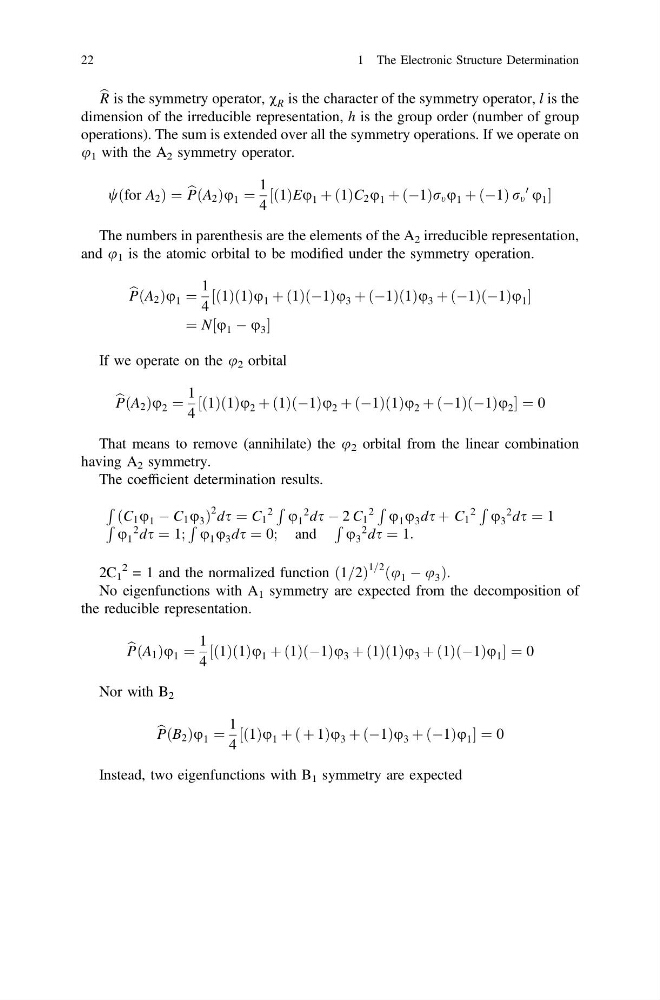
R is the symmetry operator, v R is the character of the symmetry operator, l is the
dimension of the irreducible representation, h is the group order (number of group
operations). The sum is extended over all the symmetry operations. If we operate on
u 1 with the A 2 symmetry operator.
w for A 2
ð
Þ¼ b
P A 2
ð Þu 1 ¼
1
4
ð1ÞEu 1 þ ð1ÞC 2 u 1 þ ðÀ1Þr t u 1 þ ðÀ1Þ r t
0
u 1
½
The numbers in parenthesis are the elements of the A 2 irreducible representation,
and u 1 is the atomic orbital to be modified under the symmetry operation.
b
P A 2
ð Þu 1 ¼
1
4
ð1Þð1Þu 1 þ ð1ÞðÀ1Þu 3 þ ðÀ1Þð1Þu 3 þ ðÀ1ÞðÀ1Þu 1
½
¼ N u 1 À u 3
½
If we operate on the u 2 orbital
b
P A 2
ð Þu 2 ¼
1
4
ð1Þð1Þu 2 þ ð1ÞðÀ1Þu 2 þ ðÀ1Þð1Þu 2 þ ðÀ1ÞðÀ1Þu 2
½
¼ 0
That means to remove (annihilate) the u 2 orbital from the linear combination
having A 2 symmetry.
The coefficient determination results.
R
C 1 u 1 À C 1 u 3
ð
Þ
2 ds ¼ C 1
2
R u 1
2 ds À 2 C 1
2
R u 1 u 3 ds þ C 1
2
R u 3
2 ds ¼ 1
R u 1
2 ds ¼ 1;
R u 1 u 3 ds ¼ 0; and
R u 3
2 ds ¼ 1:
2C 1
2 = 1 and the normalized function ð1=2Þ
1=2 ðu 1 À u 3 Þ.
No eigenfunctions with A 1 symmetry are expected from the decomposition of
the reducible representation.
b
P A 1
ð Þu 1 ¼
1
4
ð1Þð1Þu 1 þ ð1ÞðÀ1Þu 3 þ ð1Þð1Þu 3 þ ð1ÞðÀ1Þu 1
½
¼ 0
Nor with B 2
b
P B 2
ð Þu 1 ¼
1
4
ð1Þu 1 þ ð þ 1Þu 3 þ ðÀ1Þu 3 þ ðÀ1Þu 1
½
¼ 0
Instead, two eigenfunctions with B 1 symmetry are expected
22
1 The Electronic Structure Determination
R is the symmetry operator, v R is the character of the symmetry operator, l is the
dimension of the irreducible representation, h is the group order (number of group
operations). The sum is extended over all the symmetry operations. If we operate on
u 1 with the A 2 symmetry operator.
w for A 2
ð
Þ¼ b
P A 2
ð Þu 1 ¼
1
4
ð1ÞEu 1 þ ð1ÞC 2 u 1 þ ðÀ1Þr t u 1 þ ðÀ1Þ r t
0
u 1
½
The numbers in parenthesis are the elements of the A 2 irreducible representation,
and u 1 is the atomic orbital to be modified under the symmetry operation.
b
P A 2
ð Þu 1 ¼
1
4
ð1Þð1Þu 1 þ ð1ÞðÀ1Þu 3 þ ðÀ1Þð1Þu 3 þ ðÀ1ÞðÀ1Þu 1
½
¼ N u 1 À u 3
½
If we operate on the u 2 orbital
b
P A 2
ð Þu 2 ¼
1
4
ð1Þð1Þu 2 þ ð1ÞðÀ1Þu 2 þ ðÀ1Þð1Þu 2 þ ðÀ1ÞðÀ1Þu 2
½
¼ 0
That means to remove (annihilate) the u 2 orbital from the linear combination
having A 2 symmetry.
The coefficient determination results.
R
C 1 u 1 À C 1 u 3
ð
Þ
2 ds ¼ C 1
2
R u 1
2 ds À 2 C 1
2
R u 1 u 3 ds þ C 1
2
R u 3
2 ds ¼ 1
R u 1
2 ds ¼ 1;
R u 1 u 3 ds ¼ 0; and
R u 3
2 ds ¼ 1:
2C 1
2 = 1 and the normalized function ð1=2Þ
1=2 ðu 1 À u 3 Þ.
No eigenfunctions with A 1 symmetry are expected from the decomposition of
the reducible representation.
b
P A 1
ð Þu 1 ¼
1
4
ð1Þð1Þu 1 þ ð1ÞðÀ1Þu 3 þ ð1Þð1Þu 3 þ ð1ÞðÀ1Þu 1
½
¼ 0
Nor with B 2
b
P B 2
ð Þu 1 ¼
1
4
ð1Þu 1 þ ð þ 1Þu 3 þ ðÀ1Þu 3 þ ðÀ1Þu 1
½
¼ 0
Instead, two eigenfunctions with B 1 symmetry are expected
22
1 The Electronic Structure Determination