

HR ¼ RH
If we take the wave equation
HW i = EW i and multiply each side by the symmetry operation R, we obtain
HRW i = ERW i due to the commutation of operators
RW i is the eigenfunction
RW i = ±1W i and W i results basis of irreproducible representation.
1.6.4 Obtaining Molecular Orbitals with a Given Symmetry
Given the symmetry properties of the molecular orbitals, it appears not mandatory
but very convenient that the molecular eigenfunctions were chosen as
symmetry-adapted linear combination of atomic orbitals. They supply the best
operative bases to perform the MO calculation, avoiding the long and unuseful
calculations necessary in the case the eigenfunctions are not bases of irreducible
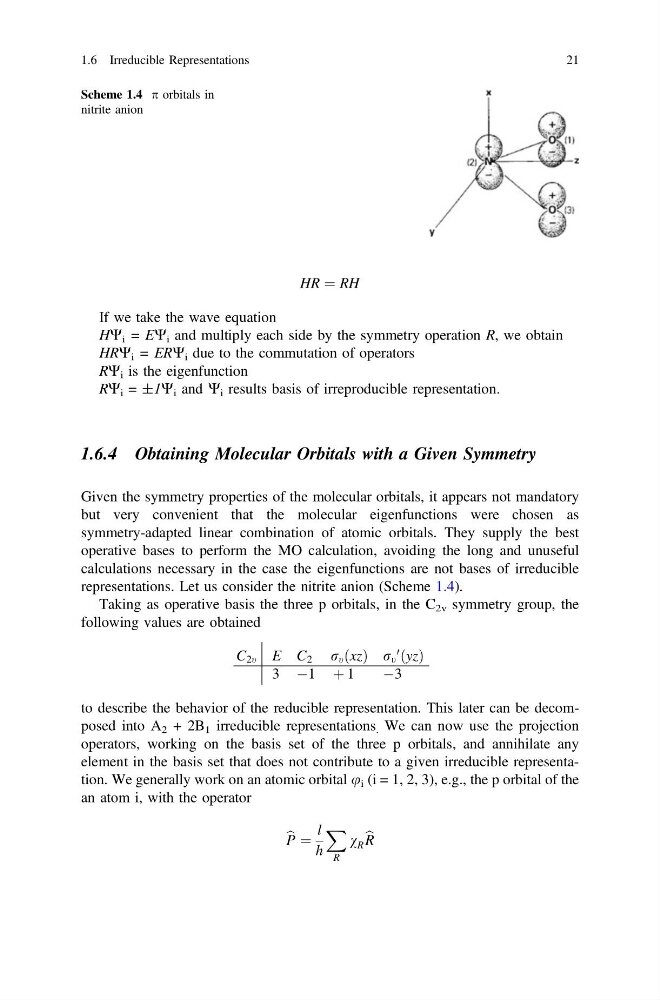
representations. Let us consider the nitrite anion (Scheme 1.4).
Taking as operative basis the three p orbitals, in the C 2v symmetry group, the
following values are obtained
C 2t E C 2 r t ðxzÞ r t
0
ðyzÞ
3 À1 þ 1
À3
to describe the behavior of the reducible representation. This later can be decomposed into A 2 + 2B 1 irreducible representations . We can now use the projection
operators, working on the basis set of the three p orbitals, and annihilate any
element in the basis set that does not contribute to a given irreducible representation. We generally work on an atomic orbital u i (i = 1, 2, 3), e.g., the p orbital of the
an atom i, with the operator
b
P ¼
l
h
X
R
v R b
R
Scheme 1.4 p orbitals in
nitrite anion
1.6 Irreducible Representations
21
If we take the wave equation
HW i = EW i and multiply each side by the symmetry operation R, we obtain
HRW i = ERW i due to the commutation of operators
RW i is the eigenfunction
RW i = ±1W i and W i results basis of irreproducible representation.
1.6.4 Obtaining Molecular Orbitals with a Given Symmetry
Given the symmetry properties of the molecular orbitals, it appears not mandatory
but very convenient that the molecular eigenfunctions were chosen as
symmetry-adapted linear combination of atomic orbitals. They supply the best
operative bases to perform the MO calculation, avoiding the long and unuseful
calculations necessary in the case the eigenfunctions are not bases of irreducible
representations. Let us consider the nitrite anion (Scheme 1.4).
Taking as operative basis the three p orbitals, in the C 2v symmetry group, the
following values are obtained
C 2t E C 2 r t ðxzÞ r t
0
ðyzÞ
3 À1 þ 1
À3
to describe the behavior of the reducible representation. This later can be decomposed into A 2 + 2B 1 irreducible representations . We can now use the projection
operators, working on the basis set of the three p orbitals, and annihilate any
element in the basis set that does not contribute to a given irreducible representation. We generally work on an atomic orbital u i (i = 1, 2, 3), e.g., the p orbital of the
an atom i, with the operator
b
P ¼
l
h
X
R
v R b
R
Scheme 1.4 p orbitals in
nitrite anion
1.6 Irreducible Representations
21