

The ESR investigation carried out on copper centers of CuO/SiO 2 before
interaction with benzene gave the spectra in Fig. 5.69.
It is consistent with a d
9 configuration attributable to Cu(II) centers. The magnetic parameters are well defined g ‖ = 2.384, g † = 2.071, A ‖ = 128 G and suggest
an octahedral distorted symmetry.
These results agree with that from the diffuse reflectance spectrum in Fig. 5.70,
where the electronic spectrum, recorded before the benzene absorption, shows the
lines of a distorted octahedral Cu(II) center.
The contact with benzene caused modification in the catalyst ESR spectrum
(Fig. 5.71).
In fact, the Cu(II) resonances decrease in intensity after contact with benzene,
while arise a new sharp signal at g = 2.003, stable for 24 h. This later can be
assigned to phenoxy radical. No hyperfine interaction with copper nucleus was
observed suggesting that the radical is stabilized by interaction with the oxide, not
with copper centers. The decrease in Cu(II) intensity signals can be associated with
the interaction of the phenoxy radical with the d
9 center, which leads to antiferromagnetic coupling.
Cu
Si
Si
Cu
Si
Si
o
o
o
o
Cu
Si
Si
o
o
o
o
Cu
Si
Si
o
o
Cu
OH
OH*
PhenO*
Si
Si
o
o
Cu
Si
Si
o
o
o
o
Cu
Si
Si
[37.3]
[8.9]
[46.5]
(23.8)
(-46.1)
(23.7)
(-12.5)
(-7.9)
A1
A2
A3
A5
A4
(-41.7)
(-4.5)
A7
B1
(-49.9)
A6
(A)
(A)
[32.3]
[1.9]
C 2 H 2
C 2 H 2
H a
H a
H a
b
o
o 2
o b
o a
o b
o a C a
C a
C a
o a
o
o
Cu
Si
Si
o
o
Cu
Si
Si
o
o
Cu
OH
Si
Si
o
o
o
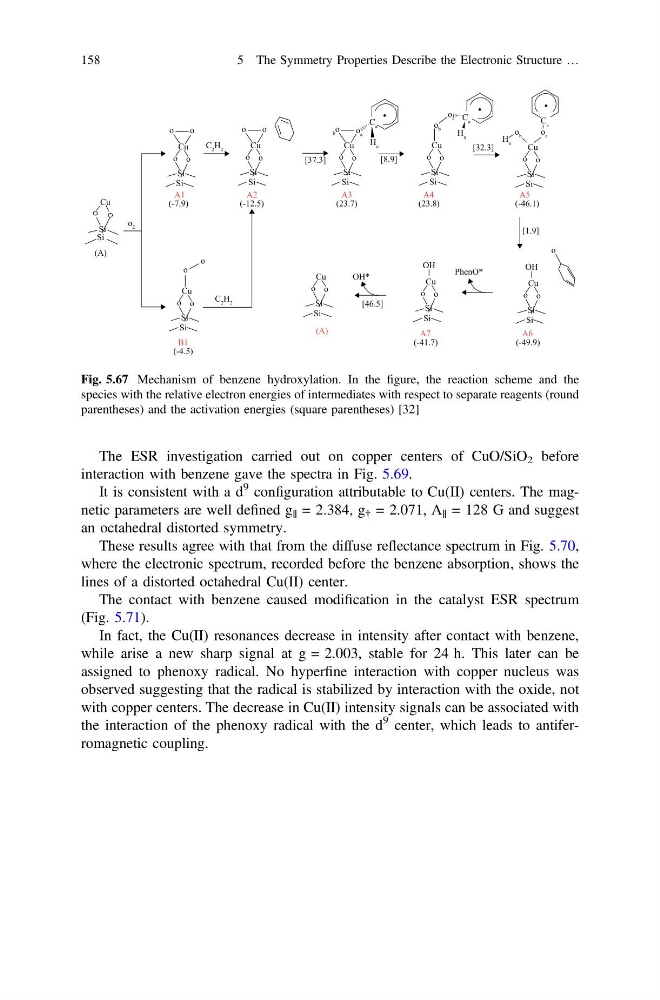
Fig. 5.67 Mechanism of benzene hydroxylation. In the figure, the reaction scheme and the
species with the relative electron energies of intermediates with respect to separate reagents (round
parentheses) and the activation energies (square parentheses) [32]
158
5 The Symmetry Properties Describe the Electronic Structure …
interaction with benzene gave the spectra in Fig. 5.69.
It is consistent with a d
9 configuration attributable to Cu(II) centers. The magnetic parameters are well defined g ‖ = 2.384, g † = 2.071, A ‖ = 128 G and suggest
an octahedral distorted symmetry.
These results agree with that from the diffuse reflectance spectrum in Fig. 5.70,
where the electronic spectrum, recorded before the benzene absorption, shows the
lines of a distorted octahedral Cu(II) center.
The contact with benzene caused modification in the catalyst ESR spectrum
(Fig. 5.71).
In fact, the Cu(II) resonances decrease in intensity after contact with benzene,
while arise a new sharp signal at g = 2.003, stable for 24 h. This later can be
assigned to phenoxy radical. No hyperfine interaction with copper nucleus was
observed suggesting that the radical is stabilized by interaction with the oxide, not
with copper centers. The decrease in Cu(II) intensity signals can be associated with
the interaction of the phenoxy radical with the d
9 center, which leads to antiferromagnetic coupling.
Cu
Si
Si
Cu
Si
Si
o
o
o
o
Cu
Si
Si
o
o
o
o
Cu
Si
Si
o
o
Cu
OH
OH*
PhenO*
Si
Si
o
o
Cu
Si
Si
o
o
o
o
Cu
Si
Si
[37.3]
[8.9]
[46.5]
(23.8)
(-46.1)
(23.7)
(-12.5)
(-7.9)
A1
A2
A3
A5
A4
(-41.7)
(-4.5)
A7
B1
(-49.9)
A6
(A)
(A)
[32.3]
[1.9]
C 2 H 2
C 2 H 2
H a
H a
H a
b
o
o 2
o b
o a
o b
o a C a
C a
C a
o a
o
o
Cu
Si
Si
o
o
Cu
Si
Si
o
o
Cu
OH
Si
Si
o
o
o
Fig. 5.67 Mechanism of benzene hydroxylation. In the figure, the reaction scheme and the
species with the relative electron energies of intermediates with respect to separate reagents (round
parentheses) and the activation energies (square parentheses) [32]
158
5 The Symmetry Properties Describe the Electronic Structure …