

surface-mediated processes. This results in the formation of surface-bound radical
species, which persist in the atmospheric environment for days and generate in
water the reactive oxygen species (ROS). The biological unbalance between the
ROS (OH
Á , O 2
− , H 2 O 2 , etc.) and the molecules that control the cellular homeostasis
leads to oxidative stress associated with respiratory and cardiovascular diseases.
Thus, EPFRs can be thought the major responsibility for the biological damage.
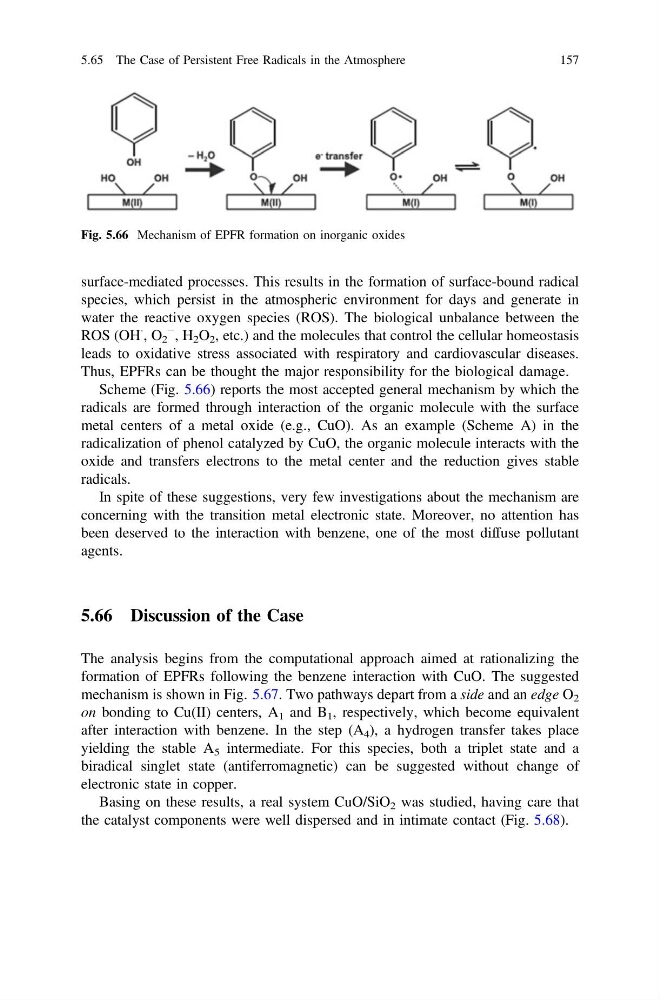
Scheme (Fig. 5.66) reports the most accepted general mechanism by which the
radicals are formed through interaction of the organic molecule with the surface
metal centers of a metal oxide (e.g., CuO). As an example (Scheme A) in the
radicalization of phenol catalyzed by CuO, the organic molecule interacts with the
oxide and transfers electrons to the metal center and the reduction gives stable
radicals.
In spite of these suggestions, very few investigations about the mechanism are
concerning with the transition metal electronic state. Moreover, no attention has
been deserved to the interaction with benzene, one of the most diffuse pollutant
agents.
5.66 Discussion of the Case
The analysis begins from the computational approach aimed at rationalizing the
formation of EPFRs following the benzene interaction with CuO. The suggested
mechanism is shown in Fig. 5.67. Two pathways depart from a side and an edge O 2
on bonding to Cu(II) centers, A 1 and B 1 , respectively, which become equivalent
after interaction with benzene. In the step (A 4 ), a hydrogen transfer takes place
yielding the stable A 5 intermediate. For this species, both a triplet state and a
biradical singlet state (antiferromagnetic) can be suggested without change of
electronic state in copper.
Basing on these results, a real system CuO/SiO 2 was studied, having care that
the catalyst components were well dispersed and in intimate contact (Fig. 5.68).
Fig. 5.66 Mechanism of EPFR formation on inorganic oxides
5.65 The Case of Persistent Free Radicals in the Atmosphere
157
species, which persist in the atmospheric environment for days and generate in
water the reactive oxygen species (ROS). The biological unbalance between the
ROS (OH
Á , O 2
− , H 2 O 2 , etc.) and the molecules that control the cellular homeostasis
leads to oxidative stress associated with respiratory and cardiovascular diseases.
Thus, EPFRs can be thought the major responsibility for the biological damage.
Scheme (Fig. 5.66) reports the most accepted general mechanism by which the
radicals are formed through interaction of the organic molecule with the surface
metal centers of a metal oxide (e.g., CuO). As an example (Scheme A) in the
radicalization of phenol catalyzed by CuO, the organic molecule interacts with the
oxide and transfers electrons to the metal center and the reduction gives stable
radicals.
In spite of these suggestions, very few investigations about the mechanism are
concerning with the transition metal electronic state. Moreover, no attention has
been deserved to the interaction with benzene, one of the most diffuse pollutant
agents.
5.66 Discussion of the Case
The analysis begins from the computational approach aimed at rationalizing the
formation of EPFRs following the benzene interaction with CuO. The suggested
mechanism is shown in Fig. 5.67. Two pathways depart from a side and an edge O 2
on bonding to Cu(II) centers, A 1 and B 1 , respectively, which become equivalent
after interaction with benzene. In the step (A 4 ), a hydrogen transfer takes place
yielding the stable A 5 intermediate. For this species, both a triplet state and a
biradical singlet state (antiferromagnetic) can be suggested without change of
electronic state in copper.
Basing on these results, a real system CuO/SiO 2 was studied, having care that
the catalyst components were well dispersed and in intimate contact (Fig. 5.68).
Fig. 5.66 Mechanism of EPFR formation on inorganic oxides
5.65 The Case of Persistent Free Radicals in the Atmosphere
157