

5.35 Discussion of the Case
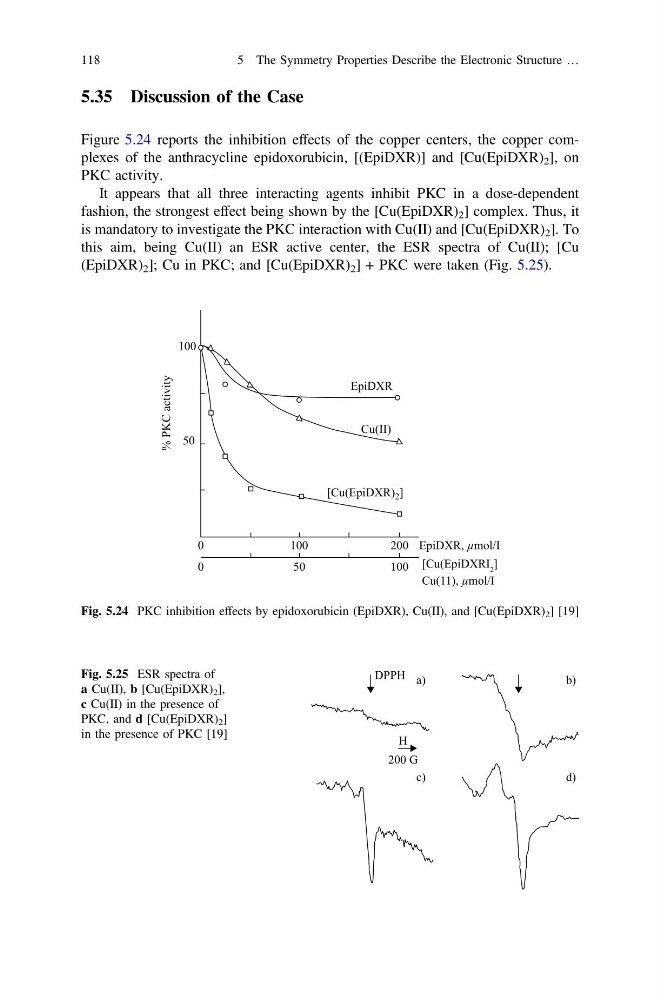
Figure 5.24 reports the inhibition effects of the copper centers, the copper complexes of the anthracycline epidoxorubicin, [(EpiDXR)] and [Cu(EpiDXR) 2 ], on
PKC activity.
It appears that all three interacting agents inhibit PKC in a dose-dependent
fashion, the strongest effect being shown by the [Cu(EpiDXR) 2 ] complex. Thus, it
is mandatory to investigate the PKC interaction with Cu(II) and [Cu(EpiDXR) 2 ]. To
this aim, being Cu(II) an ESR active center, the ESR spectra of Cu(II); [Cu
(EpiDXR) 2 ]; Cu in PKC; and [Cu(EpiDXR) 2 ] + PKC were taken (Fig. 5.25).
50
100
% PKC activity
EpiDXR
Cu(II)
[Cu(EpiDXR) 2 ]
EpiDXR, μmol/I
Cu(11), μmol/I
[Cu(EpiDXRI 2 ]
0
100
200
100
50
0
Fig. 5.24 PKC inhibition effects by epidoxorubicin (EpiDXR), Cu(II), and [Cu(EpiDXR) 2 ] [19]
DPPH
H
200 G
a)
b)
d)
c)
Fig. 5.25 ESR spectra of
a Cu(II), b [Cu(EpiDXR) 2 ],
c Cu(II) in the presence of
PKC, and d [Cu(EpiDXR) 2 ]
in the presence of PKC [19]
118
5 The Symmetry Properties Describe the Electronic Structure …
Figure 5.24 reports the inhibition effects of the copper centers, the copper complexes of the anthracycline epidoxorubicin, [(EpiDXR)] and [Cu(EpiDXR) 2 ], on
PKC activity.
It appears that all three interacting agents inhibit PKC in a dose-dependent
fashion, the strongest effect being shown by the [Cu(EpiDXR) 2 ] complex. Thus, it
is mandatory to investigate the PKC interaction with Cu(II) and [Cu(EpiDXR) 2 ]. To
this aim, being Cu(II) an ESR active center, the ESR spectra of Cu(II); [Cu
(EpiDXR) 2 ]; Cu in PKC; and [Cu(EpiDXR) 2 ] + PKC were taken (Fig. 5.25).
50
100
% PKC activity
EpiDXR
Cu(II)
[Cu(EpiDXR) 2 ]
EpiDXR, μmol/I
Cu(11), μmol/I
[Cu(EpiDXRI 2 ]
0
100
200
100
50
0
Fig. 5.24 PKC inhibition effects by epidoxorubicin (EpiDXR), Cu(II), and [Cu(EpiDXR) 2 ] [19]
DPPH
H
200 G
a)
b)
d)
c)
Fig. 5.25 ESR spectra of
a Cu(II), b [Cu(EpiDXR) 2 ],
c Cu(II) in the presence of
PKC, and d [Cu(EpiDXR) 2 ]
in the presence of PKC [19]
118
5 The Symmetry Properties Describe the Electronic Structure …