

The spectra demonstrate that Cu(II) coordinates with the anthracycline and due
to this coordination the metal ion becomes more suitable to be bonded by PKC. For
this reason, the PKC inhibition in the presence of the anthracycline is higher.
5.36 Chemical Message
The geometric planar asset of [Cu(EpiDXR) 2 ] drives the PKC to bind copper,
probably in a regular coordination site. This originates a stable bonding with the
enzyme.
5.37 The Case of the Catalytic Oxidation of Propenoidic
Phenols
Propenoidic phenols are constituents of lignin, the most abundant natural polymer
after cellulose [20]. Wastewaters from the paper industry and agroindustrial
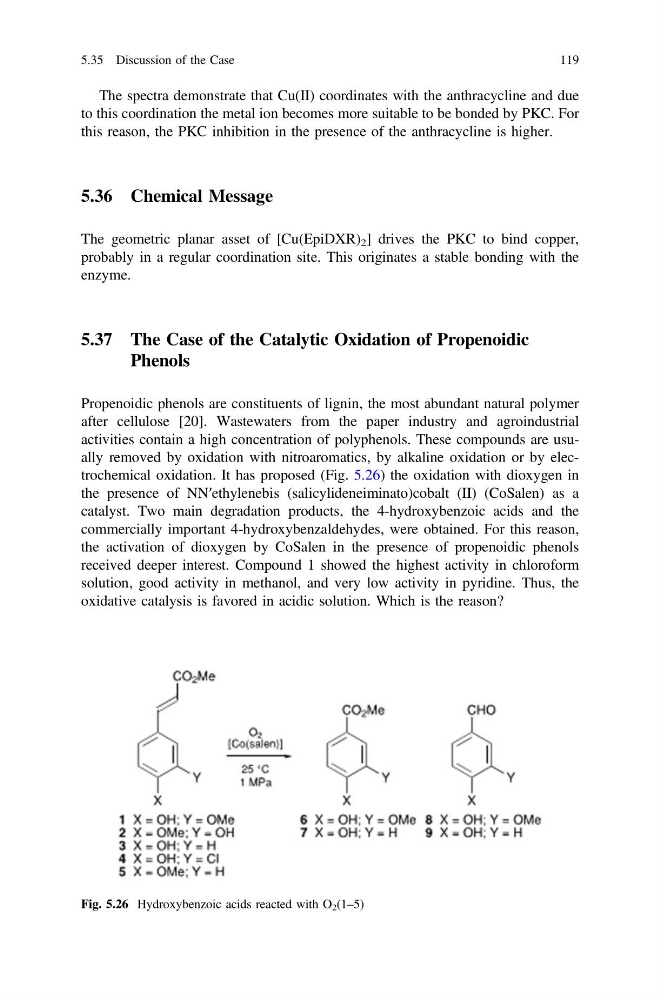
activities contain a high concentration of polyphenols. These compounds are usually removed by oxidation with nitroaromatics, by alkaline oxidation or by electrochemical oxidation. It has proposed (Fig. 5.26) the oxidation with dioxygen in
the presence of NN′ethylenebis (salicylideneiminato)cobalt (II) (CoSalen) as a
catalyst. Two main degradation products, the 4-hydroxybenzoic acids and the
commercially important 4-hydroxybenzaldehydes, were obtained. For this reason,
the activation of dioxygen by CoSalen in the presence of propenoidic phenols
received deeper interest. Compound 1 showed the highest activity in chloroform
solution, good activity in methanol, and very low activity in pyridine. Thus, the
oxidative catalysis is favored in acidic solution. Which is the reason?
Fig. 5.26 Hydroxybenzoic acids reacted with O 2 (1–5)
5.35 Discussion of the Case
119
to this coordination the metal ion becomes more suitable to be bonded by PKC. For
this reason, the PKC inhibition in the presence of the anthracycline is higher.
5.36 Chemical Message
The geometric planar asset of [Cu(EpiDXR) 2 ] drives the PKC to bind copper,
probably in a regular coordination site. This originates a stable bonding with the
enzyme.
5.37 The Case of the Catalytic Oxidation of Propenoidic
Phenols
Propenoidic phenols are constituents of lignin, the most abundant natural polymer
after cellulose [20]. Wastewaters from the paper industry and agroindustrial
activities contain a high concentration of polyphenols. These compounds are usually removed by oxidation with nitroaromatics, by alkaline oxidation or by electrochemical oxidation. It has proposed (Fig. 5.26) the oxidation with dioxygen in
the presence of NN′ethylenebis (salicylideneiminato)cobalt (II) (CoSalen) as a
catalyst. Two main degradation products, the 4-hydroxybenzoic acids and the
commercially important 4-hydroxybenzaldehydes, were obtained. For this reason,
the activation of dioxygen by CoSalen in the presence of propenoidic phenols
received deeper interest. Compound 1 showed the highest activity in chloroform
solution, good activity in methanol, and very low activity in pyridine. Thus, the
oxidative catalysis is favored in acidic solution. Which is the reason?
Fig. 5.26 Hydroxybenzoic acids reacted with O 2 (1–5)
5.35 Discussion of the Case
119