

5.33 Chemical Message
It can be suggested that Cr(V) centers present in all the annealed samples are able to
catalyze the oxidation of ammonia, by capturing the electrons deriving from
reactions (R); they are active in particular as they belong to a chromyl species
emerging from the surface.
5.34 The Case of the Inhibitory Effect of Cu(II) Toward
Protein Kinase C
Some trends in the development of new anticancer agents indicate a possible
therapeutic goal, as an alternative to DNA damage, in the inhibition of specific cell
functions, such as transduction pathways, triggered by growth factor receptor or by
tumor promoter molecules [19]. On this purpose, the chelation of transition metal
ions by anthracyclines, which appears to enhance the inhibitory action exerted by
these drugs on protein kinase C (PKC), has been investigated, to assess the existence of an interaction between the enzyme and the drug and to suggest a molecular
mechanism for the inhibitory effect.
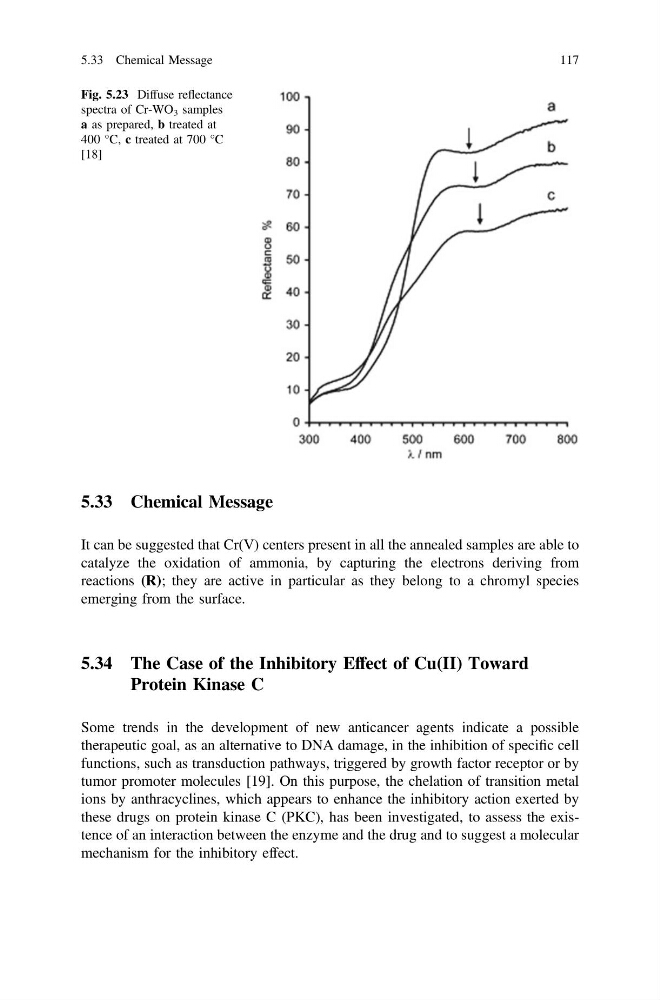
Fig. 5.23 Diffuse reflectance
spectra of Cr-WO 3 samples
a as prepared, b treated at
400 °C, c treated at 700 °C
[18]
5.33 Chemical Message
117
It can be suggested that Cr(V) centers present in all the annealed samples are able to
catalyze the oxidation of ammonia, by capturing the electrons deriving from
reactions (R); they are active in particular as they belong to a chromyl species
emerging from the surface.
5.34 The Case of the Inhibitory Effect of Cu(II) Toward
Protein Kinase C
Some trends in the development of new anticancer agents indicate a possible
therapeutic goal, as an alternative to DNA damage, in the inhibition of specific cell
functions, such as transduction pathways, triggered by growth factor receptor or by
tumor promoter molecules [19]. On this purpose, the chelation of transition metal
ions by anthracyclines, which appears to enhance the inhibitory action exerted by
these drugs on protein kinase C (PKC), has been investigated, to assess the existence of an interaction between the enzyme and the drug and to suggest a molecular
mechanism for the inhibitory effect.
Fig. 5.23 Diffuse reflectance
spectra of Cr-WO 3 samples
a as prepared, b treated at
400 °C, c treated at 700 °C
[18]
5.33 Chemical Message
117