

5.4 The Case of Adducts of NN′Ethylenebis
(acetylacetoneiminato)Cobalt (II)
[NN′Ethylenebis(acetylacetoneiminate)cobalt(II)] (CoAcacen) and [NN′ethylenebis
(salycilideneiminate)cobalt(II)] (CoSalen) have been studied for a long time, due to
their ability to coordinate molecular oxygen in a reversible way [5–8]. This property
suggested that the complexes could be model of the natural oxygen carriers, e.g.,
hemoglobin. Due to their relatively simple structure, these cobalt complexes allow
to study the electronic modifications connected to the O 2 absorption. For this
reason, it was carried out an extensive study on the pristine CoAcacen and CoSalen
and on their adducts with base molecules, typically pyridine (very reactive adduct
toward oxygen chemisorption). The study, performed by structural, electronic, and
spectromagnetic investigations, suggested the electronic configurations of the Co
(II) active to interact with molecular oxygen, at the same time transferring one
electron to O 2 and giving rise to a superoxide derivative.
Figure 5.5 reports the structure of CoAcacen, planar molecule belonging to C 2v
symmetry. The question is why this reacts so slowly with O 2 forming [Co(III)
Acacen O 2
− ] while, if the coordination of a base molecule takes place as in [Co(II)
Fe
Fe
Fe
Fe
Pt
Pt
Pt
Pt
Pt
Pt
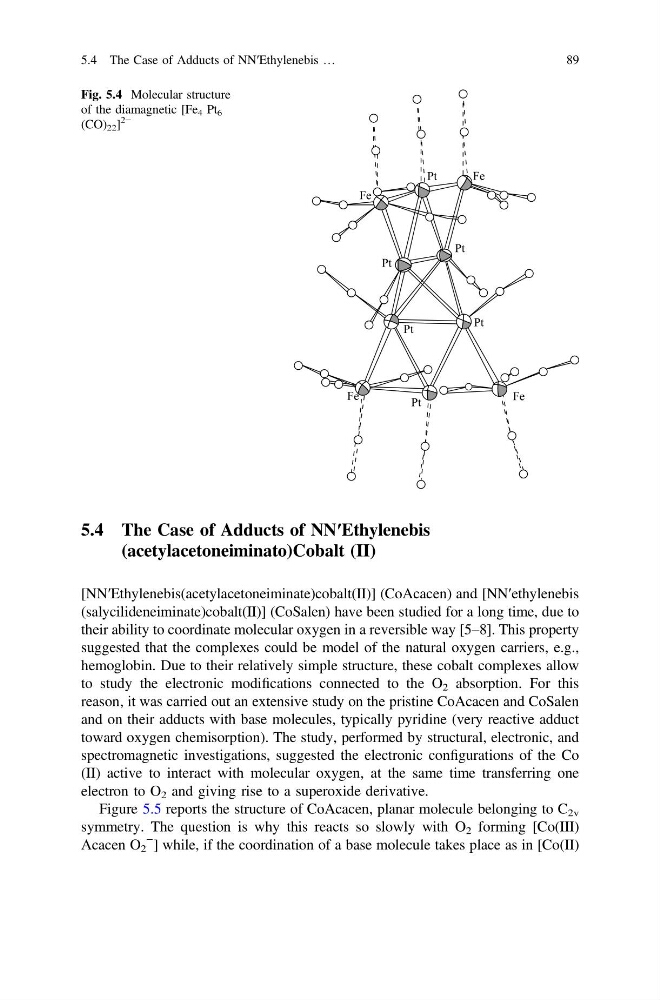
Fig. 5.4 Molecular structure
of the diamagnetic [Fe 4 Pt 6
(CO) 22 ]
2−
5.4 The Case of Adducts of NN′Ethylenebis …
89
(acetylacetoneiminato)Cobalt (II)
[NN′Ethylenebis(acetylacetoneiminate)cobalt(II)] (CoAcacen) and [NN′ethylenebis
(salycilideneiminate)cobalt(II)] (CoSalen) have been studied for a long time, due to
their ability to coordinate molecular oxygen in a reversible way [5–8]. This property
suggested that the complexes could be model of the natural oxygen carriers, e.g.,
hemoglobin. Due to their relatively simple structure, these cobalt complexes allow
to study the electronic modifications connected to the O 2 absorption. For this
reason, it was carried out an extensive study on the pristine CoAcacen and CoSalen
and on their adducts with base molecules, typically pyridine (very reactive adduct
toward oxygen chemisorption). The study, performed by structural, electronic, and
spectromagnetic investigations, suggested the electronic configurations of the Co
(II) active to interact with molecular oxygen, at the same time transferring one
electron to O 2 and giving rise to a superoxide derivative.
Figure 5.5 reports the structure of CoAcacen, planar molecule belonging to C 2v
symmetry. The question is why this reacts so slowly with O 2 forming [Co(III)
Acacen O 2
− ] while, if the coordination of a base molecule takes place as in [Co(II)
Fe
Fe
Fe
Fe
Pt
Pt
Pt
Pt
Pt
Pt
Fig. 5.4 Molecular structure
of the diamagnetic [Fe 4 Pt 6
(CO) 22 ]
2−
5.4 The Case of Adducts of NN′Ethylenebis …
89