

Acacen pyridine], the reaction to form [Co(III)Acacen PyO 2
− ] is very fast? To
answer, it is necessary to perform experiments that reveal which electronic configuration the cobalt assumes in the pristine and in the base adduct.
5.5 Discussion of the Case
The electron spin resonance investigation was performed for CoAcacen on a single
crystal sample, diluted with the NiAcacen diamagnetic host. In order to simplify,
the calculations were performed by a three-hole model, instead of the more complicated seven-electron configuration.
The following expressions report the g magnetic tensor components as a function of the distance of the excited states from the ground state, respectively, from
(xz)
2 (xy)
2
(yz)(z
2 )
2 and (xz)
2 (xy)
2 (yz)
2 (z
2 ) assumed as ground states. In parentheses
are indicated the d orbitals, xz, xy, yz, z
2 . The experimental g tensors were
reproduced for the two different ground state hypotheses, and the calculated values
are in parentheses under the experimental ones.
c and b coefficients indicate the weight of the different excited states within the
ground state and are derived from the perturbation of the ground state by the spin–
orbit operator.
Ground configuration (xz)
2 (xy)
2 (yz)(z
2 )
2
g xz ¼ 2c
2
5 þ 2c
2
2 À 2c
2
3 À 2c
2
1 À 2c
2
4 À 4c 2 c 5
g xx ¼ 2c
2
5 À 2c
2
2 À 2c
2
3 þ 2c
2
1 þ 2c
2
4 À 4
ffiffi ffi
3
p
c 1 c 5 À 4c 2 c 3 þ 4c 4 c 5
g yy ¼ 2c
2
5 À 2c
2
2 þ 2c
2
3 À 2c
2
1 À 2c
2
4 À 4c 3 c 5 þ 4
ffiffi ffi
3
p
c 1 c 2
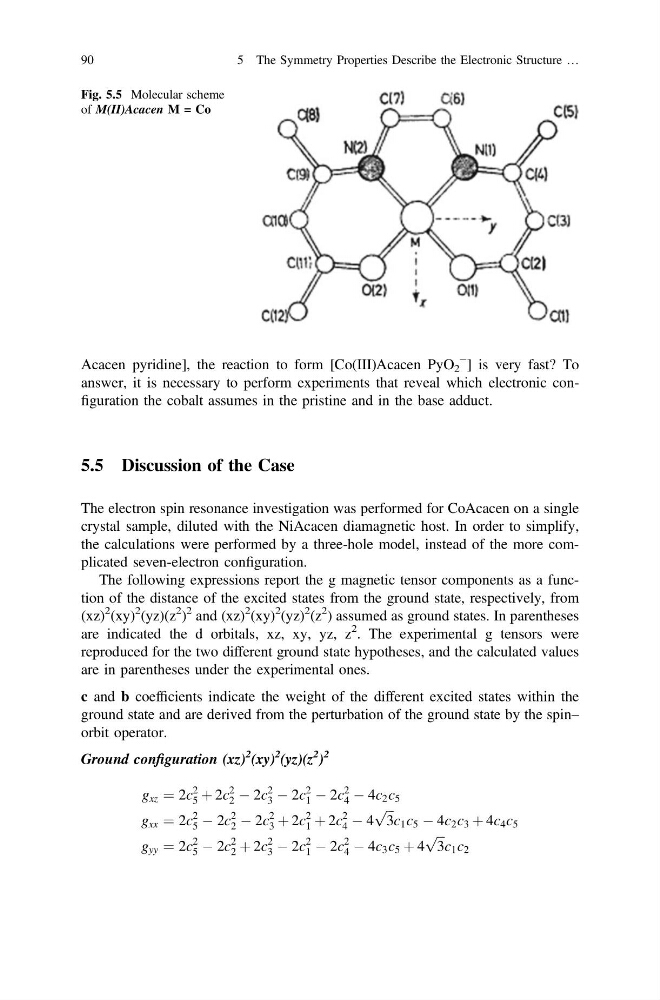
Fig. 5.5 Molecular scheme
of M(II)Acacen M = Co
90
5 The Symmetry Properties Describe the Electronic Structure …
− ] is very fast? To
answer, it is necessary to perform experiments that reveal which electronic configuration the cobalt assumes in the pristine and in the base adduct.
5.5 Discussion of the Case
The electron spin resonance investigation was performed for CoAcacen on a single
crystal sample, diluted with the NiAcacen diamagnetic host. In order to simplify,
the calculations were performed by a three-hole model, instead of the more complicated seven-electron configuration.
The following expressions report the g magnetic tensor components as a function of the distance of the excited states from the ground state, respectively, from
(xz)
2 (xy)
2
(yz)(z
2 )
2 and (xz)
2 (xy)
2 (yz)
2 (z
2 ) assumed as ground states. In parentheses
are indicated the d orbitals, xz, xy, yz, z
2 . The experimental g tensors were
reproduced for the two different ground state hypotheses, and the calculated values
are in parentheses under the experimental ones.
c and b coefficients indicate the weight of the different excited states within the
ground state and are derived from the perturbation of the ground state by the spin–
orbit operator.
Ground configuration (xz)
2 (xy)
2 (yz)(z
2 )
2
g xz ¼ 2c
2
5 þ 2c
2
2 À 2c
2
3 À 2c
2
1 À 2c
2
4 À 4c 2 c 5
g xx ¼ 2c
2
5 À 2c
2
2 À 2c
2
3 þ 2c
2
1 þ 2c
2
4 À 4
ffiffi ffi
3
p
c 1 c 5 À 4c 2 c 3 þ 4c 4 c 5
g yy ¼ 2c
2
5 À 2c
2
2 þ 2c
2
3 À 2c
2
1 À 2c
2
4 À 4c 3 c 5 þ 4
ffiffi ffi
3
p
c 1 c 2
Fig. 5.5 Molecular scheme
of M(II)Acacen M = Co
90
5 The Symmetry Properties Describe the Electronic Structure …