

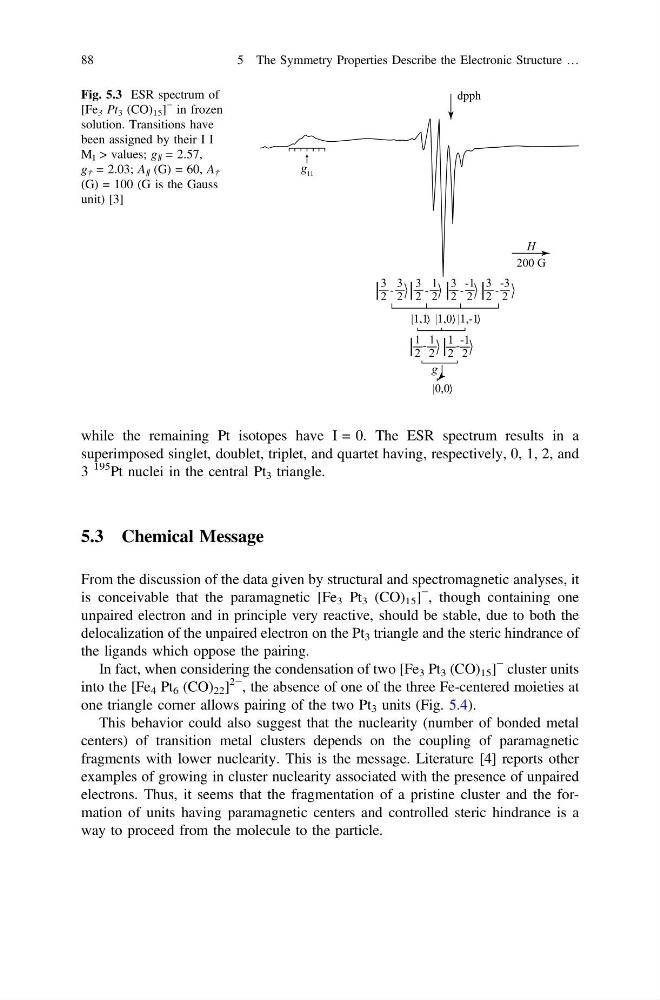
while the remaining Pt isotopes have I = 0. The ESR spectrum results in a
superimposed singlet, doublet, triplet, and quartet having, respectively, 0, 1, 2, and
3
195 Pt nuclei in the central Pt 3 triangle.
5.3 Chemical Message
From the discussion of the data given by structural and spectromagnetic analyses, it
is conceivable that the paramagnetic [Fe 3 Pt 3 (CO) 15 ]
−
, though containing one
unpaired electron and in principle very reactive, should be stable, due to both the
delocalization of the unpaired electron on the Pt 3 triangle and the steric hindrance of
the ligands which oppose the pairing.
In fact, when considering the condensation of two [Fe 3 Pt 3 (CO) 15 ]
− cluster units
into the [Fe 4 Pt 6 (CO) 22 ]
2− , the absence of one of the three Fe-centered moieties at
one triangle corner allows pairing of the two Pt 3 units (Fig. 5.4).
This behavior could also suggest that the nuclearity (number of bonded metal
centers) of transition metal clusters depends on the coupling of paramagnetic
fragments with lower nuclearity. This is the message. Literature [4] reports other
examples of growing in cluster nuclearity associated with the presence of unpaired
electrons. Thus, it seems that the fragmentation of a pristine cluster and the formation of units having paramagnetic centers and controlled steric hindrance is a
way to proceed from the molecule to the particle.
dpph
g 11
H
g
200 G
3
2
1
2
1
2
3
2
-
3
2
1
2
-
3
2
-1
2
-
3
2
-3
2
-
|1,1 |1,0 |1,-1
|
|
|
|
|
|0,0
-
1
2
-1
2
|
-
Fig. 5.3 ESR spectrum of
[Fe 3 Pt 3 (CO) 15 ]
− in frozen
solution. Transitions have
been assigned by their I I
M I > values; g ‖ = 2.57,
g † = 2.03; A ‖ (G) = 60, A †
(G) = 100 (G is the Gauss
unit) [3]
88
5 The Symmetry Properties Describe the Electronic Structure …
superimposed singlet, doublet, triplet, and quartet having, respectively, 0, 1, 2, and
3
195 Pt nuclei in the central Pt 3 triangle.
5.3 Chemical Message
From the discussion of the data given by structural and spectromagnetic analyses, it
is conceivable that the paramagnetic [Fe 3 Pt 3 (CO) 15 ]
−
, though containing one
unpaired electron and in principle very reactive, should be stable, due to both the
delocalization of the unpaired electron on the Pt 3 triangle and the steric hindrance of
the ligands which oppose the pairing.
In fact, when considering the condensation of two [Fe 3 Pt 3 (CO) 15 ]
− cluster units
into the [Fe 4 Pt 6 (CO) 22 ]
2− , the absence of one of the three Fe-centered moieties at
one triangle corner allows pairing of the two Pt 3 units (Fig. 5.4).
This behavior could also suggest that the nuclearity (number of bonded metal
centers) of transition metal clusters depends on the coupling of paramagnetic
fragments with lower nuclearity. This is the message. Literature [4] reports other
examples of growing in cluster nuclearity associated with the presence of unpaired
electrons. Thus, it seems that the fragmentation of a pristine cluster and the formation of units having paramagnetic centers and controlled steric hindrance is a
way to proceed from the molecule to the particle.
dpph
g 11
H
g
200 G
3
2
1
2
1
2
3
2
-
3
2
1
2
-
3
2
-1
2
-
3
2
-3
2
-
|1,1 |1,0 |1,-1
|
|
|
|
|
|0,0
-
1
2
-1
2
|
-
Fig. 5.3 ESR spectrum of
[Fe 3 Pt 3 (CO) 15 ]
− in frozen
solution. Transitions have
been assigned by their I I
M I > values; g ‖ = 2.57,
g † = 2.03; A ‖ (G) = 60, A †
(G) = 100 (G is the Gauss
unit) [3]
88
5 The Symmetry Properties Describe the Electronic Structure …