

4.2. METAL NANOCLUSTERS
77
JELLIUM MODEL OF CLUSTERS
ATOMS
CLUSTERS
2P6
3P6
1 f’4
3s2
2s2
2P6
1 d’ O
2s’
1 P6
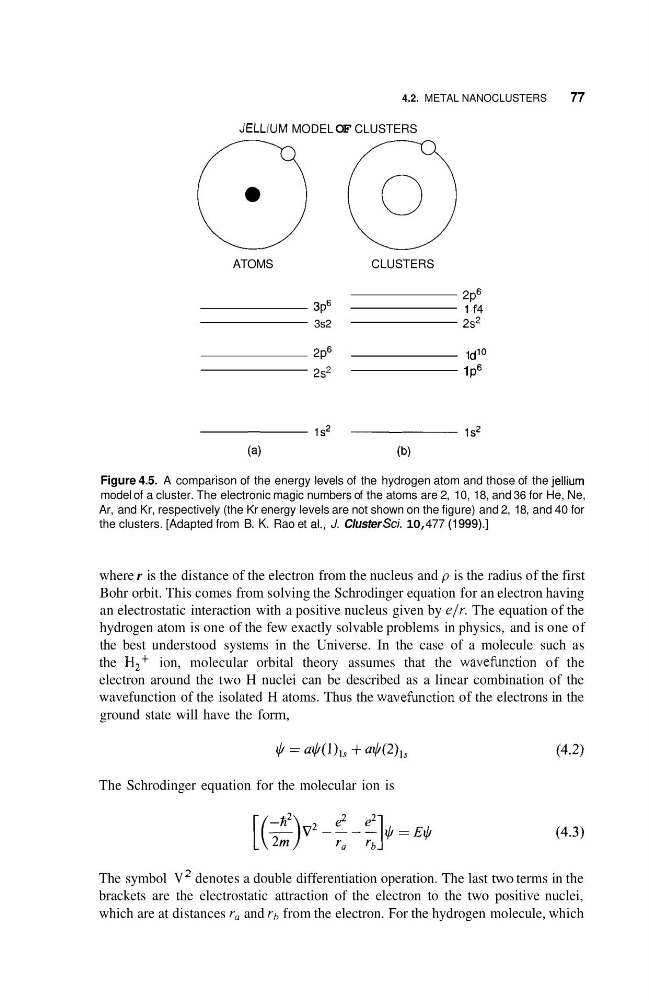
Figure 4.5. A comparison of the energy levels of the hydrogen atom and those of the jellium
model of a cluster. The electronic magic numbers of the atoms are 2, 10, 18, and 36 for He, Ne,
Ar, and Kr, respectively (the Kr energy levels are not shown on the figure) and 2, 18, and 40 for
the clusters. [Adapted from B. K. Rao et al., J. Cluster Sci. 10, 477 (1999).]
where r is the distance of the electron from the nucleus and p is the radius of the first
Bohr orbit. This comes from solving the Schrodinger equation for an electron having
an electrostatic interaction with a positive nucleus given by e/r. The equation of the
hydrogen atom is one of the few exactly solvable problems in physics, and is one of
the best understood systems in the Universe. In the case of a molecule such as
the H,+ ion, molecular orbital theory assumes that the wavefinction of the
electron around the two H nuclei can be described as a linear combination of the
wavefunction of the isolated H atoms. Thus the wavefinction of the electrons in the
ground state will have the form,
The Schrodinger equation for the molecular ion is
The symbol V * denotes a double differentiation operation. The last two terms in the
brackets are the electrostatic attraction of the electron to the two positive nuclei,
which are at distances r, and rb from the electron. For the hydrogen molecule, which
77
JELLIUM MODEL OF CLUSTERS
ATOMS
CLUSTERS
2P6
3P6
1 f’4
3s2
2s2
2P6
1 d’ O
2s’
1 P6
Figure 4.5. A comparison of the energy levels of the hydrogen atom and those of the jellium
model of a cluster. The electronic magic numbers of the atoms are 2, 10, 18, and 36 for He, Ne,
Ar, and Kr, respectively (the Kr energy levels are not shown on the figure) and 2, 18, and 40 for
the clusters. [Adapted from B. K. Rao et al., J. Cluster Sci. 10, 477 (1999).]
where r is the distance of the electron from the nucleus and p is the radius of the first
Bohr orbit. This comes from solving the Schrodinger equation for an electron having
an electrostatic interaction with a positive nucleus given by e/r. The equation of the
hydrogen atom is one of the few exactly solvable problems in physics, and is one of
the best understood systems in the Universe. In the case of a molecule such as
the H,+ ion, molecular orbital theory assumes that the wavefinction of the
electron around the two H nuclei can be described as a linear combination of the
wavefunction of the isolated H atoms. Thus the wavefinction of the electrons in the
ground state will have the form,
The Schrodinger equation for the molecular ion is
The symbol V * denotes a double differentiation operation. The last two terms in the
brackets are the electrostatic attraction of the electron to the two positive nuclei,
which are at distances r, and rb from the electron. For the hydrogen molecule, which