

76
PROPERTIES OF INDIVIDUAL NANOPARTICLES
2
0
1 25
; 20
k 15
10
z
Q 5
s
Y O
Z
0
2
4
6
8
10 12 14 16 18 20
h
v
c v
2
:
Q
k
Y
Q
J
z
W
Iz
z
ATOMIC NUMBER
(a)
5.3
5.1
4.9
4.7
4.5
4.3
4.1
3.9
3.7
3.5
0
2
4
6
8 1 0 1 2 1 4
NUMBER OF ATOMS
( 4
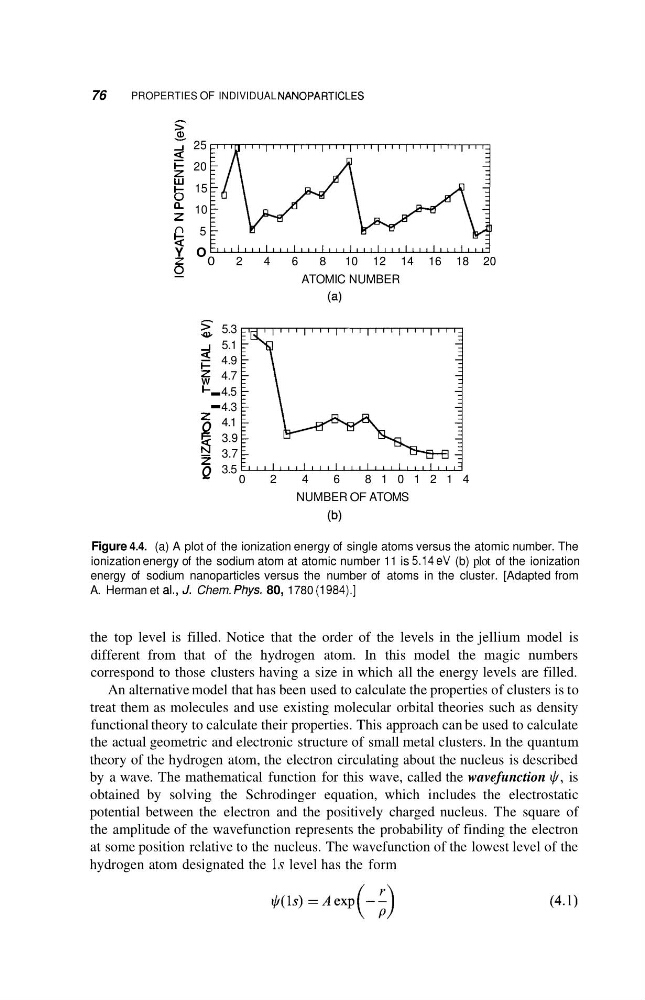
Figure 4.4. (a) A plot of the ionization energy of single atoms versus the atomic number. The
ionization energy of the sodium atom at atomic number 11 is 5.14eV (b) plot of the ionization
energy of sodium nanoparticles versus the number of atoms in the cluster. [Adapted from
A. Herman et al., J. Chem. Phys. 80, 1780 (1984).]
the top level is filled. Notice that the order of the levels in the jellium model is
different from that of the hydrogen atom. In this model the magic numbers
correspond to those clusters having a size in which all the energy levels are filled.
An alternative model that has been used to calculate the properties of clusters is to
treat them as molecules and use existing molecular orbital theories such as density
functional theory to calculate their properties. This approach can be used to calculate
the actual geometric and electronic structure of small metal clusters. In the quantum
theory of the hydrogen atom, the electron circulating about the nucleus is described
by a wave. The mathematical function for this wave, called the wavefunction $, is
obtained by solving the Schrodinger equation, which includes the electrostatic
potential between the electron and the positively charged nucleus. The square of
the amplitude of the wavefunction represents the probability of finding the electron
at some position relative to the nucleus. The wavefunction of the lowest level of the
hydrogen atom designated the 1s level has the form
PROPERTIES OF INDIVIDUAL NANOPARTICLES
2
0
1 25
; 20
k 15
10
z
Q 5
s
Y O
Z
0
2
4
6
8
10 12 14 16 18 20
h
v
c v
2
:
Q
k
Y
Q
J
z
W
Iz
z
ATOMIC NUMBER
(a)
5.3
5.1
4.9
4.7
4.5
4.3
4.1
3.9
3.7
3.5
0
2
4
6
8 1 0 1 2 1 4
NUMBER OF ATOMS
( 4
Figure 4.4. (a) A plot of the ionization energy of single atoms versus the atomic number. The
ionization energy of the sodium atom at atomic number 11 is 5.14eV (b) plot of the ionization
energy of sodium nanoparticles versus the number of atoms in the cluster. [Adapted from
A. Herman et al., J. Chem. Phys. 80, 1780 (1984).]
the top level is filled. Notice that the order of the levels in the jellium model is
different from that of the hydrogen atom. In this model the magic numbers
correspond to those clusters having a size in which all the energy levels are filled.
An alternative model that has been used to calculate the properties of clusters is to
treat them as molecules and use existing molecular orbital theories such as density
functional theory to calculate their properties. This approach can be used to calculate
the actual geometric and electronic structure of small metal clusters. In the quantum
theory of the hydrogen atom, the electron circulating about the nucleus is described
by a wave. The mathematical function for this wave, called the wavefunction $, is
obtained by solving the Schrodinger equation, which includes the electrostatic
potential between the electron and the positively charged nucleus. The square of
the amplitude of the wavefunction represents the probability of finding the electron
at some position relative to the nucleus. The wavefunction of the lowest level of the
hydrogen atom designated the 1s level has the form