

78
PROPERTIES OF INDIVIDUAL NANOPARTICLES
has two electrons, a term for the electrostatic repulsion of the two electrons would be
added. The Schrodinger equation is solved with this linear combination [Eq. (4.2)]
of wavefunctions. When there are many atoms in the molecule and many electrons,
the problem becomes complex, and many approximations are used to obtain the
solution. Density functional theory represents one approximation. With the development of large fast computer capability and new theoretical approaches, it is possible
using molecular orbital theory to determine the geometric and electronic structures
of large molecules with a high degree of accuracy. The calculations can find the
structure with the lowest energy, which will be the equilibrium geometry. These
molecular orbital methods with some modification have been applied to metal
nanoparticle s .
4.2.3. Geometric Structure
Generally the crystal structure of large nanoparticles is the same as the bulk structure
with somewhat different lattice parameters. X-ray diffraction studies of 80-nm
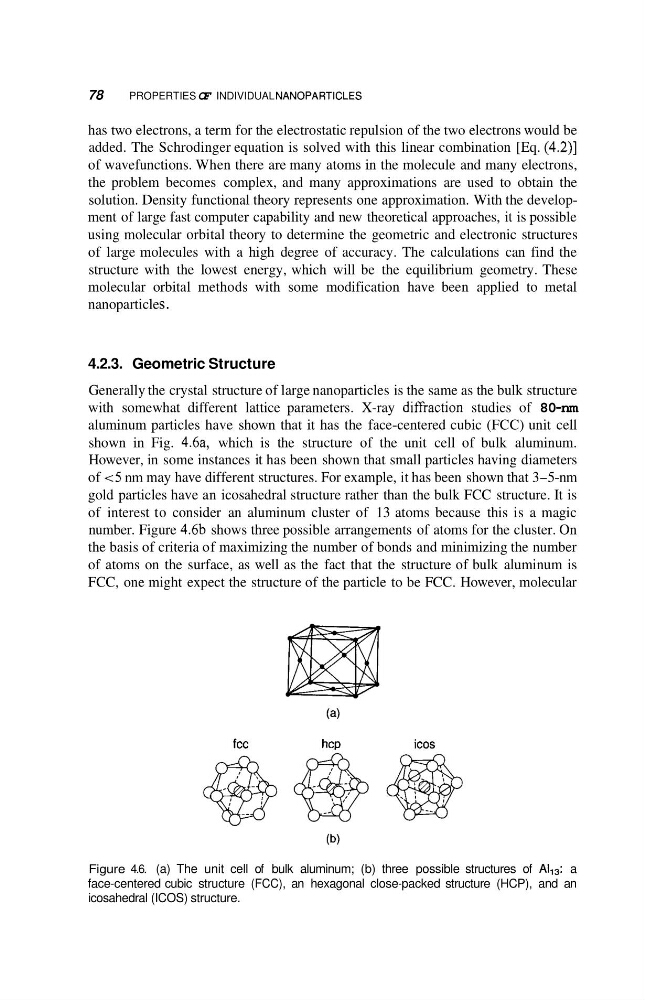
aluminum particles have shown that it has the face-centered cubic (FCC) unit cell
shown in Fig. 4.6a, which is the structure of the unit cell of bulk aluminum.
However, in some instances it has been shown that small particles having diameters
of <5 nm may have different structures. For example, it has been shown that 3-5-nm
gold particles have an icosahedral structure rather than the bulk FCC structure. It is
of interest to consider an aluminum cluster of 13 atoms because this is a magic
number. Figure 4.6b shows three possible arrangements of atoms for the cluster. On
the basis of criteria of maximizing the number of bonds and minimizing the number
of atoms on the surface, as well as the fact that the structure of bulk aluminum is
FCC, one might expect the structure of the particle to be FCC. However, molecular
fcc
icos
Figure 4.6. (a) The unit cell of bulk aluminum; (b) three possible structures of AIj3: a
face-centered cubic structure (FCC), an hexagonal close-packed structure (HCP), and an
icosahedral (ICOS) structure.
PROPERTIES OF INDIVIDUAL NANOPARTICLES
has two electrons, a term for the electrostatic repulsion of the two electrons would be
added. The Schrodinger equation is solved with this linear combination [Eq. (4.2)]
of wavefunctions. When there are many atoms in the molecule and many electrons,
the problem becomes complex, and many approximations are used to obtain the
solution. Density functional theory represents one approximation. With the development of large fast computer capability and new theoretical approaches, it is possible
using molecular orbital theory to determine the geometric and electronic structures
of large molecules with a high degree of accuracy. The calculations can find the
structure with the lowest energy, which will be the equilibrium geometry. These
molecular orbital methods with some modification have been applied to metal
nanoparticle s .
4.2.3. Geometric Structure
Generally the crystal structure of large nanoparticles is the same as the bulk structure
with somewhat different lattice parameters. X-ray diffraction studies of 80-nm
aluminum particles have shown that it has the face-centered cubic (FCC) unit cell
shown in Fig. 4.6a, which is the structure of the unit cell of bulk aluminum.
However, in some instances it has been shown that small particles having diameters
of <5 nm may have different structures. For example, it has been shown that 3-5-nm
gold particles have an icosahedral structure rather than the bulk FCC structure. It is
of interest to consider an aluminum cluster of 13 atoms because this is a magic
number. Figure 4.6b shows three possible arrangements of atoms for the cluster. On
the basis of criteria of maximizing the number of bonds and minimizing the number
of atoms on the surface, as well as the fact that the structure of bulk aluminum is
FCC, one might expect the structure of the particle to be FCC. However, molecular
fcc
icos
Figure 4.6. (a) The unit cell of bulk aluminum; (b) three possible structures of AIj3: a
face-centered cubic structure (FCC), an hexagonal close-packed structure (HCP), and an
icosahedral (ICOS) structure.