

58
METHODS OF MEASURING PROPERTIES
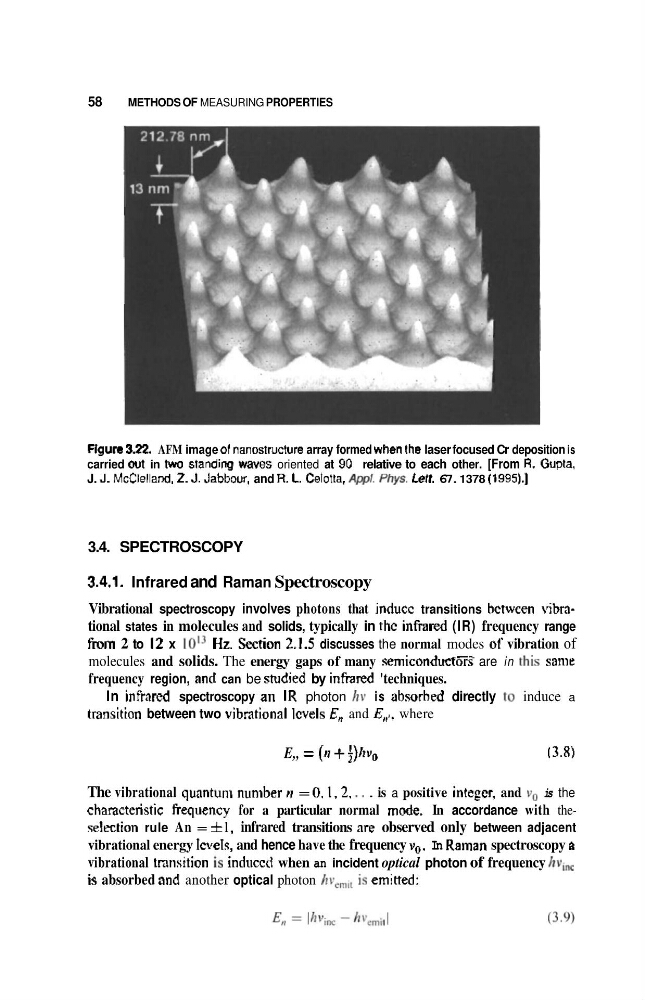
Figure 3.22. AFM image of nanostructure array formed when the laser focused Cr deposition is
carried Out in twu standim waves oriented at 90 relative to each other. [From R. Gupta,
J. J. McClelland, 2. J. Jabbour, and R. L. CelotEa, Ami. Fhys. Left 67. 1378 (1995),]
3.4. SPECTROSCOPY
3.4.1. Infrared and Raman Spectroscopy
Vibrational spectroscopy involves photons that inducc transitions bctween vibrational states in molecules and solids, typically in thc infrared (IR) frequency range
from 2 to 12 x IO'> Hz. Secrion 2.1.5 discusses the normal modes of' vibration of
molecules and solids. The energy gaps of many wrniconductm are in !his same
frequency region, nnd can be studied by infmred 'techniques.
In infrmd spectroscopy an IR photon hi, is absorhed directly to induce a
transition between two vibrational lcvcls E,, and E,,,. where
E,, = (11 f f)ho
(3.8)
The vibrational quantum nuniber IF = 0. 1,2, " . . is a positive integer, and vo is the
chamcteristic freqiiency for a particular normal mode. In accordance with theselection rule An = + l , infrared transitions are observed only between adjacent
vibrational energy Imels, and hence have the frequency v,. In Raman spectroscopy B
vibrational tnrisrtion is induccd when an incident optical photon of frequency hint
is absorbed and another optical photon hvtm,L if emjtted:
METHODS OF MEASURING PROPERTIES
Figure 3.22. AFM image of nanostructure array formed when the laser focused Cr deposition is
carried Out in twu standim waves oriented at 90 relative to each other. [From R. Gupta,
J. J. McClelland, 2. J. Jabbour, and R. L. CelotEa, Ami. Fhys. Left 67. 1378 (1995),]
3.4. SPECTROSCOPY
3.4.1. Infrared and Raman Spectroscopy
Vibrational spectroscopy involves photons that inducc transitions bctween vibrational states in molecules and solids, typically in thc infrared (IR) frequency range
from 2 to 12 x IO'> Hz. Secrion 2.1.5 discusses the normal modes of' vibration of
molecules and solids. The energy gaps of many wrniconductm are in !his same
frequency region, nnd can be studied by infmred 'techniques.
In infrmd spectroscopy an IR photon hi, is absorhed directly to induce a
transition between two vibrational lcvcls E,, and E,,,. where
E,, = (11 f f)ho
(3.8)
The vibrational quantum nuniber IF = 0. 1,2, " . . is a positive integer, and vo is the
chamcteristic freqiiency for a particular normal mode. In accordance with theselection rule An = + l , infrared transitions are observed only between adjacent
vibrational energy Imels, and hence have the frequency v,. In Raman spectroscopy B
vibrational tnrisrtion is induccd when an incident optical photon of frequency hint
is absorbed and another optical photon hvtm,L if emjtted: