

13.3. MOLECULAR AND SUPRAMOLECULAR SWITCHES
353
1 1 0
Rotaxane Monolayer
&P SiO,/Si Substrate
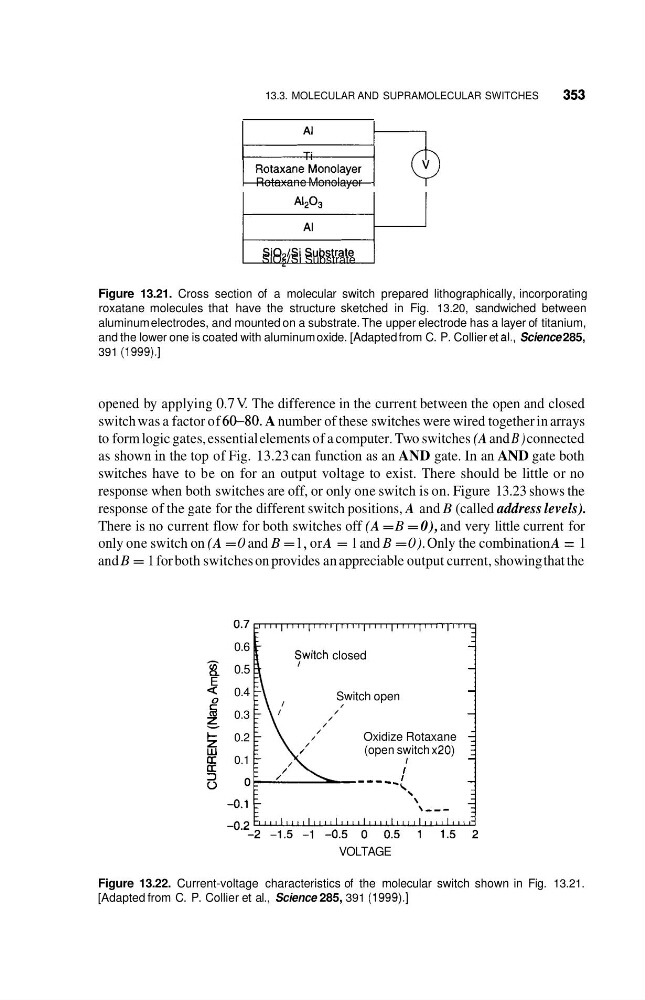
Figure 13.21. Cross section of a molecular switch prepared lithographically, incorporating
roxatane molecules that have the structure sketched in Fig. 13.20, sandwiched between
aluminum electrodes, and mounted on a substrate. The upper electrode has a layer of titanium,
and the lower one is coated with aluminum oxide. [Adapted from C. P. Collier et al., Science 285,
391 (1999).]
opened by applying 0.7 V The difference in the current between the open and closed
switch was a factor of 60-80. A number of these switches were wired together in arrays
to form logic gates, essential elements of a computer. Two switches (A and B ) connected
as shown in the top of Fig. 13.23 can function as an AND gate. In an AND gate both
switches have to be on for an output voltage to exist. There should be little or no
response when both switches are off, or only one switch is on. Figure 13.23 shows the
response of the gate for the different switch positions, A and B (called address levels).
There is no current flow for both switches off (A = B = 0), and very little current for
only one switch on (A = 0 and B = 1, or A = 1 and B = 0). Only the combination A = 1
and B = 1 for both switches on provides an appreciable output current, showing that the
v)
Q
E
<
0
t
m
z
I -
z w
0:
0:
3
u
0.6
0.5
0.4
0.3
0.2
0.1
0
-
:witch closed
-
Switch open
-
-
Oxidize Rotaxane +
/
(open switch x20) !
-
I
/
I
- \
/
---_ I
-
VOLTAGE
Figure 13.22. Current-voltage characteristics of the molecular switch shown in Fig. 13.21.
[Adapted from C. P. Collier et al., Science 285, 391 (1999).]
353
1 1 0
Rotaxane Monolayer
&P SiO,/Si Substrate
Figure 13.21. Cross section of a molecular switch prepared lithographically, incorporating
roxatane molecules that have the structure sketched in Fig. 13.20, sandwiched between
aluminum electrodes, and mounted on a substrate. The upper electrode has a layer of titanium,
and the lower one is coated with aluminum oxide. [Adapted from C. P. Collier et al., Science 285,
391 (1999).]
opened by applying 0.7 V The difference in the current between the open and closed
switch was a factor of 60-80. A number of these switches were wired together in arrays
to form logic gates, essential elements of a computer. Two switches (A and B ) connected
as shown in the top of Fig. 13.23 can function as an AND gate. In an AND gate both
switches have to be on for an output voltage to exist. There should be little or no
response when both switches are off, or only one switch is on. Figure 13.23 shows the
response of the gate for the different switch positions, A and B (called address levels).
There is no current flow for both switches off (A = B = 0), and very little current for
only one switch on (A = 0 and B = 1, or A = 1 and B = 0). Only the combination A = 1
and B = 1 for both switches on provides an appreciable output current, showing that the
v)
Q
E
<
0
t
m
z
I -
z w
0:
0:
3
u
0.6
0.5
0.4
0.3
0.2
0.1
0
-
:witch closed
-
Switch open
-
-
Oxidize Rotaxane +
/
(open switch x20) !
-
I
/
I
- \
/
---_ I
-
VOLTAGE
Figure 13.22. Current-voltage characteristics of the molecular switch shown in Fig. 13.21.
[Adapted from C. P. Collier et al., Science 285, 391 (1999).]