

13.3. MOLECULAR AND SUPRAMOLECULAR SWITCHES
351
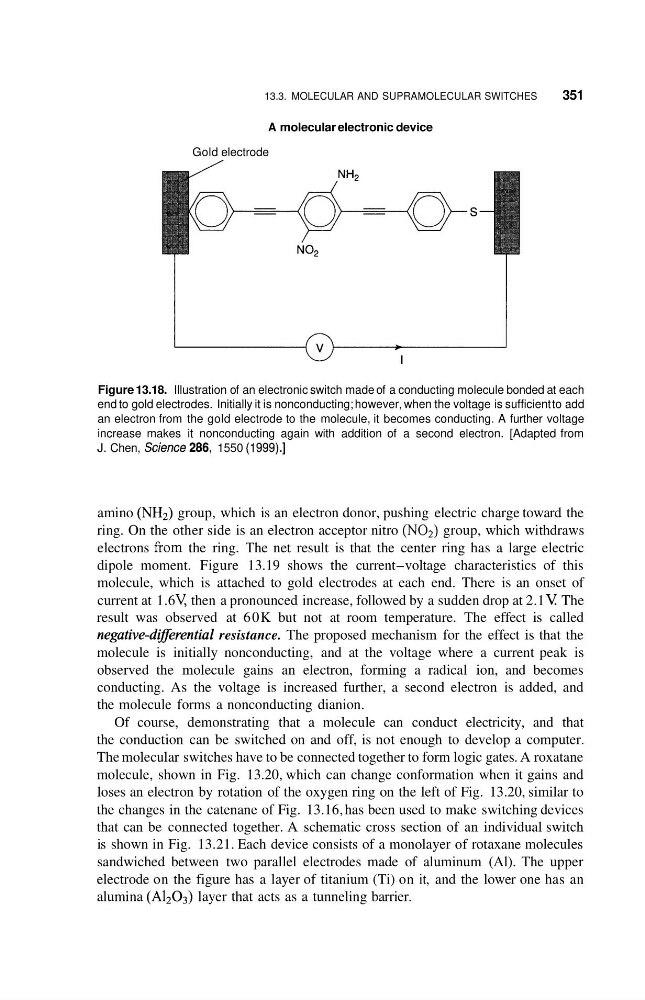
A molecular electronic device
Gold electrode
r
I
Figure 13.18. Illustration of an electronic switch made of a conducting molecule bonded at each
end to gold electrodes. Initially it is nonconducting; however, when the voltage is sufficient to add
an electron from the gold electrode to the molecule, it becomes conducting. A further voltage
increase makes it nonconducting again with addition of a second electron. [Adapted from
J. Chen, Science286, 1550 (1999).]
amino (NH2) group, which is an electron donor, pushing electric charge toward the
ring. On the other side is an electron acceptor nitro (NO2) group, which withdraws
electrons from the ring. The net result is that the center ring has a large electric
dipole moment. Figure 13.19 shows the current-voltage characteristics of this
molecule, which is attached to gold electrodes at each end. There is an onset of
current at 1.6 V, then a pronounced increase, followed by a sudden drop at 2.1 V The
result was observed at 60K but not at room temperature. The effect is called
negative-diflerential resistance. The proposed mechanism for the effect is that the
molecule is initially nonconducting, and at the voltage where a current peak is
observed the molecule gains an electron, forming a radical ion, and becomes
conducting. As the voltage is increased further, a second electron is added, and
the molecule forms a nonconducting dianion.
Of course, demonstrating that a molecule can conduct electricity, and that
the conduction can be switched on and off, is not enough to develop a computer.
The molecular switches have to be connected together to form logic gates. A roxatane
molecule, shown in Fig. 13.20, which can change conformation when it gains and
loses an electron by rotation of the oxygen ring on the left of Fig. 13.20, similar to
the changes in the catenane of Fig. 13.16, has been used to make switching devices
that can be connected together. A schematic cross section of an individual switch
is shown in Fig. 13.21. Each device consists of a monolayer of rotaxane molecules
sandwiched between two parallel electrodes made of aluminum (Al). The upper
electrode on the figure has a layer of titanium (Ti) on it, and the lower one has an
alumina (A1203) layer that acts as a tunneling barrier.
351
A molecular electronic device
Gold electrode
r
I
Figure 13.18. Illustration of an electronic switch made of a conducting molecule bonded at each
end to gold electrodes. Initially it is nonconducting; however, when the voltage is sufficient to add
an electron from the gold electrode to the molecule, it becomes conducting. A further voltage
increase makes it nonconducting again with addition of a second electron. [Adapted from
J. Chen, Science286, 1550 (1999).]
amino (NH2) group, which is an electron donor, pushing electric charge toward the
ring. On the other side is an electron acceptor nitro (NO2) group, which withdraws
electrons from the ring. The net result is that the center ring has a large electric
dipole moment. Figure 13.19 shows the current-voltage characteristics of this
molecule, which is attached to gold electrodes at each end. There is an onset of
current at 1.6 V, then a pronounced increase, followed by a sudden drop at 2.1 V The
result was observed at 60K but not at room temperature. The effect is called
negative-diflerential resistance. The proposed mechanism for the effect is that the
molecule is initially nonconducting, and at the voltage where a current peak is
observed the molecule gains an electron, forming a radical ion, and becomes
conducting. As the voltage is increased further, a second electron is added, and
the molecule forms a nonconducting dianion.
Of course, demonstrating that a molecule can conduct electricity, and that
the conduction can be switched on and off, is not enough to develop a computer.
The molecular switches have to be connected together to form logic gates. A roxatane
molecule, shown in Fig. 13.20, which can change conformation when it gains and
loses an electron by rotation of the oxygen ring on the left of Fig. 13.20, similar to
the changes in the catenane of Fig. 13.16, has been used to make switching devices
that can be connected together. A schematic cross section of an individual switch
is shown in Fig. 13.21. Each device consists of a monolayer of rotaxane molecules
sandwiched between two parallel electrodes made of aluminum (Al). The upper
electrode on the figure has a layer of titanium (Ti) on it, and the lower one has an
alumina (A1203) layer that acts as a tunneling barrier.