

350
NANOMACHINES AND NANODEVICES
removed using a solvent technique and replaced with 1 &octanedithiol, which has
sulfur groups at both ends of the chain. A gold-coated STM tip was scanned over
the top of the monolayer to find the 1,8-octanedithiol. The tip was then put in
contact with the end of the molecule, forming an electric circuit between the tip
and the flat gold surface. The octanethiol molecules, which are bound only to the
bottom gold electrode, serve as molecular insulators, electrically isolating the
octanedithiol wires. The voltage between the tip and the bottom gold electrode is
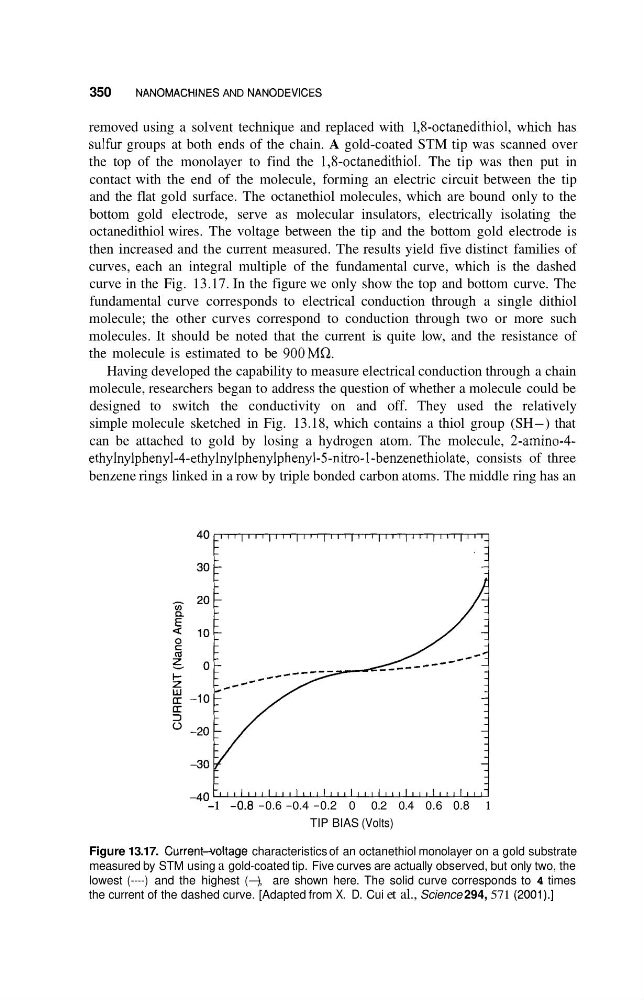
then increased and the current measured. The results yield five distinct families of
curves, each an integral multiple of the fundamental curve, which is the dashed
curve in the Fig. 13.17. In the figure we only show the top and bottom curve. The
fundamental curve corresponds to electrical conduction through a single dithiol
molecule; the other curves correspond to conduction through two or more such
molecules. It should be noted that the current is quite low, and the resistance of
the molecule is estimated to be 900MQ.
Having developed the capability to measure electrical conduction through a chain
molecule, researchers began to address the question of whether a molecule could be
designed to switch the conductivity on and off. They used the relatively
simple molecule sketched in Fig. 13.18, which contains a thiol group (SH-) that
can be attached to gold by losing a hydrogen atom. The molecule, 2-amino-4ethylnylphenyl-4-ethylnylphenylphenyl-5-nitro- 1 -benzenethiolate, consists of three
benzene rings linked in a row by triple bonded carbon atoms. The middle ring has an
- 4 0 " " " " " " " " ' " ' ~ " ' ' ' ' 1 1 ' ' ~ i
-1 -0.8 -0.6 -0.4 -0.2 0 0.2 0.4 0.6 0.8 1
TIP BIAS (Volts)
Figure 13.17. Current-voltage characteristics of an octanethiol monolayer on a gold substrate
measured by STM using a gold-coated tip. Five curves are actually observed, but only two, the
lowest (----) and the highest (- ), are shown here. The solid curve corresponds to 4 times
the current of the dashed curve. [Adapted from X. D. Cui et al., Science 294, 571 (2001).]
NANOMACHINES AND NANODEVICES
removed using a solvent technique and replaced with 1 &octanedithiol, which has
sulfur groups at both ends of the chain. A gold-coated STM tip was scanned over
the top of the monolayer to find the 1,8-octanedithiol. The tip was then put in
contact with the end of the molecule, forming an electric circuit between the tip
and the flat gold surface. The octanethiol molecules, which are bound only to the
bottom gold electrode, serve as molecular insulators, electrically isolating the
octanedithiol wires. The voltage between the tip and the bottom gold electrode is
then increased and the current measured. The results yield five distinct families of
curves, each an integral multiple of the fundamental curve, which is the dashed
curve in the Fig. 13.17. In the figure we only show the top and bottom curve. The
fundamental curve corresponds to electrical conduction through a single dithiol
molecule; the other curves correspond to conduction through two or more such
molecules. It should be noted that the current is quite low, and the resistance of
the molecule is estimated to be 900MQ.
Having developed the capability to measure electrical conduction through a chain
molecule, researchers began to address the question of whether a molecule could be
designed to switch the conductivity on and off. They used the relatively
simple molecule sketched in Fig. 13.18, which contains a thiol group (SH-) that
can be attached to gold by losing a hydrogen atom. The molecule, 2-amino-4ethylnylphenyl-4-ethylnylphenylphenyl-5-nitro- 1 -benzenethiolate, consists of three
benzene rings linked in a row by triple bonded carbon atoms. The middle ring has an
- 4 0 " " " " " " " " ' " ' ~ " ' ' ' ' 1 1 ' ' ~ i
-1 -0.8 -0.6 -0.4 -0.2 0 0.2 0.4 0.6 0.8 1
TIP BIAS (Volts)
Figure 13.17. Current-voltage characteristics of an octanethiol monolayer on a gold substrate
measured by STM using a gold-coated tip. Five curves are actually observed, but only two, the
lowest (----) and the highest (- ), are shown here. The solid curve corresponds to 4 times
the current of the dashed curve. [Adapted from X. D. Cui et al., Science 294, 571 (2001).]