

348
NANOMACHINES AND NANODEVICES
- -
(+)- c PL
\
\
\
\
/
Me
' Me
5a
5b
/ s
/
/ s
M
P
(-)-CPL
LPL
UPL
I
I
Writing
Reading
Erasing
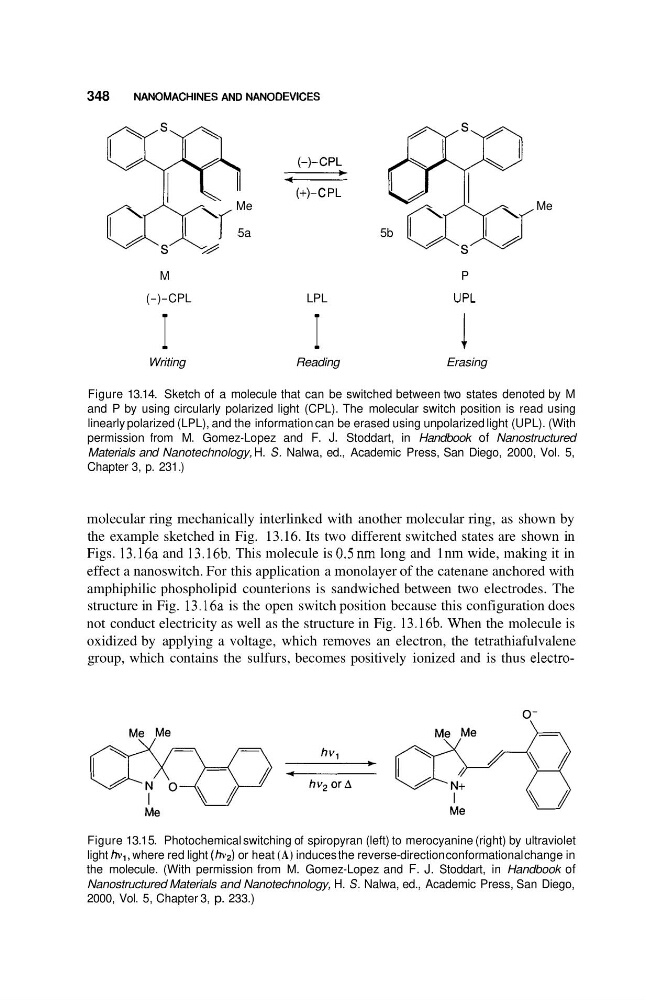
Figure 13.14. Sketch of a molecule that can be switched between two states denoted by M
and P by using circularly polarized light (CPL). The molecular switch position is read using
linearly polarized (LPL), and the information can be erased using unpolarized light (UPL). (With
permission from M. Gomez-Lopez and F. J. Stoddart, in Handbook of Nanostructured
Materials and Nanotechnology, H. S. Nalwa, ed., Academic Press, San Diego, 2000, Vol. 5,
Chapter 3, p. 231 .)
molecular ring mechanically interlinked with another molecular ring, as shown by
the example sketched in Fig. 13.16. Its two different switched states are shown in
Figs. 13.16a and 13.16b. This molecule is 0.5nm long and 1 nm wide, making it in
effect a nanoswitch. For this application a monolayer of the catenane anchored with
amphiphilic phospholipid counterions is sandwiched between two electrodes. The
structure in Fig. 13.16a is the open switch position because this configuration does
not conduct electricity as well as the structure in Fig. 13.16b. When the molecule is
oxidized by applying a voltage, which removes an electron, the tetrathiafulvalene
group, which contains the sulfurs, becomes positively ionized and is thus electroFigure 13.1 5. Photochemical switching of spiropyran (left) to merocyanine (right) by ultraviolet
light hv,, where red light (h,) or heat (A) induces the reverse-direction conformational change in
the molecule. (With permission from M. Gomez-Lopez and F. J. Stoddart, in Handbook of
Nanostructured Materials and Nanotechnology, H. S. Nalwa, ed., Academic Press, San Diego,
2000, Vol. 5, Chapter 3, p. 233.)
NANOMACHINES AND NANODEVICES
- -
(+)- c PL
\
\
\
\
/
Me
' Me
5a
5b
/ s
/
/ s
M
P
(-)-CPL
LPL
UPL
I
I
Writing
Reading
Erasing
Figure 13.14. Sketch of a molecule that can be switched between two states denoted by M
and P by using circularly polarized light (CPL). The molecular switch position is read using
linearly polarized (LPL), and the information can be erased using unpolarized light (UPL). (With
permission from M. Gomez-Lopez and F. J. Stoddart, in Handbook of Nanostructured
Materials and Nanotechnology, H. S. Nalwa, ed., Academic Press, San Diego, 2000, Vol. 5,
Chapter 3, p. 231 .)
molecular ring mechanically interlinked with another molecular ring, as shown by
the example sketched in Fig. 13.16. Its two different switched states are shown in
Figs. 13.16a and 13.16b. This molecule is 0.5nm long and 1 nm wide, making it in
effect a nanoswitch. For this application a monolayer of the catenane anchored with
amphiphilic phospholipid counterions is sandwiched between two electrodes. The
structure in Fig. 13.16a is the open switch position because this configuration does
not conduct electricity as well as the structure in Fig. 13.16b. When the molecule is
oxidized by applying a voltage, which removes an electron, the tetrathiafulvalene
group, which contains the sulfurs, becomes positively ionized and is thus electroFigure 13.1 5. Photochemical switching of spiropyran (left) to merocyanine (right) by ultraviolet
light hv,, where red light (h,) or heat (A) induces the reverse-direction conformational change in
the molecule. (With permission from M. Gomez-Lopez and F. J. Stoddart, in Handbook of
Nanostructured Materials and Nanotechnology, H. S. Nalwa, ed., Academic Press, San Diego,
2000, Vol. 5, Chapter 3, p. 233.)