

13.3. MOLECULAR AND SUPRAMOLECULAR SWITCHES
347
representation of the basic elements of a molecular switch, in which stimulus SI
brings about a conversion from state 0 to state 1, and stimulus S, induces the reverse
conversion. There are a number of different kinds of molecular switches.
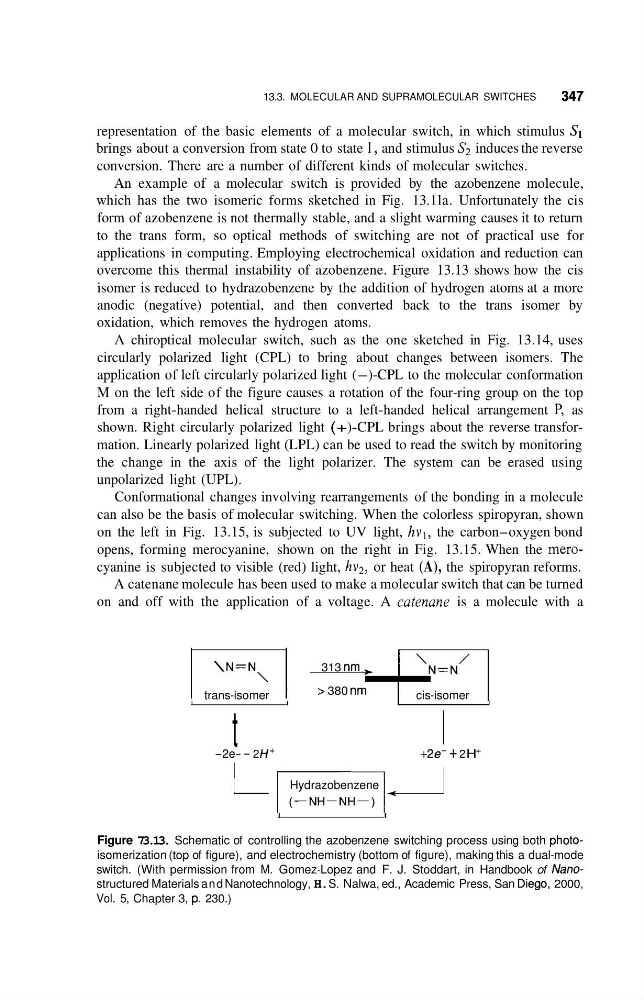
An example of a molecular switch is provided by the azobenzene molecule,
which has the two isomeric forms sketched in Fig. 13.1 la. Unfortunately the cis
form of azobenzene is not thermally stable, and a slight warming causes it to return
to the trans form, so optical methods of switching are not of practical use for
applications in computing. Employing electrochemical oxidation and reduction can
overcome this thermal instability of azobenzene. Figure 13.13 shows how the cis
isomer is reduced to hydrazobenzene by the addition of hydrogen atoms at a more
anodic (negative) potential, and then converted back to the trans isomer by
oxidation, which removes the hydrogen atoms.
A chiroptical molecular switch, such as the one sketched in Fig. 13.14, uses
circularly polarized light (CPL) to bring about changes between isomers. The
application of left circularly polarized light (-)-CPL to the molecular conformation
M on the left side of the figure causes a rotation of the four-ring group on the top
from a right-handed helical structure to a left-handed helical arrangement P, as
shown. Right circularly polarized light (+ )-CPL brings about the reverse transformation. Linearly polarized light (LPL) can be used to read the switch by monitoring
the change in the axis of the light polarizer. The system can be erased using
unpolarized light (UPL).
Conformational changes involving rearrangements of the bonding in a molecule
can also be the basis of molecular switching. When the colorless spiropyran, shown
on the left in Fig. 13.15, is subjected to UV light, hvl, the carbon-oxygen bond
opens, forming merocyanine, shown on the right in Fig. 13.15. When the merocyanine is subjected to visible (red) light, hv2, or heat (A), the spiropyran reforms.
A catenane molecule has been used to make a molecular switch that can be turned
on and off with the application of a voltage. A catenane is a molecule with a
/
1 \N=N ~
cis-isomer
~
\ N=N\
I 313 nm
.
> 380 nm
trans-isomer
I
I
I
I
t
-2e- - 2 H+
+2e- + 2 H
+
Hydrazobenzene
I
I
Figure 73.13. Schematic of controlling the azobenzene switching process using both photoisomerization (top of figure), and electrochemistry (bottom of figure), making this a dual-mode
switch. (With permission from M. Gomez-Lopez and F. J. Stoddart, in Handbook of Nanostructured Materials and Nanotechnology, H. S. Nalwa, ed., Academic Press, San Diego, 2000,
Vol. 5, Chapter 3, p. 230.)
347
representation of the basic elements of a molecular switch, in which stimulus SI
brings about a conversion from state 0 to state 1, and stimulus S, induces the reverse
conversion. There are a number of different kinds of molecular switches.
An example of a molecular switch is provided by the azobenzene molecule,
which has the two isomeric forms sketched in Fig. 13.1 la. Unfortunately the cis
form of azobenzene is not thermally stable, and a slight warming causes it to return
to the trans form, so optical methods of switching are not of practical use for
applications in computing. Employing electrochemical oxidation and reduction can
overcome this thermal instability of azobenzene. Figure 13.13 shows how the cis
isomer is reduced to hydrazobenzene by the addition of hydrogen atoms at a more
anodic (negative) potential, and then converted back to the trans isomer by
oxidation, which removes the hydrogen atoms.
A chiroptical molecular switch, such as the one sketched in Fig. 13.14, uses
circularly polarized light (CPL) to bring about changes between isomers. The
application of left circularly polarized light (-)-CPL to the molecular conformation
M on the left side of the figure causes a rotation of the four-ring group on the top
from a right-handed helical structure to a left-handed helical arrangement P, as
shown. Right circularly polarized light (+ )-CPL brings about the reverse transformation. Linearly polarized light (LPL) can be used to read the switch by monitoring
the change in the axis of the light polarizer. The system can be erased using
unpolarized light (UPL).
Conformational changes involving rearrangements of the bonding in a molecule
can also be the basis of molecular switching. When the colorless spiropyran, shown
on the left in Fig. 13.15, is subjected to UV light, hvl, the carbon-oxygen bond
opens, forming merocyanine, shown on the right in Fig. 13.15. When the merocyanine is subjected to visible (red) light, hv2, or heat (A), the spiropyran reforms.
A catenane molecule has been used to make a molecular switch that can be turned
on and off with the application of a voltage. A catenane is a molecule with a
/
1 \N=N ~
cis-isomer
~
\ N=N\
I 313 nm
.
> 380 nm
trans-isomer
I
I
I
I
t
-2e- - 2 H+
+2e- + 2 H
+
Hydrazobenzene
I
I
Figure 73.13. Schematic of controlling the azobenzene switching process using both photoisomerization (top of figure), and electrochemistry (bottom of figure), making this a dual-mode
switch. (With permission from M. Gomez-Lopez and F. J. Stoddart, in Handbook of Nanostructured Materials and Nanotechnology, H. S. Nalwa, ed., Academic Press, San Diego, 2000,
Vol. 5, Chapter 3, p. 230.)