

344
NANOMACHINES AND NANODEVICES
nanosired machine i s the capability o f moving the power gear. The idea o f using an
electric field, which does not require contacts with the nanostructure, to roll a Chn
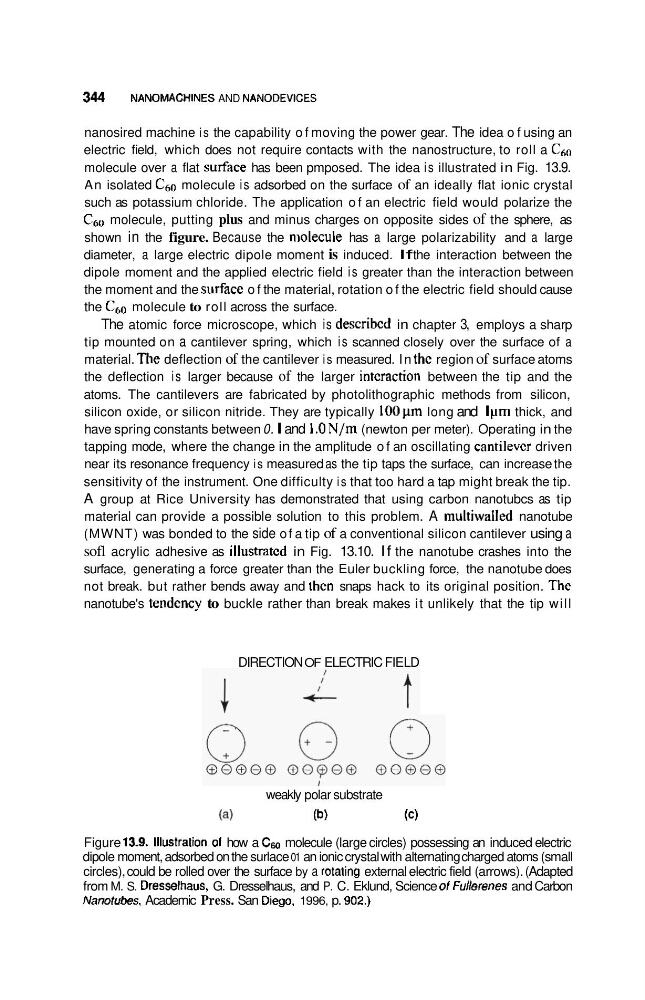
molecule over a flat surfice has been pmposed. The idea is illustrated in Fig. 13.9.
An isolated C6,, molecule is adsorbed on the surface of an ideally flat ionic crystal
such as potassium chloride. The application o f an electric field would polarize the
C6,, molecule, putting plus and minus charges on opposite sides of the sphere, as
shown in the figure. Because the nlolecule has a large polarizability and a large
diameter, a large electric dipole moment is induced. If the interaction between the
dipole moment and the applied electric field is greater than the interaction between
the moment and the surfacc o f the material, rotation o f the electric field should cause
the C ,
,
" molecule to roll across the surface.
The atomic force microscope, which is describcd in chapter 3, employs a sharp
tip mounted on a cantilever spring, which is scanned closely over the surface of a
material. The deflection of the cantilever is measured. I n thc region of surface atoms
the deflection is larger because of the larger intcraction between the tip and the
atoms. The cantilevers are fabricated by photolithographic methods from silicon,
silicon oxide, or silicon nitride. They are typically 100pm long and I p m thick, and
have spring constants between 0. I and I .O N/m (newton per meter). Operating in the
tapping mode, where the change in the amplitude o f an oscillating cantilevcr driven
near its resonance frequency i s measured as the tip taps the surface, can increase the
sensitivity of the instrument. One difficulty is that too hard a tap might break the tip.
A group at Rice University has demonstrated that using carbon nanotubcs as tip
material can provide a possible solution to this problem. A multiwalled nanotube
(MWNT) was bonded to the side o f a tip of a conventional silicon cantilever using a
sofl acrylic adhesive as illustratcd in Fig. 13.10. If the nanotube crashes into the
surface, generating a force greater than the Euler buckling force, the nanotube does
not break. but rather bends away and thcn snaps hack to its original position. The
nanotube's tendcncy to buckle rather than break makes it unlikely that the tip will
DIRECTION OF ELECTRIC FIELD
weakly polar substrate
(a)
(b)
(C)
Figure 13.9. Illustration of how a Csa molecule (large circles) possessing an induced electric
dipole moment, adsorbed on the surlace 01 an ionic crystal with alternating charged atoms (small
circles), could be rolled over the surface by a rotaling external electric field (arrows). (Adapted
from M. S. Dresselhaus, G. Dresselhaus, and P. C. Eklund, Science 01 Fullerenes and Carbon
Nanotubes, Academic Press. San Diego. 1996, p. 902.)
NANOMACHINES AND NANODEVICES
nanosired machine i s the capability o f moving the power gear. The idea o f using an
electric field, which does not require contacts with the nanostructure, to roll a Chn
molecule over a flat surfice has been pmposed. The idea is illustrated in Fig. 13.9.
An isolated C6,, molecule is adsorbed on the surface of an ideally flat ionic crystal
such as potassium chloride. The application o f an electric field would polarize the
C6,, molecule, putting plus and minus charges on opposite sides of the sphere, as
shown in the figure. Because the nlolecule has a large polarizability and a large
diameter, a large electric dipole moment is induced. If the interaction between the
dipole moment and the applied electric field is greater than the interaction between
the moment and the surfacc o f the material, rotation o f the electric field should cause
the C ,
,
" molecule to roll across the surface.
The atomic force microscope, which is describcd in chapter 3, employs a sharp
tip mounted on a cantilever spring, which is scanned closely over the surface of a
material. The deflection of the cantilever is measured. I n thc region of surface atoms
the deflection is larger because of the larger intcraction between the tip and the
atoms. The cantilevers are fabricated by photolithographic methods from silicon,
silicon oxide, or silicon nitride. They are typically 100pm long and I p m thick, and
have spring constants between 0. I and I .O N/m (newton per meter). Operating in the
tapping mode, where the change in the amplitude o f an oscillating cantilevcr driven
near its resonance frequency i s measured as the tip taps the surface, can increase the
sensitivity of the instrument. One difficulty is that too hard a tap might break the tip.
A group at Rice University has demonstrated that using carbon nanotubcs as tip
material can provide a possible solution to this problem. A multiwalled nanotube
(MWNT) was bonded to the side o f a tip of a conventional silicon cantilever using a
sofl acrylic adhesive as illustratcd in Fig. 13.10. If the nanotube crashes into the
surface, generating a force greater than the Euler buckling force, the nanotube does
not break. but rather bends away and thcn snaps hack to its original position. The
nanotube's tendcncy to buckle rather than break makes it unlikely that the tip will
DIRECTION OF ELECTRIC FIELD
weakly polar substrate
(a)
(b)
(C)
Figure 13.9. Illustration of how a Csa molecule (large circles) possessing an induced electric
dipole moment, adsorbed on the surlace 01 an ionic crystal with alternating charged atoms (small
circles), could be rolled over the surface by a rotaling external electric field (arrows). (Adapted
from M. S. Dresselhaus, G. Dresselhaus, and P. C. Eklund, Science 01 Fullerenes and Carbon
Nanotubes, Academic Press. San Diego. 1996, p. 902.)