

13.3. MOLECULAR AND SUPRAMOLECULAR SWITCHES
345
CANTILEVER
\
\
\
\
\
\ CARBON NANOTUBE
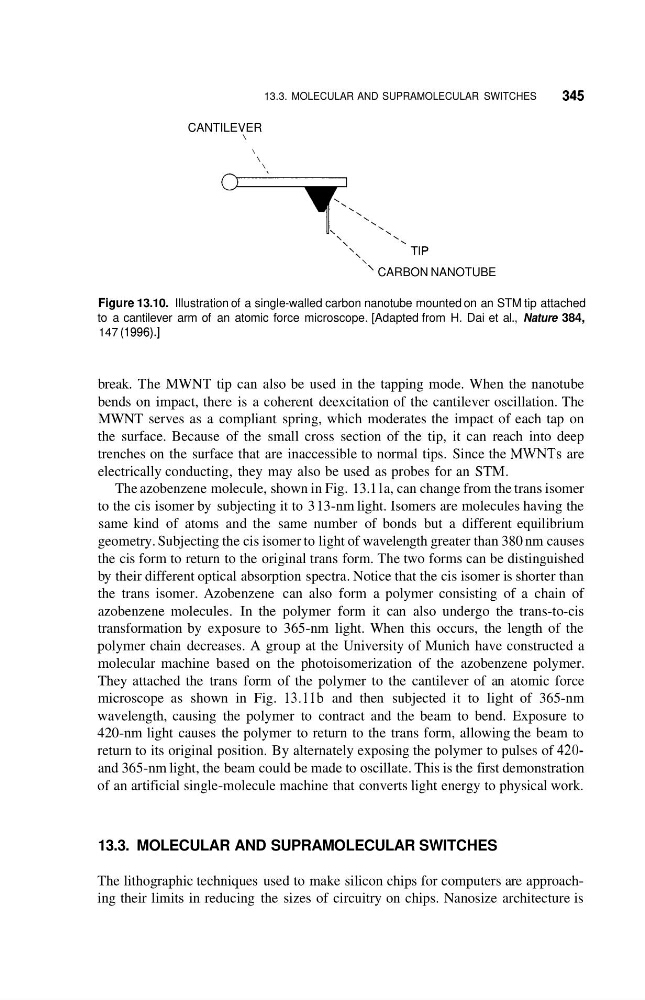
Figure 13.10. Illustration of a single-walled carbon nanotube mounted on an STM tip attached
to a cantilever arm of an atomic force microscope. [Adapted from H. Dai et al., Nature 384,
147 (1996).]
break. The MWNT tip can also be used in the tapping mode. When the nanotube
bends on impact, there is a coherent deexcitation of the cantilever oscillation. The
MWNT serves as a compliant spring, which moderates the impact of each tap on
the surface. Because of the small cross section of the tip, it can reach into deep
trenches on the surface that are inaccessible to normal tips. Since the MWNTs are
electrically conducting, they may also be used as probes for an STM.
The azobenzene molecule, shown in Fig. 13.1 1 a, can change from the trans isomer
to the cis isomer by subjecting it to 3 13-nm light. Isomers are molecules having the
same kind of atoms and the same number of bonds but a different equilibrium
geometry. Subjecting the cis isomer to light of wavelength greater than 380 nm causes
the cis form to return to the original trans form. The two forms can be distinguished
by their different optical absorption spectra. Notice that the cis isomer is shorter than
the trans isomer. Azobenzene can also form a polymer consisting of a chain of
azobenzene molecules. In the polymer form it can also undergo the trans-to-cis
transformation by exposure to 365-nm light. When this occurs, the length of the
polymer chain decreases. A group at the University of Munich have constructed a
molecular machine based on the photoisomerization of the azobenzene polymer.
They attached the trans form of the polymer to the cantilever of an atomic force
microscope as shown in Fig. 13.11b and then subjected it to light of 365-nm
wavelength, causing the polymer to contract and the beam to bend. Exposure to
420-nm light causes the polymer to return to the trans form, allowing the beam to
return to its original position. By alternately exposing the polymer to pulses of 420and 365-nm light, the beam could be made to oscillate. This is the first demonstration
of an artificial single-molecule machine that converts light energy to physical work.
13.3. MOLECULAR AND SUPRAMOLECULAR SWITCHES
The lithographic techniques used to make silicon chips for computers are approaching their limits in reducing the sizes of circuitry on chips. Nanosize architecture is
345
CANTILEVER
\
\
\
\
\
\ CARBON NANOTUBE
Figure 13.10. Illustration of a single-walled carbon nanotube mounted on an STM tip attached
to a cantilever arm of an atomic force microscope. [Adapted from H. Dai et al., Nature 384,
147 (1996).]
break. The MWNT tip can also be used in the tapping mode. When the nanotube
bends on impact, there is a coherent deexcitation of the cantilever oscillation. The
MWNT serves as a compliant spring, which moderates the impact of each tap on
the surface. Because of the small cross section of the tip, it can reach into deep
trenches on the surface that are inaccessible to normal tips. Since the MWNTs are
electrically conducting, they may also be used as probes for an STM.
The azobenzene molecule, shown in Fig. 13.1 1 a, can change from the trans isomer
to the cis isomer by subjecting it to 3 13-nm light. Isomers are molecules having the
same kind of atoms and the same number of bonds but a different equilibrium
geometry. Subjecting the cis isomer to light of wavelength greater than 380 nm causes
the cis form to return to the original trans form. The two forms can be distinguished
by their different optical absorption spectra. Notice that the cis isomer is shorter than
the trans isomer. Azobenzene can also form a polymer consisting of a chain of
azobenzene molecules. In the polymer form it can also undergo the trans-to-cis
transformation by exposure to 365-nm light. When this occurs, the length of the
polymer chain decreases. A group at the University of Munich have constructed a
molecular machine based on the photoisomerization of the azobenzene polymer.
They attached the trans form of the polymer to the cantilever of an atomic force
microscope as shown in Fig. 13.11b and then subjected it to light of 365-nm
wavelength, causing the polymer to contract and the beam to bend. Exposure to
420-nm light causes the polymer to return to the trans form, allowing the beam to
return to its original position. By alternately exposing the polymer to pulses of 420and 365-nm light, the beam could be made to oscillate. This is the first demonstration
of an artificial single-molecule machine that converts light energy to physical work.
13.3. MOLECULAR AND SUPRAMOLECULAR SWITCHES
The lithographic techniques used to make silicon chips for computers are approaching their limits in reducing the sizes of circuitry on chips. Nanosize architecture is