

13.2. NANOELECTROMECHAsrlICAL SYSTEMS (NEMSs)
343
If one applies an external oscillating force Focos(dt) to a darnpcd harmonic
oscillator, a very large increase in amplitude occurs when the rrcqucncy of the
applied force w’ equals the naninl resonant frequency tu of the oscillator. This is
called resononce. The increase in amplitude depends on the magnitude of the
damping term b in Eq. ( 13.2). which Es the cause of dissipation, Figure 13.3b shows
how the magnitude of the damping factor affects the amplitude at rcsonance for a
vibrating mass on a spring. Noticc that the smaller the damping factor, the narrower
the resonance peak, and the greater the increase in amplitude. The qualiiy factor Q
for the resonance given by thc cxprcssion Q =woldto, where d w is thc width of the
resonance at half height and iol), the resonant frequency. The quality factor is the
energy stored divided by the energy dissipated per cycle, so the inverse of the qualiv
factor 1/Q is a measure ofthe dissipation of energy. Nanosized cantilcvcrs have very
high Q values and dissipate little cnergy as, they oscillate. Such devices will be very
sensitive to external damping. which is essential to developing sensing devices.
High-Q devices also have low thcrmomechanical noise, which means significantly
less random mechanical fluctuations, The Q values of high+ electrical devices are
in thc order of several hundreds, but NEMS oscillators can Rave Q vnlucs I000 times
higher. Another advantage OF NEMS devices is that they require very little power to
drive them. A picowatt (IO-” W) of po\wr can drive an NEMS devicc with a low
signal-to-noise ratio (SN R).
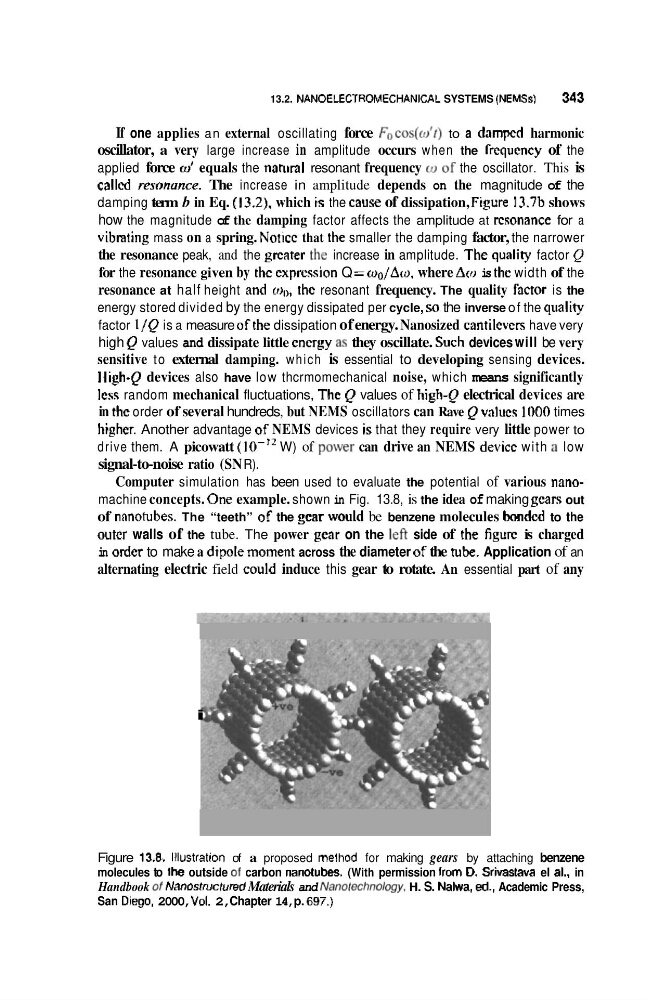
Computer simulation has been used to evaluate the potential of various nanomachine concepts. One example. shown in Fig. 13.8, is the idea of making gcars out
of nnnotubes. The “teeth” of the gcar would be benzene molecules b~ndcd to the
outcr walls of the tube. The power gcar on the left side of the figurc is charged
in order to make a dipole mon-tent across the diameter af the mk. Application of an
alternating electric field could induce this gear to rotate. An essential part of any
i
Figure 13.8. Illustration of a proposed rnelhod for making gears by attaching benzene
molecules to ihe outside of carbon nanotubes. (With permission from D, SrivasEava el al., in
Handbook of Namstructured Materials and Nanor8chmlogy, H. S. Nalwa, ed., Academic Press,
San Diego, 2000, Yol. 2, Chapter 14, p. 697.)
343
If one applies an external oscillating force Focos(dt) to a darnpcd harmonic
oscillator, a very large increase in amplitude occurs when the rrcqucncy of the
applied force w’ equals the naninl resonant frequency tu of the oscillator. This is
called resononce. The increase in amplitude depends on the magnitude of the
damping term b in Eq. ( 13.2). which Es the cause of dissipation, Figure 13.3b shows
how the magnitude of the damping factor affects the amplitude at rcsonance for a
vibrating mass on a spring. Noticc that the smaller the damping factor, the narrower
the resonance peak, and the greater the increase in amplitude. The qualiiy factor Q
for the resonance given by thc cxprcssion Q =woldto, where d w is thc width of the
resonance at half height and iol), the resonant frequency. The quality factor is the
energy stored divided by the energy dissipated per cycle, so the inverse of the qualiv
factor 1/Q is a measure ofthe dissipation of energy. Nanosized cantilcvcrs have very
high Q values and dissipate little cnergy as, they oscillate. Such devices will be very
sensitive to external damping. which is essential to developing sensing devices.
High-Q devices also have low thcrmomechanical noise, which means significantly
less random mechanical fluctuations, The Q values of high+ electrical devices are
in thc order of several hundreds, but NEMS oscillators can Rave Q vnlucs I000 times
higher. Another advantage OF NEMS devices is that they require very little power to
drive them. A picowatt (IO-” W) of po\wr can drive an NEMS devicc with a low
signal-to-noise ratio (SN R).
Computer simulation has been used to evaluate the potential of various nanomachine concepts. One example. shown in Fig. 13.8, is the idea of making gcars out
of nnnotubes. The “teeth” of the gcar would be benzene molecules b~ndcd to the
outcr walls of the tube. The power gcar on the left side of the figurc is charged
in order to make a dipole mon-tent across the diameter af the mk. Application of an
alternating electric field could induce this gear to rotate. An essential part of any
i
Figure 13.8. Illustration of a proposed rnelhod for making gears by attaching benzene
molecules to ihe outside of carbon nanotubes. (With permission from D, SrivasEava el al., in
Handbook of Namstructured Materials and Nanor8chmlogy, H. S. Nalwa, ed., Academic Press,
San Diego, 2000, Yol. 2, Chapter 14, p. 697.)