

306
ORGANIC COMPOUNDS AND POLYMERS
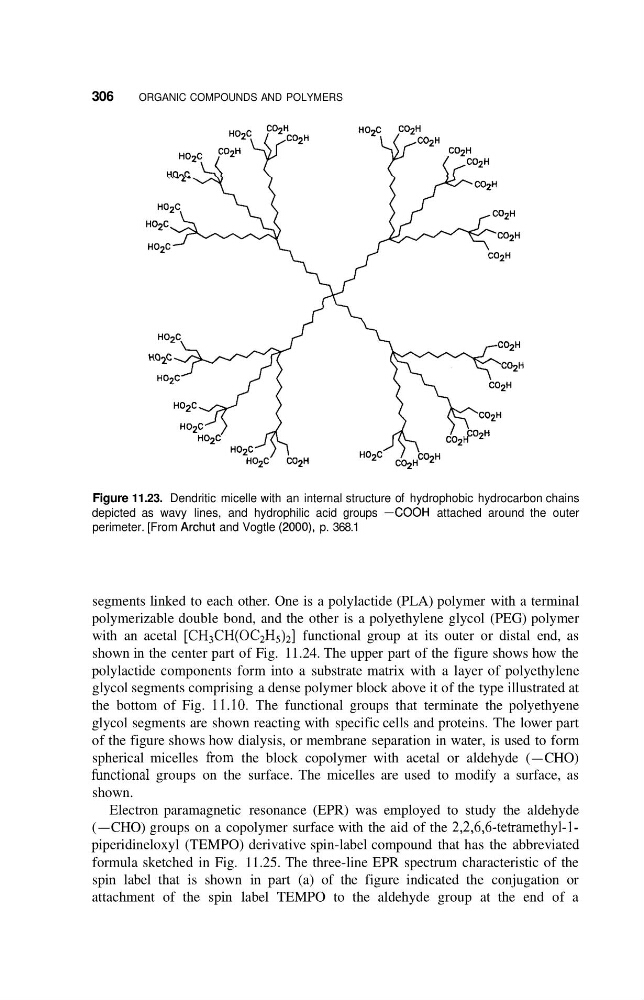
Figure 11.23. Dendritic micelle with an internal structure of hydrophobic hydrocarbon chains
depicted as wavy lines, and hydrophilic acid groups -COOH attached around the outer
perimeter. [From Archut and Vogtle (2000), p. 368.1
segments linked to each other. One is a polylactide (PLA) polymer with a terminal
polymerizable double bond, and the other is a polyethylene glycol (PEG) polymer
with an acetal [CH3CH(OC2H5)2] functional group at its outer or distal end, as
shown in the center part of Fig. 11.24. The upper part of the figure shows how the
polylactide components form into a substrate matrix with a layer of polyethylene
glycol segments comprising a dense polymer block above it of the type illustrated at
the bottom of Fig. 11.10. The functional groups that terminate the polyethyene
glycol segments are shown reacting with specific cells and proteins. The lower part
of the figure shows how dialysis, or membrane separation in water, is used to form
spherical micelles from the block copolymer with acetal or aldehyde (-CHO)
fhctional groups on the surface. The micelles are used to modify a surface, as
shown.
Electron paramagnetic resonance (EPR) was employed to study the aldehyde
(-CHO) groups on a copolymer surface with the aid of the 2,2,6,6-tetramethyl-lpiperidineloxyl (TEMPO) derivative spin-label compound that has the abbreviated
formula sketched in Fig. 11.25. The three-line EPR spectrum characteristic of the
spin label that is shown in part (a) of the figure indicated the conjugation or
attachment of the spin label TEMPO to the aldehyde group at the end of a
ORGANIC COMPOUNDS AND POLYMERS
Figure 11.23. Dendritic micelle with an internal structure of hydrophobic hydrocarbon chains
depicted as wavy lines, and hydrophilic acid groups -COOH attached around the outer
perimeter. [From Archut and Vogtle (2000), p. 368.1
segments linked to each other. One is a polylactide (PLA) polymer with a terminal
polymerizable double bond, and the other is a polyethylene glycol (PEG) polymer
with an acetal [CH3CH(OC2H5)2] functional group at its outer or distal end, as
shown in the center part of Fig. 11.24. The upper part of the figure shows how the
polylactide components form into a substrate matrix with a layer of polyethylene
glycol segments comprising a dense polymer block above it of the type illustrated at
the bottom of Fig. 11.10. The functional groups that terminate the polyethyene
glycol segments are shown reacting with specific cells and proteins. The lower part
of the figure shows how dialysis, or membrane separation in water, is used to form
spherical micelles from the block copolymer with acetal or aldehyde (-CHO)
fhctional groups on the surface. The micelles are used to modify a surface, as
shown.
Electron paramagnetic resonance (EPR) was employed to study the aldehyde
(-CHO) groups on a copolymer surface with the aid of the 2,2,6,6-tetramethyl-lpiperidineloxyl (TEMPO) derivative spin-label compound that has the abbreviated
formula sketched in Fig. 11.25. The three-line EPR spectrum characteristic of the
spin label that is shown in part (a) of the figure indicated the conjugation or
attachment of the spin label TEMPO to the aldehyde group at the end of a