

11.5. SUPRAMOLECULAR STRUCTURES
305
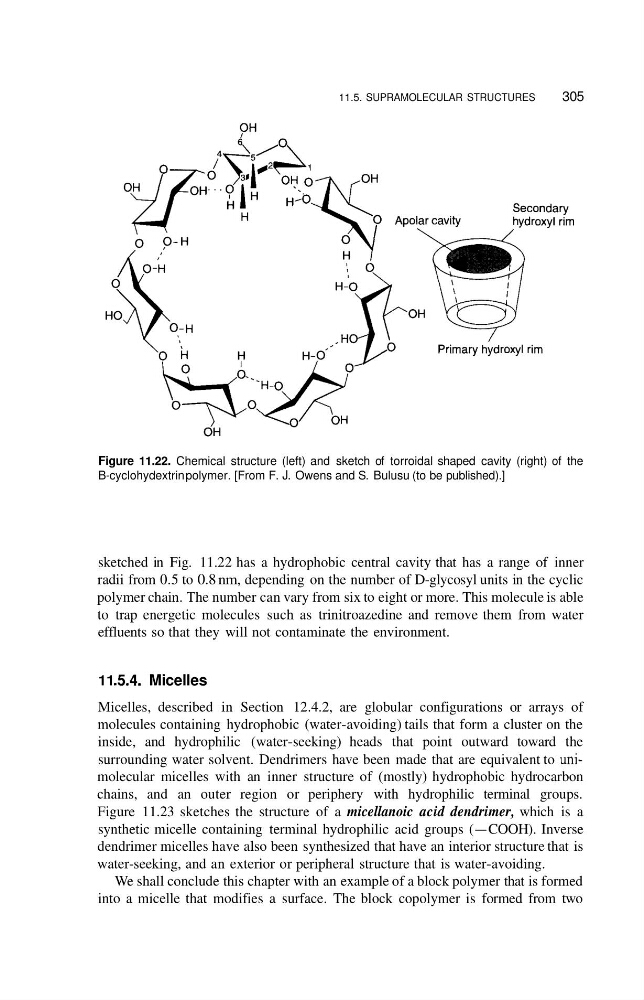
Figure 11.22. Chemical structure (left) and sketch of torroidal shaped cavity (right) of the
B-cyclohydextrin polymer. [From F. J. Owens and S. Bulusu (to be published).]
sketched in Fig. 11.22 has a hydrophobic central cavity that has a range of inner
radii from 0.5 to 0.8 nm, depending on the number of D-glycosyl units in the cyclic
polymer chain. The number can vary from six to eight or more. This molecule is able
to trap energetic molecules such as trinitroazedine and remove them from water
effluents so that they will not contaminate the environment.
11 5 4 . Micelles
Micelles, described in Section 12.4.2, are globular configurations or arrays of
molecules containing hydrophobic (water-avoiding) tails that form a cluster on the
inside, and hydrophilic (water-seeking) heads that point outward toward the
surrounding water solvent. Dendrimers have been made that are equivalent to unimolecular micelles with an inner structure of (mostly) hydrophobic hydrocarbon
chains, and an outer region or periphery with hydrophilic terminal groups.
Figure 11.23 sketches the structure of a micellanoic acid dendrimer, which is a
synthetic micelle containing terminal hydrophilic acid groups (-COOH). Inverse
dendrimer micelles have also been synthesized that have an interior structure that is
water-seeking, and an exterior or peripheral structure that is water-avoiding.
We shall conclude this chapter with an example of a block polymer that is formed
into a micelle that modifies a surface. The block copolymer is formed from two
305
Figure 11.22. Chemical structure (left) and sketch of torroidal shaped cavity (right) of the
B-cyclohydextrin polymer. [From F. J. Owens and S. Bulusu (to be published).]
sketched in Fig. 11.22 has a hydrophobic central cavity that has a range of inner
radii from 0.5 to 0.8 nm, depending on the number of D-glycosyl units in the cyclic
polymer chain. The number can vary from six to eight or more. This molecule is able
to trap energetic molecules such as trinitroazedine and remove them from water
effluents so that they will not contaminate the environment.
11 5 4 . Micelles
Micelles, described in Section 12.4.2, are globular configurations or arrays of
molecules containing hydrophobic (water-avoiding) tails that form a cluster on the
inside, and hydrophilic (water-seeking) heads that point outward toward the
surrounding water solvent. Dendrimers have been made that are equivalent to unimolecular micelles with an inner structure of (mostly) hydrophobic hydrocarbon
chains, and an outer region or periphery with hydrophilic terminal groups.
Figure 11.23 sketches the structure of a micellanoic acid dendrimer, which is a
synthetic micelle containing terminal hydrophilic acid groups (-COOH). Inverse
dendrimer micelles have also been synthesized that have an interior structure that is
water-seeking, and an exterior or peripheral structure that is water-avoiding.
We shall conclude this chapter with an example of a block polymer that is formed
into a micelle that modifies a surface. The block copolymer is formed from two