

304
ORGANIC COMPOUNDS AND POLYMERS
called a hexamer self-assembled via hydrogen bonding, with six of the original
dendrimers forming its wedges. Supramolecular dendritic structures with high
molecular weights have also been prepared by utilizing metal coordination and
hydrogen bonding.
Many dendrimers tenaciously hold back some solvent, and some of them can trap
molecules such as radicals, charged moieties (parts of molecules), and dyes. When
molecules of different sizes are trapped they can be selectively released by gradual
hydrolysis (reaction with water) of the dendrimer outer and middle layers.
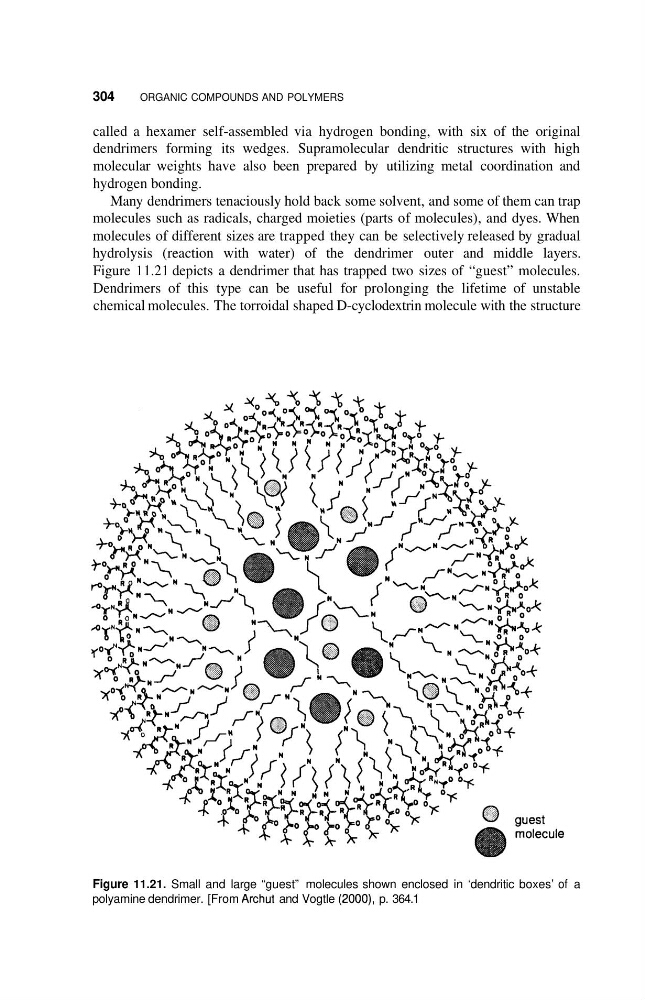
Figure 1 1.2 1 depicts a dendrimer that has trapped two sizes of “guest” molecules.
Dendrimers of this type can be useful for prolonging the lifetime of unstable
chemical molecules. The torroidal shaped D-cyclodextrin molecule with the structure
Figure 11.21. Small and large “guest” molecules shown enclosed in ‘dendritic boxes’ of a
polyamine dendrimer. [From Archut and Vogtle (2000), p. 364.1
ORGANIC COMPOUNDS AND POLYMERS
called a hexamer self-assembled via hydrogen bonding, with six of the original
dendrimers forming its wedges. Supramolecular dendritic structures with high
molecular weights have also been prepared by utilizing metal coordination and
hydrogen bonding.
Many dendrimers tenaciously hold back some solvent, and some of them can trap
molecules such as radicals, charged moieties (parts of molecules), and dyes. When
molecules of different sizes are trapped they can be selectively released by gradual
hydrolysis (reaction with water) of the dendrimer outer and middle layers.
Figure 1 1.2 1 depicts a dendrimer that has trapped two sizes of “guest” molecules.
Dendrimers of this type can be useful for prolonging the lifetime of unstable
chemical molecules. The torroidal shaped D-cyclodextrin molecule with the structure
Figure 11.21. Small and large “guest” molecules shown enclosed in ‘dendritic boxes’ of a
polyamine dendrimer. [From Archut and Vogtle (2000), p. 364.1