

300
ORGANIC COMPOUNDS AND POLYMERS
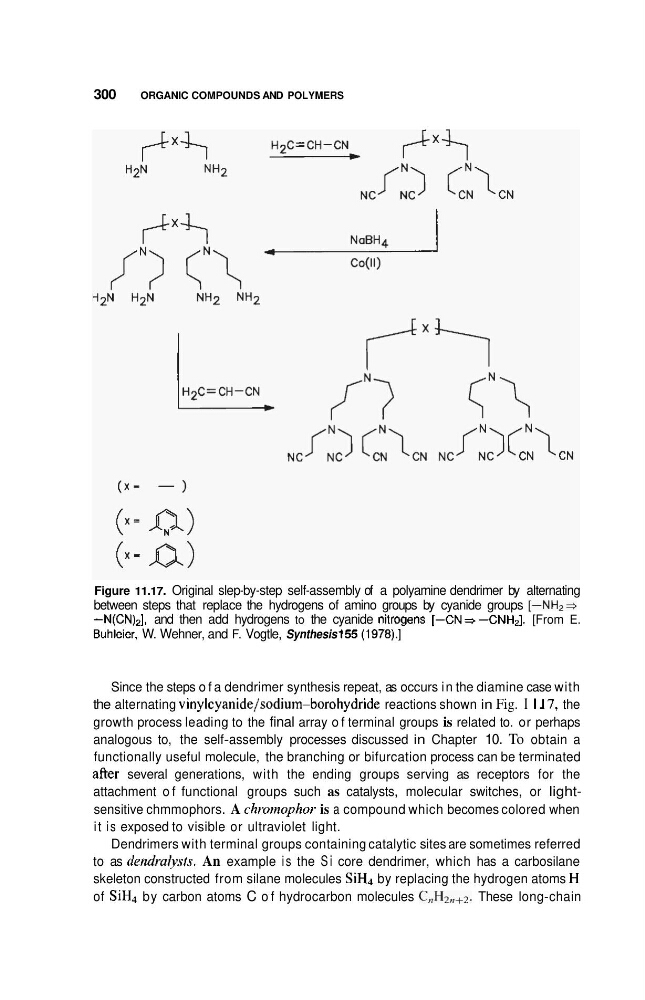
Figure 11.17. Original slep-by-step self-assembly of a polyamine dendrimer by alternating
between steps that replace the hydrogens of amino groups by cyanide groups [-NH,+
-N(CN),], and then add hydrogens to the cyanide nitrogens [-CN+-CNH2].
[From E.
Buhleier, W. Wehner, and F. Vogtle, Synthesis 155 (1978).]
Since the steps o f a dendrimer synthesis repeat, as occurs in the diamine case with
the alternating vinylcyanide/sodium-borohydride reactions shown in Fig. I I. 17, the
growth process leading to the final array o f terminal groups is related to. or perhaps
analogous to, the self-assembly processes discussed in Chapter 10. To obtain a
functionally useful molecule, the branching or bifurcation process can be terminated
after several generations, with the ending groups serving as receptors for the
attachment o f functional groups such as catalysts, molecular switches, or lightsensitive chmmophors. A chromophoi. is a compound which becomes colored when
it is exposed to visible or ultraviolet light.
Dendrimers with terminal groups containing catalytic sites are sometimes referred
to as dendrulysts. An example is the S i core dendrimer, which has a carbosilane
skeleton constructed from silane molecules SiH4 by replacing the hydrogen atoms H
of SiH4 by carbon atoms C o f hydrocarbon molecules C,tHZn+2. These long-chain
ORGANIC COMPOUNDS AND POLYMERS
Figure 11.17. Original slep-by-step self-assembly of a polyamine dendrimer by alternating
between steps that replace the hydrogens of amino groups by cyanide groups [-NH,+
-N(CN),], and then add hydrogens to the cyanide nitrogens [-CN+-CNH2].
[From E.
Buhleier, W. Wehner, and F. Vogtle, Synthesis 155 (1978).]
Since the steps o f a dendrimer synthesis repeat, as occurs in the diamine case with
the alternating vinylcyanide/sodium-borohydride reactions shown in Fig. I I. 17, the
growth process leading to the final array o f terminal groups is related to. or perhaps
analogous to, the self-assembly processes discussed in Chapter 10. To obtain a
functionally useful molecule, the branching or bifurcation process can be terminated
after several generations, with the ending groups serving as receptors for the
attachment o f functional groups such as catalysts, molecular switches, or lightsensitive chmmophors. A chromophoi. is a compound which becomes colored when
it is exposed to visible or ultraviolet light.
Dendrimers with terminal groups containing catalytic sites are sometimes referred
to as dendrulysts. An example is the S i core dendrimer, which has a carbosilane
skeleton constructed from silane molecules SiH4 by replacing the hydrogen atoms H
of SiH4 by carbon atoms C o f hydrocarbon molecules C,tHZn+2. These long-chain