

11.5. SVPRAMOLECUUAR STRUCTURES
2 s
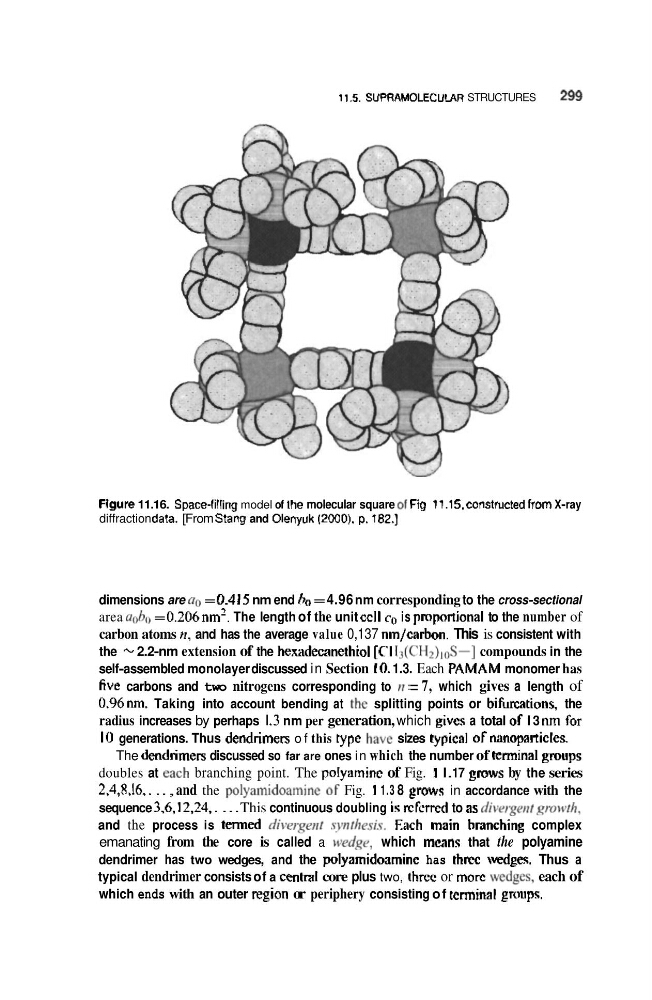
Flgure 11.16. Space-fiHing model of the molecular square of Fig 11.1 5. construcfed from X-ray
diffraction data. [From S t a q and Olenyuk (20013)~ p. 782.1
dimensions are a0 = 0.4 15 nm end ho = 4.96 nm corresponding to the cross-sectional
area rrob,, = 0.206nm'. The length of the unit ccll co is proportional to the number of
carbon atoms II, and has the average value 0,137 ntnlcarbon. This is consistent with
the - 2.2-nm extension of the hexadecmethiol [c'l l,~(~I-l~),,,S-] compounds in the
self-assembled monolayer discussed in Section IO. 1.3. Each PAMAM monomer has
five carbons and two nitrogens corresponding to IF = 7, which gives a length of
0.96nrn. Taking into account bending at the splitting points or bihrcations, the
radius increases by perhaps I .3 nm per generation, which gives a total of I 3 nrn for
I O generations. Thus dendrimers o f this type haw sizes typical OF nanopartictes.
The dendrirners discussed so far are ones in which the number of terminal gmoups
doubles at each branching point. The pIyaminc of Fig. 1 I. 17 grows by the series
2,4,8,16,. . . , and the p0lyamidQamine OF Fig. 1 1.3 8 grow in accordance with the
sequence 3,6,12,24,. . . . This continuous doubling is: rcfcrrcd to as divtv~wf gtwvth,
and the process is t m e d rliw-gmf swdtesi.T. Each main hnnching complex
emanating from the core is called a i t d q p , which rncans that the polyamine
dendrimer has two wedges, and the polyamidoaminc has hrec wedge, Thus a
typical dendrimer consists of a centra[ core plus two, nhrcc or mom wed5es, each of
which ends with an outer region or periphery consisting of tcrminal grmps.
2 s
Flgure 11.16. Space-fiHing model of the molecular square of Fig 11.1 5. construcfed from X-ray
diffraction data. [From S t a q and Olenyuk (20013)~ p. 782.1
dimensions are a0 = 0.4 15 nm end ho = 4.96 nm corresponding to the cross-sectional
area rrob,, = 0.206nm'. The length of the unit ccll co is proportional to the number of
carbon atoms II, and has the average value 0,137 ntnlcarbon. This is consistent with
the - 2.2-nm extension of the hexadecmethiol [c'l l,~(~I-l~),,,S-] compounds in the
self-assembled monolayer discussed in Section IO. 1.3. Each PAMAM monomer has
five carbons and two nitrogens corresponding to IF = 7, which gives a length of
0.96nrn. Taking into account bending at the splitting points or bihrcations, the
radius increases by perhaps I .3 nm per generation, which gives a total of I 3 nrn for
I O generations. Thus dendrimers o f this type haw sizes typical OF nanopartictes.
The dendrirners discussed so far are ones in which the number of terminal gmoups
doubles at each branching point. The pIyaminc of Fig. 1 I. 17 grows by the series
2,4,8,16,. . . , and the p0lyamidQamine OF Fig. 1 1.3 8 grow in accordance with the
sequence 3,6,12,24,. . . . This continuous doubling is: rcfcrrcd to as divtv~wf gtwvth,
and the process is t m e d rliw-gmf swdtesi.T. Each main hnnching complex
emanating from the core is called a i t d q p , which rncans that the polyamine
dendrimer has two wedges, and the polyamidoaminc has hrec wedge, Thus a
typical dendrimer consists of a centra[ core plus two, nhrcc or mom wed5es, each of
which ends with an outer region or periphery consisting of tcrminal grmps.