

286
ORGANIC COMPOUNDS AND POLYMERS
1 000
300
100
30
10
3
1
.3
.1
L " " ' 1
1
3
10
30
100
300
1000
D/L
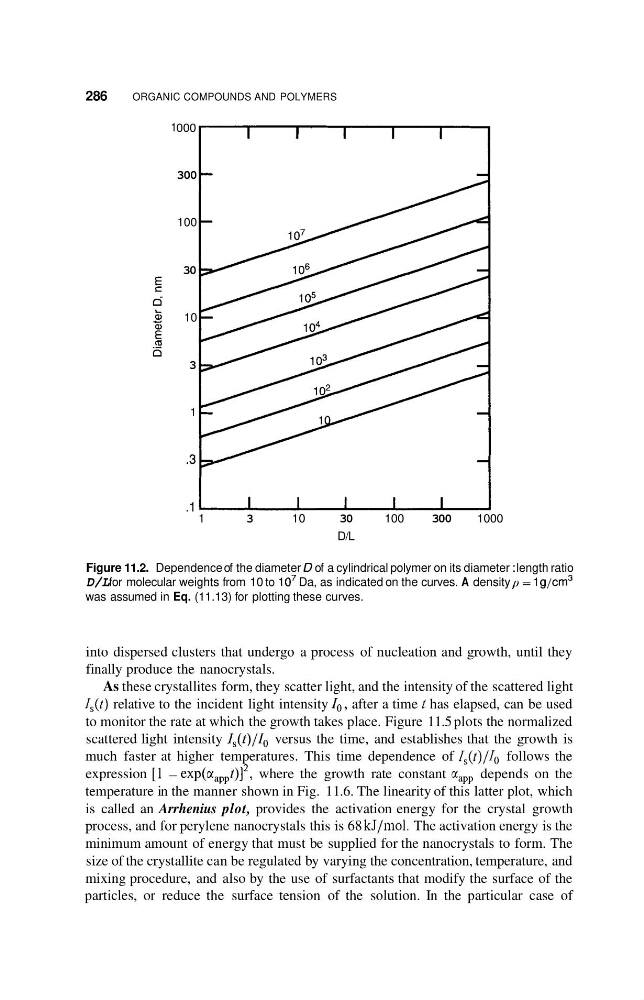
Figure 11.2. Dependence of the diameter D of a cylindrical polymer on its diameter : length ratio
D/L for molecular weights from 10 to 10' Da, as indicated on the curves. A density p = 1 g/cm3
was assumed in Eq. (11.13) for plotting these curves.
into dispersed clusters that undergo a process of nucleation and growth, until they
finally produce the nanocrystals.
As these crystallites form, they scatter light, and the intensity of the scattered light
Z,(t) relative to the incident light intensity I,, after a time t has elapsed, can be used
to monitor the rate at which the growth takes place. Figure 1 1.5 plots the normalized
scattered light intensity Is(t)/Io versus the time, and establishes that the growth is
much faster at higher temperatures. This time dependence of Zs(t)/Io follows the
expression [l - exp(a,,,t)]*, where the growth rate constant clap, depends on the
temperature in the manner shown in Fig. 1 1.6. The linearity of this latter plot, which
is called an Arrhenius plot, provides the activation energy for the crystal growth
process, and for perylene nanocrystals this is 68 kJ/mol. The activation energy is the
minimum amount of energy that must be supplied for the nanocrystals to form. The
size of the crystallite can be regulated by varying the concentration, temperature, and
mixing procedure, and also by the use of surfactants that modify the surface of the
particles, or reduce the surface tension of the solution. In the particular case of
ORGANIC COMPOUNDS AND POLYMERS
1 000
300
100
30
10
3
1
.3
.1
L " " ' 1
1
3
10
30
100
300
1000
D/L
Figure 11.2. Dependence of the diameter D of a cylindrical polymer on its diameter : length ratio
D/L for molecular weights from 10 to 10' Da, as indicated on the curves. A density p = 1 g/cm3
was assumed in Eq. (11.13) for plotting these curves.
into dispersed clusters that undergo a process of nucleation and growth, until they
finally produce the nanocrystals.
As these crystallites form, they scatter light, and the intensity of the scattered light
Z,(t) relative to the incident light intensity I,, after a time t has elapsed, can be used
to monitor the rate at which the growth takes place. Figure 1 1.5 plots the normalized
scattered light intensity Is(t)/Io versus the time, and establishes that the growth is
much faster at higher temperatures. This time dependence of Zs(t)/Io follows the
expression [l - exp(a,,,t)]*, where the growth rate constant clap, depends on the
temperature in the manner shown in Fig. 1 1.6. The linearity of this latter plot, which
is called an Arrhenius plot, provides the activation energy for the crystal growth
process, and for perylene nanocrystals this is 68 kJ/mol. The activation energy is the
minimum amount of energy that must be supplied for the nanocrystals to form. The
size of the crystallite can be regulated by varying the concentration, temperature, and
mixing procedure, and also by the use of surfactants that modify the surface of the
particles, or reduce the surface tension of the solution. In the particular case of