

1 1.3. NANOCRYSTALS
285
This expression is exact for the shape of a cube, but it can be used to estimate
average diameters of polymers of various shapes. If the molecule is a sphere of
diameter Do, then we h o w from solid geometry that its volume is given by
V = nDi/6, and inserting this in Eq. (11.10) provides the expression
dspH = Do = 0.1469(Mw/p)1/3 nm for a spherical molecule. For a molecule
shaped like a cylinder of diameter D and length (or height) L with the same
volume as a sphere of diameter Do, we have the expression nDi/6 = nD2L/4, which
gives
113
113
113
1 /3
213
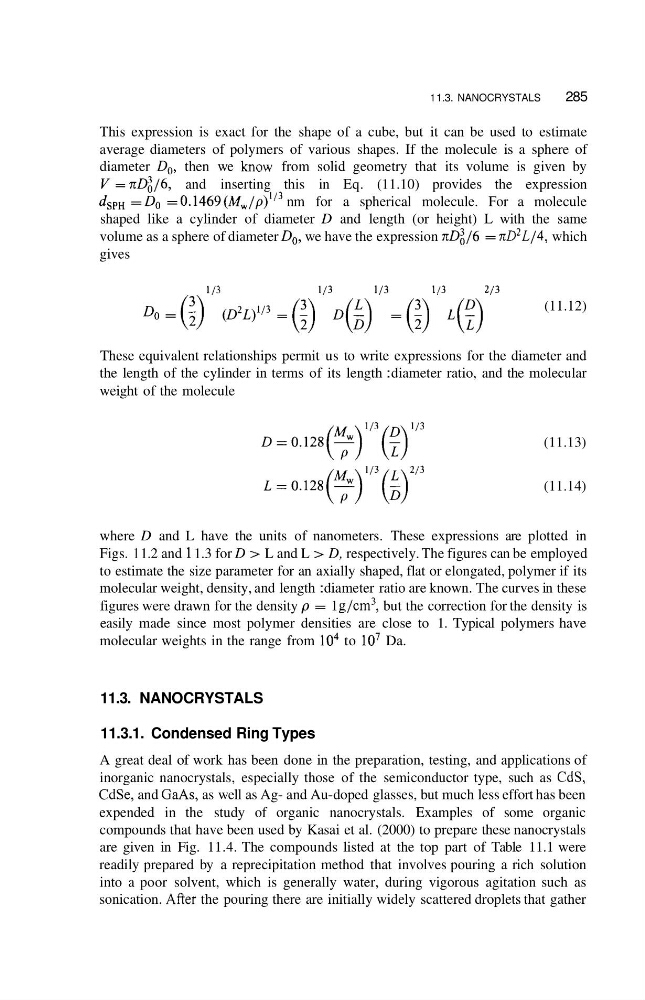
Do = (i) (D2L)'I3 = ( : ) D ( i ) = (i) L e )
(11.12)
These equivalent relationships permit us to write expressions for the diameter and
the length of the cylinder in terms of its length : diameter ratio, and the molecular
weight of the molecule
(11.13)
(11.14)
where D and L have the units of nanometers. These expressions are plotted in
Figs. 1 1.2 and 1 1.3 for D > L and L > D, respectively. The figures can be employed
to estimate the size parameter for an axially shaped, flat or elongated, polymer if its
molecular weight, density, and length : diameter ratio are known. The curves in these
figures were drawn for the density p = 1 g/cm3, but the correction for the density is
easily made since most polymer densities are close to 1. Typical polymers have
molecular weights in the range from lo4 to lo7 Da.
11.3. NANOCRYSTALS
11.3.1. Condensed Ring Types
A great deal of work has been done in the preparation, testing, and applications of
inorganic nanocrystals, especially those of the semiconductor type, such as CdS,
CdSe, and GaAs, as well as Ag- and Au-doped glasses, but much less effort has been
expended in the study of organic nanocrystals. Examples of some organic
compounds that have been used by Kasai et al. (2000) to prepare these nanocrystals
are given in Fig. 11.4. The compounds listed at the top part of Table 11.1 were
readily prepared by a reprecipitation method that involves pouring a rich solution
into a poor solvent, which is generally water, during vigorous agitation such as
sonication. After the pouring there are initially widely scattered droplets that gather
285
This expression is exact for the shape of a cube, but it can be used to estimate
average diameters of polymers of various shapes. If the molecule is a sphere of
diameter Do, then we h o w from solid geometry that its volume is given by
V = nDi/6, and inserting this in Eq. (11.10) provides the expression
dspH = Do = 0.1469(Mw/p)1/3 nm for a spherical molecule. For a molecule
shaped like a cylinder of diameter D and length (or height) L with the same
volume as a sphere of diameter Do, we have the expression nDi/6 = nD2L/4, which
gives
113
113
113
1 /3
213
Do = (i) (D2L)'I3 = ( : ) D ( i ) = (i) L e )
(11.12)
These equivalent relationships permit us to write expressions for the diameter and
the length of the cylinder in terms of its length : diameter ratio, and the molecular
weight of the molecule
(11.13)
(11.14)
where D and L have the units of nanometers. These expressions are plotted in
Figs. 1 1.2 and 1 1.3 for D > L and L > D, respectively. The figures can be employed
to estimate the size parameter for an axially shaped, flat or elongated, polymer if its
molecular weight, density, and length : diameter ratio are known. The curves in these
figures were drawn for the density p = 1 g/cm3, but the correction for the density is
easily made since most polymer densities are close to 1. Typical polymers have
molecular weights in the range from lo4 to lo7 Da.
11.3. NANOCRYSTALS
11.3.1. Condensed Ring Types
A great deal of work has been done in the preparation, testing, and applications of
inorganic nanocrystals, especially those of the semiconductor type, such as CdS,
CdSe, and GaAs, as well as Ag- and Au-doped glasses, but much less effort has been
expended in the study of organic nanocrystals. Examples of some organic
compounds that have been used by Kasai et al. (2000) to prepare these nanocrystals
are given in Fig. 11.4. The compounds listed at the top part of Table 11.1 were
readily prepared by a reprecipitation method that involves pouring a rich solution
into a poor solvent, which is generally water, during vigorous agitation such as
sonication. After the pouring there are initially widely scattered droplets that gather