

11.3. NANOCRYSTALS
287
1
-1
0)
C
a,
5
-1
000
300
100
30
10
3
1
.3
.1
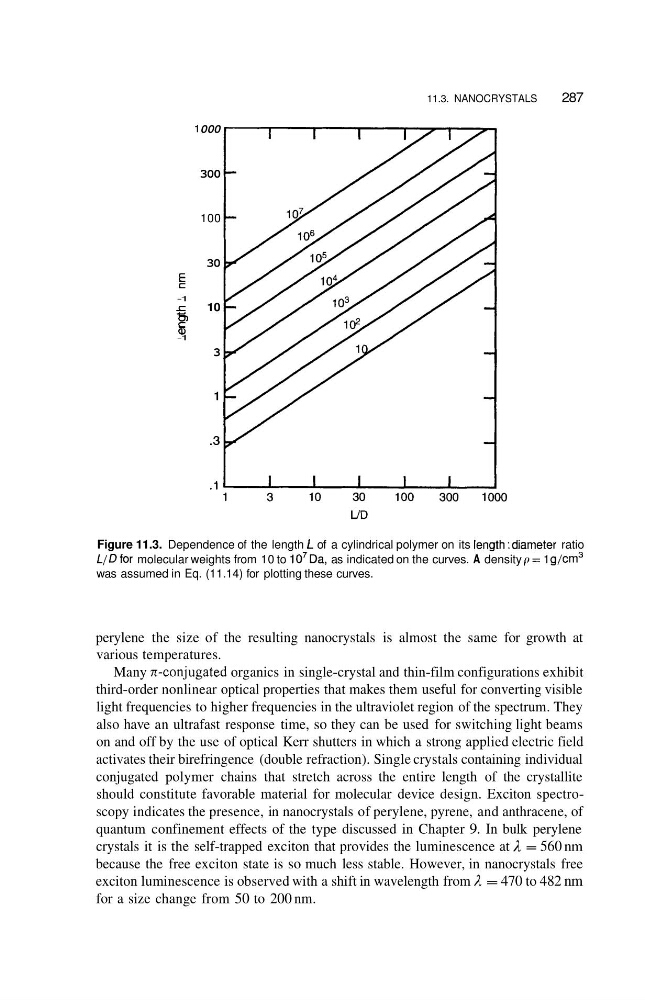
Figure 11.3. Dependence of the length L of a cylindrical polymer on its 1ength:diameter ratio
L/Dfor molecular weights from 10 to lO’Da, as indicated on the curves. A density p = 1 g/cm3
was assumed in Eq. (11.14) for plotting these curves.
perylene the size of the resulting nanocrystals is almost the same for growth at
various temperatures.
Many .n-conjugated organics in single-crystal and thin-film configurations exhibit
third-order nonlinear optical properties that makes them useful for converting visible
light frequencies to higher frequencies in the ultraviolet region of the spectrum. They
also have an ultrafast response time, so they can be used for switching light beams
on and off by the use of optical Kerr shutters in which a strong applied electric field
activates their birefringence (double refraction). Single crystals containing individual
conjugated polymer chains that stretch across the entire length of the crystallite
should constitute favorable material for molecular device design. Exciton spectroscopy indicates the presence, in nanocrystals of perylene, pyrene, and anthracene, of
quantum confinement effects of the type discussed in Chapter 9. In bulk perylene
crystals it is the self-trapped exciton that provides the luminescence at 1 = 560 nm
because the free exciton state is so much less stable. However, in nanocrystals free
exciton luminescence is observed with a shift in wavelength from 2 = 470 to 482 nm
for a size change from 50 to 200 nm.
287
1
-1
0)
C
a,
5
-1
000
300
100
30
10
3
1
.3
.1
Figure 11.3. Dependence of the length L of a cylindrical polymer on its 1ength:diameter ratio
L/Dfor molecular weights from 10 to lO’Da, as indicated on the curves. A density p = 1 g/cm3
was assumed in Eq. (11.14) for plotting these curves.
perylene the size of the resulting nanocrystals is almost the same for growth at
various temperatures.
Many .n-conjugated organics in single-crystal and thin-film configurations exhibit
third-order nonlinear optical properties that makes them useful for converting visible
light frequencies to higher frequencies in the ultraviolet region of the spectrum. They
also have an ultrafast response time, so they can be used for switching light beams
on and off by the use of optical Kerr shutters in which a strong applied electric field
activates their birefringence (double refraction). Single crystals containing individual
conjugated polymer chains that stretch across the entire length of the crystallite
should constitute favorable material for molecular device design. Exciton spectroscopy indicates the presence, in nanocrystals of perylene, pyrene, and anthracene, of
quantum confinement effects of the type discussed in Chapter 9. In bulk perylene
crystals it is the self-trapped exciton that provides the luminescence at 1 = 560 nm
because the free exciton state is so much less stable. However, in nanocrystals free
exciton luminescence is observed with a shift in wavelength from 2 = 470 to 482 nm
for a size change from 50 to 200 nm.