

10.2. CATALYSIS
275
with a top and bottom surface area of 660m2/g. It has been found possible to
intercalate or place between the layers bulky ions that form pillars that hold the
layers apart, as shown in Fig. 10.15c, and thereby provide a system of spaces or
pores where various small molecules can reside. The dimensions of the pores
produced by this layering process are in the low-nanometer range. These materials
are called pillared inorganic layered compounds (PILCs).
The pillaring is often carried out with the aid of the positively charged AlI3
Keggin ion, which has the formula [AI,,04(OH)24(H20),2]7+, or alternately
(AI04[Al(OH)2H20],2]7+. The aluminum atom groups depicted by circles (Le.,
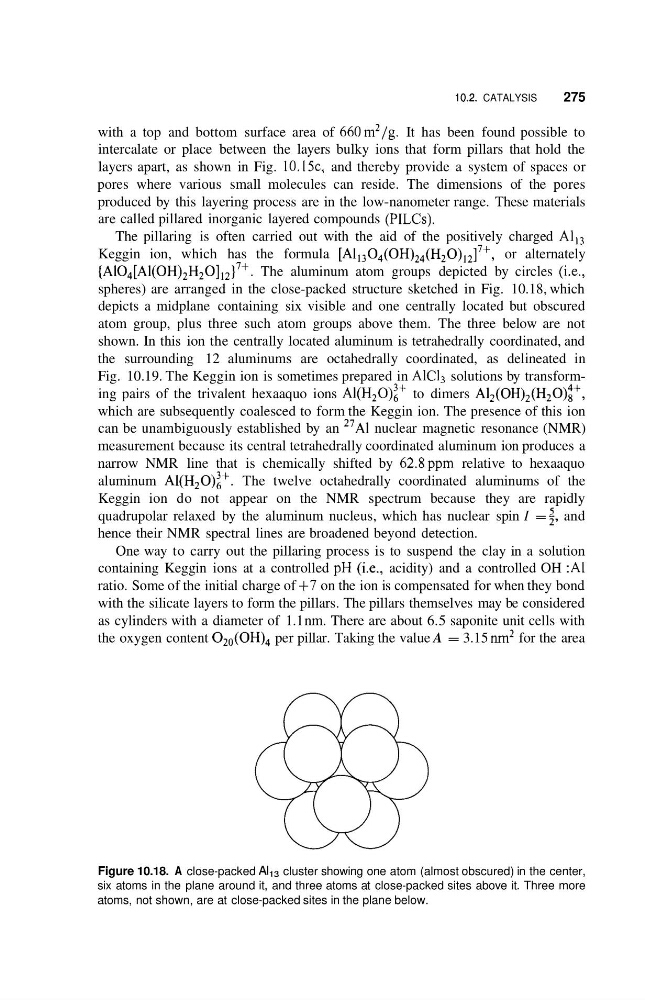
spheres) are arranged in the close-packed structure sketched in Fig. 10.18, which
depicts a midplane containing six visible and one centrally located but obscured
atom group, plus three such atom groups above them. The three below are not
shown. In this ion the centrally located aluminum is tetrahedrally coordinated, and
the surrounding 12 aluminums are octahedrally coordinated, as delineated in
Fig. 10.19. The Keggin ion is sometimes prepared in AlC13 solutions by transforming pairs of the trivalent hexaaquo ions A1(H20)p to dimers A12(OH)2(H20)i+,
which are subsequently coalesced to form the Keggin ion. The presence of this ion
can be unambiguously established by an 27Al nuclear magnetic resonance (NMR)
measurement because its central tetrahedrally coordinated aluminum ion produces a
narrow NMR line that is chemically shifted by 62.8ppm relative to hexaaquo
aluminum A1(H20)2+. The twelve octahedrally coordinated aluminums of the
Keggin ion do not appear on the NMR spectrum because they are rapidly
quadrupolar relaxed by the aluminum nucleus, which has nuclear spin I = i, and
hence their NMR spectral lines are broadened beyond detection.
One way to carry out the pillaring process is to suspend the clay in a solution
containing Keggin ions at a controlled pH @e., acidity) and a controlled OH : A1
ratio. Some of the initial charge of +7 on the ion is compensated for when they bond
with the silicate layers to form the pillars. The pillars themselves may be considered
as cylinders with a diameter of 1.1 nm. There are about 6.5 saponite unit cells with
the oxygen content 02,(OH), per pillar. Taking the value A = 3.15 nm2 for the area
Figure 10.18. A close-packed AIl3 cluster showing one atom (almost obscured) in the center,
six atoms in the plane around it, and three atoms at close-packed sites above it. Three more
atoms, not shown, are at close-packed sites in the plane below.
275
with a top and bottom surface area of 660m2/g. It has been found possible to
intercalate or place between the layers bulky ions that form pillars that hold the
layers apart, as shown in Fig. 10.15c, and thereby provide a system of spaces or
pores where various small molecules can reside. The dimensions of the pores
produced by this layering process are in the low-nanometer range. These materials
are called pillared inorganic layered compounds (PILCs).
The pillaring is often carried out with the aid of the positively charged AlI3
Keggin ion, which has the formula [AI,,04(OH)24(H20),2]7+, or alternately
(AI04[Al(OH)2H20],2]7+. The aluminum atom groups depicted by circles (Le.,
spheres) are arranged in the close-packed structure sketched in Fig. 10.18, which
depicts a midplane containing six visible and one centrally located but obscured
atom group, plus three such atom groups above them. The three below are not
shown. In this ion the centrally located aluminum is tetrahedrally coordinated, and
the surrounding 12 aluminums are octahedrally coordinated, as delineated in
Fig. 10.19. The Keggin ion is sometimes prepared in AlC13 solutions by transforming pairs of the trivalent hexaaquo ions A1(H20)p to dimers A12(OH)2(H20)i+,
which are subsequently coalesced to form the Keggin ion. The presence of this ion
can be unambiguously established by an 27Al nuclear magnetic resonance (NMR)
measurement because its central tetrahedrally coordinated aluminum ion produces a
narrow NMR line that is chemically shifted by 62.8ppm relative to hexaaquo
aluminum A1(H20)2+. The twelve octahedrally coordinated aluminums of the
Keggin ion do not appear on the NMR spectrum because they are rapidly
quadrupolar relaxed by the aluminum nucleus, which has nuclear spin I = i, and
hence their NMR spectral lines are broadened beyond detection.
One way to carry out the pillaring process is to suspend the clay in a solution
containing Keggin ions at a controlled pH @e., acidity) and a controlled OH : A1
ratio. Some of the initial charge of +7 on the ion is compensated for when they bond
with the silicate layers to form the pillars. The pillars themselves may be considered
as cylinders with a diameter of 1.1 nm. There are about 6.5 saponite unit cells with
the oxygen content 02,(OH), per pillar. Taking the value A = 3.15 nm2 for the area
Figure 10.18. A close-packed AIl3 cluster showing one atom (almost obscured) in the center,
six atoms in the plane around it, and three atoms at close-packed sites above it. Three more
atoms, not shown, are at close-packed sites in the plane below.