

274
SELF-ASSEMBLY AND CATALYSIS
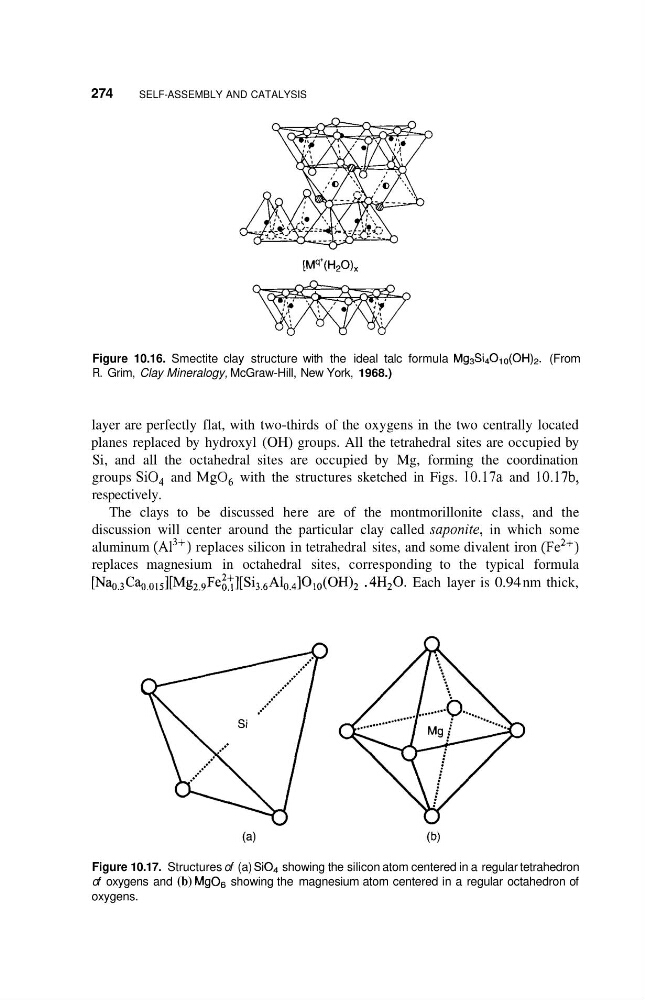
Figure 10.16. Smectite clay structure with the ideal talc formula Mg3Si4010(OH)n. (From
R. Grim, Clay Mineralogy, McGraw-Hill, New York, 1968.)
layer are perfectly flat, with two-thirds of the oxygens in the two centrally located
planes replaced by hydroxyl (OH) groups. All the tetrahedral sites are occupied by
Si, and all the octahedral sites are occupied by Mg, forming the coordination
groups SiO, and MgO, with the structures sketched in Figs. 10.17a and 10.17b,
respectively.
The clays to be discussed here are of the montmorillonite class, and the
discussion will center around the particular clay called saponite, in which some
aluminum (Ai3+) replaces silicon in tetrahedral sites, and some divalent iron (Fe2+)
replaces magnesium in octahedral sites, corresponding to the typical formula
[Na,,3Ca,,,,,][Mg2,,Fe~~][Si3,6Al~,~]olo(OH)2 . 4H20. Each layer is 0.94 nm thick,
Figure 10.17. Structures of (a) Si OI showing the silicon atom centered in a regular tetrahedron
of oxygens and (b) Mg06 showing the magnesium atom centered in a regular octahedron of
oxygens.
SELF-ASSEMBLY AND CATALYSIS
Figure 10.16. Smectite clay structure with the ideal talc formula Mg3Si4010(OH)n. (From
R. Grim, Clay Mineralogy, McGraw-Hill, New York, 1968.)
layer are perfectly flat, with two-thirds of the oxygens in the two centrally located
planes replaced by hydroxyl (OH) groups. All the tetrahedral sites are occupied by
Si, and all the octahedral sites are occupied by Mg, forming the coordination
groups SiO, and MgO, with the structures sketched in Figs. 10.17a and 10.17b,
respectively.
The clays to be discussed here are of the montmorillonite class, and the
discussion will center around the particular clay called saponite, in which some
aluminum (Ai3+) replaces silicon in tetrahedral sites, and some divalent iron (Fe2+)
replaces magnesium in octahedral sites, corresponding to the typical formula
[Na,,3Ca,,,,,][Mg2,,Fe~~][Si3,6Al~,~]olo(OH)2 . 4H20. Each layer is 0.94 nm thick,
Figure 10.17. Structures of (a) Si OI showing the silicon atom centered in a regular tetrahedron
of oxygens and (b) Mg06 showing the magnesium atom centered in a regular octahedron of
oxygens.