

10.2. CATALYSIS
273
2,290t ' ' ' ' '
'
'
. '
2,330
7
I
m
c
r
0
.- - 2 2,300 -
z
0
u)
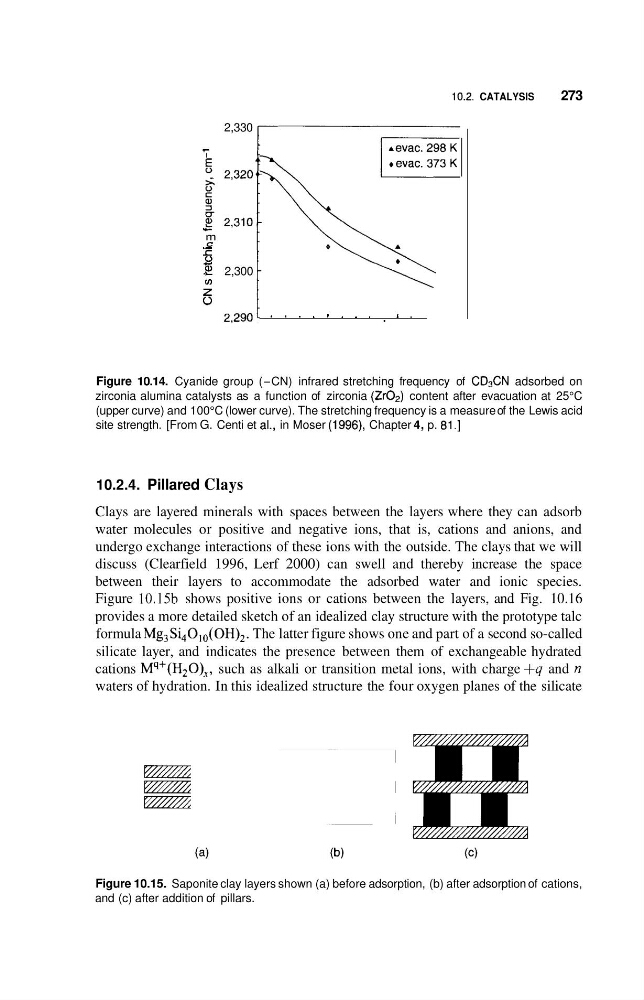
Figure 10.14. Cyanide group (-CN) infrared stretching frequency of CD3CN adsorbed on
zirconia alumina catalysts as a function of zirconia (Zr02) content after evacuation at 25°C
(upper curve) and 100°C (lower curve). The stretching frequency is a measure of the Lewis acid
site strength. [From G. Centi et al., in Moser (1996), Chapter 4, p. 81.1
10.2.4. Pillared Clays
Clays are layered minerals with spaces between the layers where they can adsorb
water molecules or positive and negative ions, that is, cations and anions, and
undergo exchange interactions of these ions with the outside. The clays that we will
discuss (Clearfield 1996, Lerf 2000) can swell and thereby increase the space
between their layers to accommodate the adsorbed water and ionic species.
Figure 10.15b shows positive ions or cations between the layers, and Fig. 10.16
provides a more detailed sketch of an idealized clay structure with the prototype talc
formula Mg,Si,O,,-JOH),.
The latter figure shows one and part of a second so-called
silicate layer, and indicates the presence between them of exchangeable hydrated
cations Mq+(H20)~,, such as alkali or transition metal ions, with charge +q and n
waters of hydration. In this idealized structure the four oxygen planes of the silicate
Figure 10.15. Saponite clay layers shown (a) before adsorption, (b) after adsorption of cations,
and (c) after addition of pillars.
273
2,290t ' ' ' ' '
'
'
. '
2,330
7
I
m
c
r
0
.- - 2 2,300 -
z
0
u)
Figure 10.14. Cyanide group (-CN) infrared stretching frequency of CD3CN adsorbed on
zirconia alumina catalysts as a function of zirconia (Zr02) content after evacuation at 25°C
(upper curve) and 100°C (lower curve). The stretching frequency is a measure of the Lewis acid
site strength. [From G. Centi et al., in Moser (1996), Chapter 4, p. 81.1
10.2.4. Pillared Clays
Clays are layered minerals with spaces between the layers where they can adsorb
water molecules or positive and negative ions, that is, cations and anions, and
undergo exchange interactions of these ions with the outside. The clays that we will
discuss (Clearfield 1996, Lerf 2000) can swell and thereby increase the space
between their layers to accommodate the adsorbed water and ionic species.
Figure 10.15b shows positive ions or cations between the layers, and Fig. 10.16
provides a more detailed sketch of an idealized clay structure with the prototype talc
formula Mg,Si,O,,-JOH),.
The latter figure shows one and part of a second so-called
silicate layer, and indicates the presence between them of exchangeable hydrated
cations Mq+(H20)~,, such as alkali or transition metal ions, with charge +q and n
waters of hydration. In this idealized structure the four oxygen planes of the silicate
Figure 10.15. Saponite clay layers shown (a) before adsorption, (b) after adsorption of cations,
and (c) after addition of pillars.