

276
SELF-ASSEMBLY AND CATALYSIS
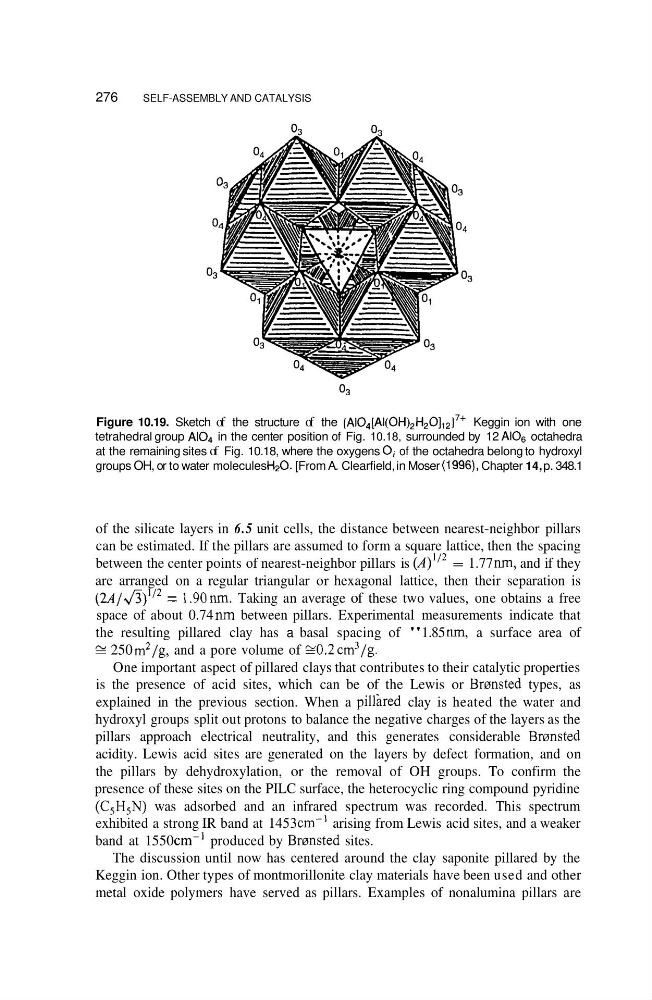
Figure 10.19. Sketch of the structure of the (A10,[Al(OH)2H20],,)7+ Keggin ion with one
tetrahedral group A104 in the center position of Fig. 10.18, surrounded by 12 A106 octahedra
at the remaining sites of Fig. 10.18, where the oxygens 0; of the octahedra belong to hydroxyl
groups OH, or to water molecules H20. [From A. Clearfield, in Moser (1996), Chapter 14, p. 348.1
of the silicate layers in 6.5 unit cells, the distance between nearest-neighbor pillars
can be estimated. If the pillars are assumed to form a square lattice, then the spacing
between the center points of nearest-neighbor pillars is (A)'/' = 1.77 nm, and if they
are arranged on a regular triangular or hexagonal lattice, then their separation is
(2A/1/5)'l2 = 1.9Onm. Taking an average of these two values, one obtains a free
space of about 0.74 nm between pillars. Experimental measurements indicate that
the resulting pillared clay has a basal spacing of "1.85 tun, a surface area of
E 250 m2/g, and a pore volume of -0.2 cm3/g.
One important aspect of pillared clays that contributes to their catalytic properties
is the presence of acid sites, which can be of the Lewis or Brransted types, as
explained in the previous section. When a pill'ared clay is heated the water and
hydroxyl groups split out protons to balance the negative charges of the layers as the
pillars approach electrical neutrality, and this generates considerable Brransted
acidity. Lewis acid sites are generated on the layers by defect formation, and on
the pillars by dehydroxylation, or the removal of OH groups. To confirm the
presence of these sites on the PILC surface, the heterocyclic ring compound pyridine
(C,H,N) was adsorbed and an infrared spectrum was recorded. This spectrum
exhibited a strong IR band at 1453 cm-l arising from Lewis acid sites, and a weaker
band at 1550 cm-I produced by Brransted sites.
The discussion until now has centered around the clay saponite pillared by the
Keggin ion. Other types of montmorillonite clay materials have been used and other
metal oxide polymers have served as pillars. Examples of nonalumina pillars are
SELF-ASSEMBLY AND CATALYSIS
Figure 10.19. Sketch of the structure of the (A10,[Al(OH)2H20],,)7+ Keggin ion with one
tetrahedral group A104 in the center position of Fig. 10.18, surrounded by 12 A106 octahedra
at the remaining sites of Fig. 10.18, where the oxygens 0; of the octahedra belong to hydroxyl
groups OH, or to water molecules H20. [From A. Clearfield, in Moser (1996), Chapter 14, p. 348.1
of the silicate layers in 6.5 unit cells, the distance between nearest-neighbor pillars
can be estimated. If the pillars are assumed to form a square lattice, then the spacing
between the center points of nearest-neighbor pillars is (A)'/' = 1.77 nm, and if they
are arranged on a regular triangular or hexagonal lattice, then their separation is
(2A/1/5)'l2 = 1.9Onm. Taking an average of these two values, one obtains a free
space of about 0.74 nm between pillars. Experimental measurements indicate that
the resulting pillared clay has a basal spacing of "1.85 tun, a surface area of
E 250 m2/g, and a pore volume of -0.2 cm3/g.
One important aspect of pillared clays that contributes to their catalytic properties
is the presence of acid sites, which can be of the Lewis or Brransted types, as
explained in the previous section. When a pill'ared clay is heated the water and
hydroxyl groups split out protons to balance the negative charges of the layers as the
pillars approach electrical neutrality, and this generates considerable Brransted
acidity. Lewis acid sites are generated on the layers by defect formation, and on
the pillars by dehydroxylation, or the removal of OH groups. To confirm the
presence of these sites on the PILC surface, the heterocyclic ring compound pyridine
(C,H,N) was adsorbed and an infrared spectrum was recorded. This spectrum
exhibited a strong IR band at 1453 cm-l arising from Lewis acid sites, and a weaker
band at 1550 cm-I produced by Brransted sites.
The discussion until now has centered around the clay saponite pillared by the
Keggin ion. Other types of montmorillonite clay materials have been used and other
metal oxide polymers have served as pillars. Examples of nonalumina pillars are