

10.2. CATALYSIS
269
are also other materials such as silicas and aluminas which can be prepared so that
they have a porous structure of a more or less random type; that is, they serve as
sponges on a mesoscopic or micrometer scale. It is quite common for these materials
to have pores with diameters in the nanometer range. Pore surface areas are
sometimes determined by the Brunauer-Emmett-Teller (BET) adsorption isotherm
method in which measurements are made of the uptake of a gas such as nitrogen
(N2) by the pores.
Most commercial heterogeneous catalysts have a very porous structure, with
surface areas of several hundred square meters per gram. Ordinarily an heterogeneous catalyst consists of a high-surface-area material that serves as a catalyst
support or substrate, and the surface linings of its pores contain a dispersed active
component, such as acid sites or platinum atoms, which bring about or accelerate the
catalytic reaction. Examples of substrates are the oxides silica (Si02), gammaalumina (y-A1203), titania (Ti02 in its tetragonal anatase form), and zirconia (ZrOz).
Mixed oxides are also in common use, such as high-surface-area silica-alumina.
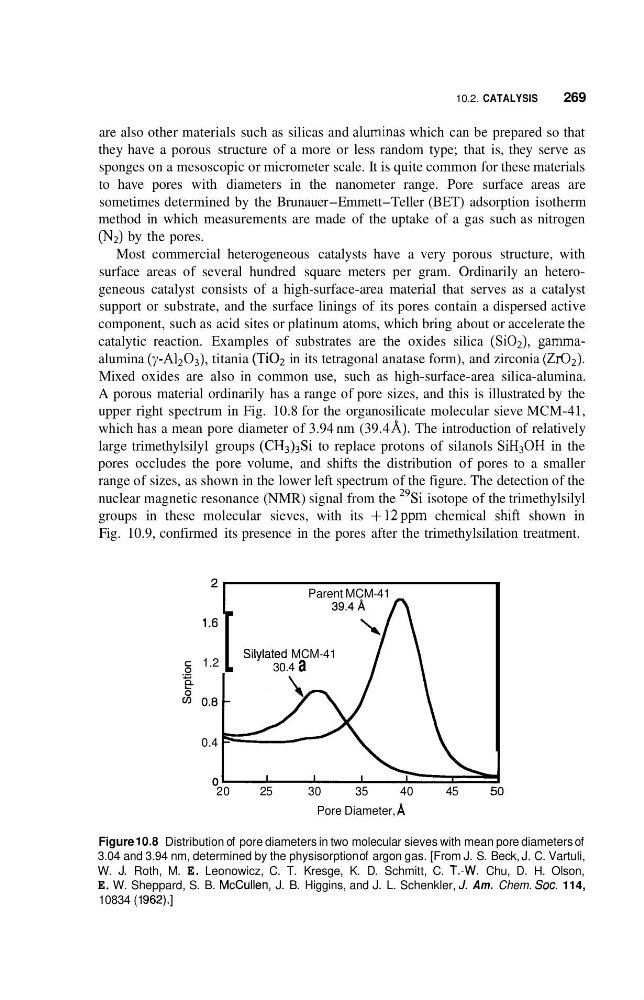
A porous material ordinarily has a range of pore sizes, and this is illustrated by the
upper right spectrum in Fig. 10.8 for the organosilicate molecular sieve MCM-41,
which has a mean pore diameter of 3.94 nm (39.4 A). The introduction of relatively
large trimethylsilyl groups (CH3)3Si to replace protons of silanols SiH30H in the
pores occludes the pore volume, and shifts the distribution of pores to a smaller
range of sizes, as shown in the lower left spectrum of the figure. The detection of the
nuclear magnetic resonance (NMR) signal from the 29Si isotope of the trimethylsilyl
groups in these molecular sieves, with its +12ppm chemical shiR shown in
Fig. 10.9, confirmed its presence in the pores after the trimethylsilation treatment.
7 .
-1
Parent MCM-41
'" [ Silylated MCM-41
1.2
30.4 a
0.4 F -
\
0
20
25
30
35
40
45
!
Pore Diameter, A
Figure 10.8 Distribution of pore diameters in two molecular sieves with mean pore diameters of
3.04 and 3.94 nm, determined by the physisorption of argon gas. [From J. S. Beck, J. C. Vartuli,
W. J. Roth, M. E. Leonowicz, C. T. Kresge, K. D. Schmitt, C. T.-W. Chu, D. H. Olson,
E. W. Sheppard, S. B. McCullen, J. B. Higgins, and J. L. Schenkler, J. Am. Chem. SOC. 114,
10834 (1 962).]
269
are also other materials such as silicas and aluminas which can be prepared so that
they have a porous structure of a more or less random type; that is, they serve as
sponges on a mesoscopic or micrometer scale. It is quite common for these materials
to have pores with diameters in the nanometer range. Pore surface areas are
sometimes determined by the Brunauer-Emmett-Teller (BET) adsorption isotherm
method in which measurements are made of the uptake of a gas such as nitrogen
(N2) by the pores.
Most commercial heterogeneous catalysts have a very porous structure, with
surface areas of several hundred square meters per gram. Ordinarily an heterogeneous catalyst consists of a high-surface-area material that serves as a catalyst
support or substrate, and the surface linings of its pores contain a dispersed active
component, such as acid sites or platinum atoms, which bring about or accelerate the
catalytic reaction. Examples of substrates are the oxides silica (Si02), gammaalumina (y-A1203), titania (Ti02 in its tetragonal anatase form), and zirconia (ZrOz).
Mixed oxides are also in common use, such as high-surface-area silica-alumina.
A porous material ordinarily has a range of pore sizes, and this is illustrated by the
upper right spectrum in Fig. 10.8 for the organosilicate molecular sieve MCM-41,
which has a mean pore diameter of 3.94 nm (39.4 A). The introduction of relatively
large trimethylsilyl groups (CH3)3Si to replace protons of silanols SiH30H in the
pores occludes the pore volume, and shifts the distribution of pores to a smaller
range of sizes, as shown in the lower left spectrum of the figure. The detection of the
nuclear magnetic resonance (NMR) signal from the 29Si isotope of the trimethylsilyl
groups in these molecular sieves, with its +12ppm chemical shiR shown in
Fig. 10.9, confirmed its presence in the pores after the trimethylsilation treatment.
7 .
-1
Parent MCM-41
'" [ Silylated MCM-41
1.2
30.4 a
0.4 F -
\
0
20
25
30
35
40
45
!
Pore Diameter, A
Figure 10.8 Distribution of pore diameters in two molecular sieves with mean pore diameters of
3.04 and 3.94 nm, determined by the physisorption of argon gas. [From J. S. Beck, J. C. Vartuli,
W. J. Roth, M. E. Leonowicz, C. T. Kresge, K. D. Schmitt, C. T.-W. Chu, D. H. Olson,
E. W. Sheppard, S. B. McCullen, J. B. Higgins, and J. L. Schenkler, J. Am. Chem. SOC. 114,
10834 (1 962).]