

270
SELF-ASSEMBLY AND CATALYSIS
I
I
I
I
1
1
1
1
-
1
1
1
~
~
"
~
'
1
'
'
'
'
1
~
~
'
~
1
'
0.0
-80.0
-1 60.0
PPm
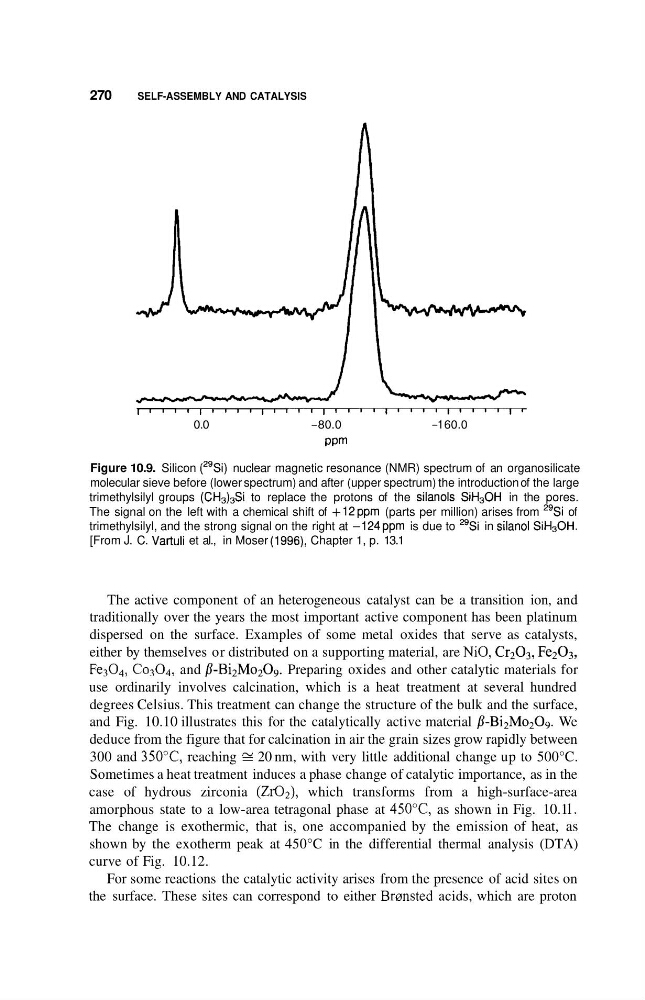
Figure 10.9. Silicon ("Si) nuclear magnetic resonance (NMR) spectrum of an organosilicate
molecular sieve before (lower spectrum) and after (upper spectrum) the introduction of the large
trimethylsilyl groups (CH3)3Si to replace the protons of the silanols SiH30H in the pores.
The signal on the left with a chemical shift of +12ppm (parts per million) arises from "Si of
trimethylsilyl, and the strong signal on the right at -124ppm is due to "Si in silanol SiH30H.
[From J. C. Vartuli et al., in Moser (1996), Chapter 1, p. 13.1
The active component of an heterogeneous catalyst can be a transition ion, and
traditionally over the years the most important active component has been platinum
dispersed on the surface. Examples of some metal oxides that serve as catalysts,
either by themselves or distributed on a supporting material, are NiO, Cr203, Fe203,
Fe304, Co304, and P-Bi2M0209. Preparing oxides and other catalytic materials for
use ordinarily involves calcination, which is a heat treatment at several hundred
degrees Celsius. This treatment can change the structure of the bulk and the surface,
and Fig. 10.10 illustrates this for the catalytically active material P-Bi2M0209. We
deduce from the figure that for calcination in air the grain sizes grow rapidly between
300 and 350"C, reaching 20 nm, with very little additional change up to 500°C.
Sometimes a heat treatment induces a phase change of catalytic importance, as in the
case of hydrous zirconia (Zr02), which transforms from a high-surface-area
amorphous state to a low-area tetragonal phase at 450°C, as shown in Fig. 10.1 1.
The change is exothermic, that is, one accompanied by the emission of heat, as
shown by the exotherm peak at 450°C in the differential thermal analysis (DTA)
curve of Fig. 10.12.
For some reactions the catalytic activity arises from the presence of acid sites on
the surface. These sites can correspond to either Brcansted acids, which are proton
SELF-ASSEMBLY AND CATALYSIS
I
I
I
I
1
1
1
1
-
1
1
1
~
~
"
~
'
1
'
'
'
'
1
~
~
'
~
1
'
0.0
-80.0
-1 60.0
PPm
Figure 10.9. Silicon ("Si) nuclear magnetic resonance (NMR) spectrum of an organosilicate
molecular sieve before (lower spectrum) and after (upper spectrum) the introduction of the large
trimethylsilyl groups (CH3)3Si to replace the protons of the silanols SiH30H in the pores.
The signal on the left with a chemical shift of +12ppm (parts per million) arises from "Si of
trimethylsilyl, and the strong signal on the right at -124ppm is due to "Si in silanol SiH30H.
[From J. C. Vartuli et al., in Moser (1996), Chapter 1, p. 13.1
The active component of an heterogeneous catalyst can be a transition ion, and
traditionally over the years the most important active component has been platinum
dispersed on the surface. Examples of some metal oxides that serve as catalysts,
either by themselves or distributed on a supporting material, are NiO, Cr203, Fe203,
Fe304, Co304, and P-Bi2M0209. Preparing oxides and other catalytic materials for
use ordinarily involves calcination, which is a heat treatment at several hundred
degrees Celsius. This treatment can change the structure of the bulk and the surface,
and Fig. 10.10 illustrates this for the catalytically active material P-Bi2M0209. We
deduce from the figure that for calcination in air the grain sizes grow rapidly between
300 and 350"C, reaching 20 nm, with very little additional change up to 500°C.
Sometimes a heat treatment induces a phase change of catalytic importance, as in the
case of hydrous zirconia (Zr02), which transforms from a high-surface-area
amorphous state to a low-area tetragonal phase at 450°C, as shown in Fig. 10.1 1.
The change is exothermic, that is, one accompanied by the emission of heat, as
shown by the exotherm peak at 450°C in the differential thermal analysis (DTA)
curve of Fig. 10.12.
For some reactions the catalytic activity arises from the presence of acid sites on
the surface. These sites can correspond to either Brcansted acids, which are proton