

268
SELF-ASSEMBLY AND CATALYSIS
same volume as a sphere of radius r, specifically, 4nr3/3 = nD2L/4, which gives
r = i[3@L/2]'13, It is easy to show that the specific surface area S(L1D) from
Eq. (10.5) is given by
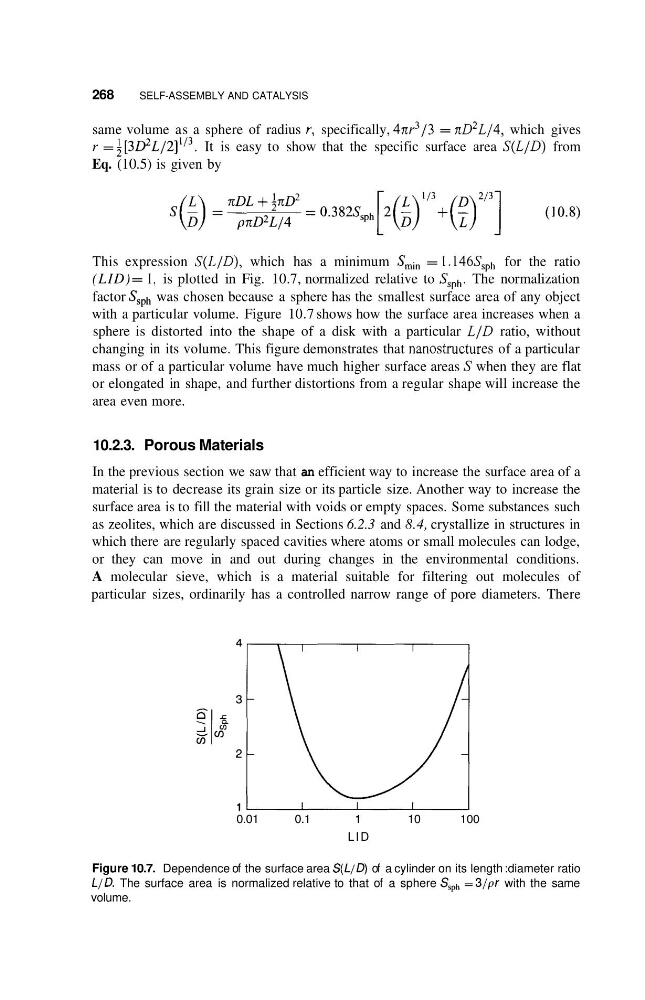
This expression S(L/D), which has a minimum Smin = 1.146SSph for the ratio
(LID) = I , is plotted in Fig. 10.7, normalized relative to S,,,. The normalization
factor SSph was chosen because a sphere has the smallest surface area of any object
with a particular volume. Figure 10.7 shows how the surface area increases when a
sphere is distorted into the shape of a disk with a particular LID ratio, without
changing in its volume. This figure demonstrates that nanostructures of a particular
mass or of a particular volume have much higher surface areas S when they are flat
or elongated in shape, and further distortions from a regular shape will increase the
area even more.
10.2.3. Porous Materials
In the previous section we saw that an efficient way to increase the surface area of a
material is to decrease its grain size or its particle size. Another way to increase the
surface area is to fill the material with voids or empty spaces. Some substances such
as zeolites, which are discussed in Sections 6.2.3 and 8.4, crystallize in structures in
which there are regularly spaced cavities where atoms or small molecules can lodge,
or they can move in and out during changes in the environmental conditions.
A molecular sieve, which is a material suitable for filtering out molecules of
particular sizes, ordinarily has a controlled narrow range of pore diameters. There
0.01
0.1
1
10
100
L I D
Figure 10.7. Dependence of the surface area S(L/D) of a cylinder on its length :diameter ratio
L/D. The surface area is normalized relative to that of a sphere S,,, = 3 / p r with the same
volume.
SELF-ASSEMBLY AND CATALYSIS
same volume as a sphere of radius r, specifically, 4nr3/3 = nD2L/4, which gives
r = i[3@L/2]'13, It is easy to show that the specific surface area S(L1D) from
Eq. (10.5) is given by
This expression S(L/D), which has a minimum Smin = 1.146SSph for the ratio
(LID) = I , is plotted in Fig. 10.7, normalized relative to S,,,. The normalization
factor SSph was chosen because a sphere has the smallest surface area of any object
with a particular volume. Figure 10.7 shows how the surface area increases when a
sphere is distorted into the shape of a disk with a particular LID ratio, without
changing in its volume. This figure demonstrates that nanostructures of a particular
mass or of a particular volume have much higher surface areas S when they are flat
or elongated in shape, and further distortions from a regular shape will increase the
area even more.
10.2.3. Porous Materials
In the previous section we saw that an efficient way to increase the surface area of a
material is to decrease its grain size or its particle size. Another way to increase the
surface area is to fill the material with voids or empty spaces. Some substances such
as zeolites, which are discussed in Sections 6.2.3 and 8.4, crystallize in structures in
which there are regularly spaced cavities where atoms or small molecules can lodge,
or they can move in and out during changes in the environmental conditions.
A molecular sieve, which is a material suitable for filtering out molecules of
particular sizes, ordinarily has a controlled narrow range of pore diameters. There
0.01
0.1
1
10
100
L I D
Figure 10.7. Dependence of the surface area S(L/D) of a cylinder on its length :diameter ratio
L/D. The surface area is normalized relative to that of a sphere S,,, = 3 / p r with the same
volume.