

10.2. CATALYSIS
267
where the length parameters a, d, and L are expressed in nanometers, and the density
p has the units g/cm3. In Eq. (10.6~) the area of the side of the disk is neglected, and
in Eq. (1 0.6d) the areas of two ends of the wire are disregarded. Similar expressions
can be written for distortions of the cube [Eq. (10.6b)l into the quantum-well and
quantum-wire configurations of Fig. 9.1.
The densities of types 111-V and 11-VI semiconductors, from Table B.5, are in the
range from 2.42 to 8.25 g/cm3, with GaAs having the typical value p = 5.32 g/cm3.
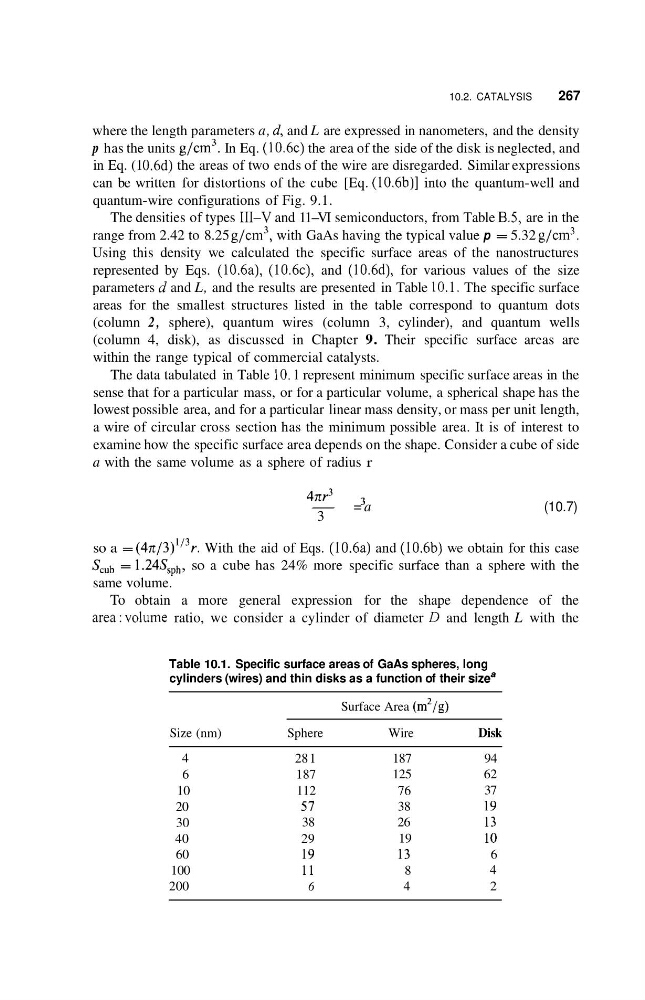
Using this density we calculated the specific surface areas of the nanostructures
represented by Eqs. (10.6a), (10.6c), and (10.6d), for various values of the size
parameters d and L, and the results are presented in Table 10.1. The specific surface
areas for the smallest structures listed in the table correspond to quantum dots
(column 2 , sphere), quantum wires (column 3, cylinder), and quantum wells
(column 4, disk), as discussed in Chapter 9. Their specific surface areas are
within the range typical of commercial catalysts.
The data tabulated in Table IO. 1 represent minimum specific surface areas in the
sense that for a particular mass, or for a particular volume, a spherical shape has the
lowest possible area, and for a particular linear mass density, or mass per unit length,
a wire of circular cross section has the minimum possible area. It is of interest to
examine how the specific surface area depends on the shape. Consider a cube of side
a with the same volume as a sphere of radius r
4nr3
- = a
3
(10.7)
so a = ( 4 ~ / 3 ) ' ' ~ r .
With the aid of Eqs. (10.6a) and (10.6b) we obtain for this case
Stub = 1.24SS,,, so a cube has 24% more specific surface than a sphere with the
same volume.
To obtain a more general expression for the shape dependence of the
area:volume ratio, we consider a cylinder of diameter D and length L with the
Table 10.1. Specific surface areas of GaAs spheres, long
cylinders (wires) and thin disks as a function of their sizea
Surface Area (m2/g)
Size (nm)
Sphere
Wire
Disk
4
6
10
20
30
40
60
100
200
28 1
187
112
57
38
29
19
11
6
187
125
76
38
26
19
13
8
4
94
62
37
19
13
10
6
4
2
267
where the length parameters a, d, and L are expressed in nanometers, and the density
p has the units g/cm3. In Eq. (10.6~) the area of the side of the disk is neglected, and
in Eq. (1 0.6d) the areas of two ends of the wire are disregarded. Similar expressions
can be written for distortions of the cube [Eq. (10.6b)l into the quantum-well and
quantum-wire configurations of Fig. 9.1.
The densities of types 111-V and 11-VI semiconductors, from Table B.5, are in the
range from 2.42 to 8.25 g/cm3, with GaAs having the typical value p = 5.32 g/cm3.
Using this density we calculated the specific surface areas of the nanostructures
represented by Eqs. (10.6a), (10.6c), and (10.6d), for various values of the size
parameters d and L, and the results are presented in Table 10.1. The specific surface
areas for the smallest structures listed in the table correspond to quantum dots
(column 2 , sphere), quantum wires (column 3, cylinder), and quantum wells
(column 4, disk), as discussed in Chapter 9. Their specific surface areas are
within the range typical of commercial catalysts.
The data tabulated in Table IO. 1 represent minimum specific surface areas in the
sense that for a particular mass, or for a particular volume, a spherical shape has the
lowest possible area, and for a particular linear mass density, or mass per unit length,
a wire of circular cross section has the minimum possible area. It is of interest to
examine how the specific surface area depends on the shape. Consider a cube of side
a with the same volume as a sphere of radius r
4nr3
- = a
3
(10.7)
so a = ( 4 ~ / 3 ) ' ' ~ r .
With the aid of Eqs. (10.6a) and (10.6b) we obtain for this case
Stub = 1.24SS,,, so a cube has 24% more specific surface than a sphere with the
same volume.
To obtain a more general expression for the shape dependence of the
area:volume ratio, we consider a cylinder of diameter D and length L with the
Table 10.1. Specific surface areas of GaAs spheres, long
cylinders (wires) and thin disks as a function of their sizea
Surface Area (m2/g)
Size (nm)
Sphere
Wire
Disk
4
6
10
20
30
40
60
100
200
28 1
187
112
57
38
29
19
11
6
187
125
76
38
26
19
13
8
4
94
62
37
19
13
10
6
4
2