

262
SELF-ASSEMBLY AND CATALYSIS
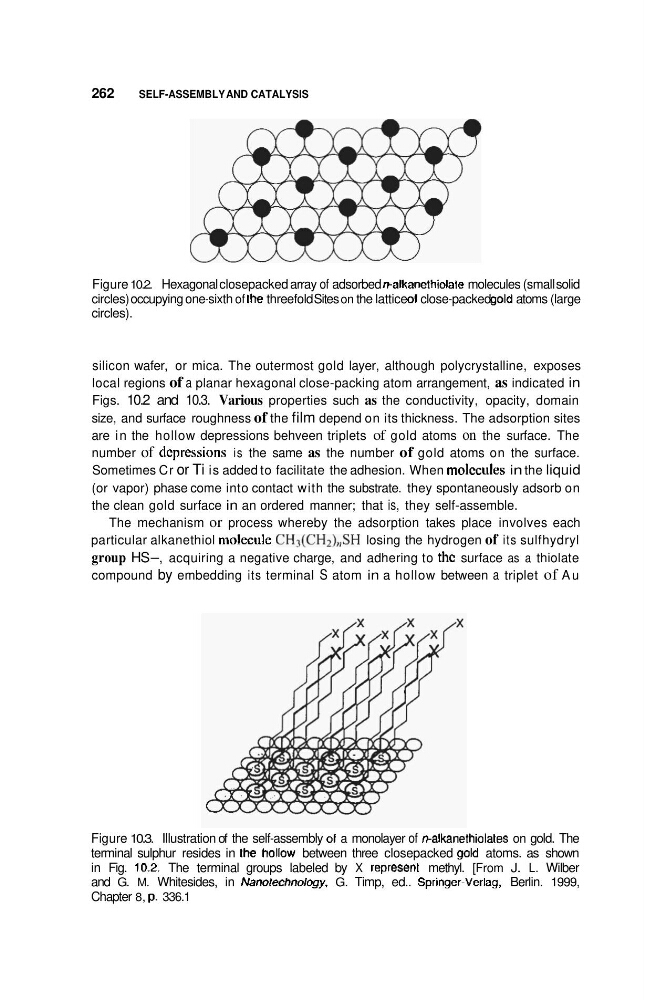
Figure 10.2. Hexagonal closepacked array of adsorbed Ralkanethiolale molecules (small solid
circles) occupying one-sixth of the threefold Sites on the lattice 01 close-packed gold atoms (large
circles).
silicon wafer, or mica. The outermost gold layer, although polycrystalline, exposes
local regions of a planar hexagonal close-packing atom arrangement, as indicated in
Figs. 10.2 and 10.3. Various properties such as the conductivity, opacity, domain
size, and surface roughness of the film depend on its thickness. The adsorption sites
are in the hollow depressions behveen triplets of gold atoms on the surface. The
number of dcpressions is the same as the number of gold atoms on the surface.
Sometimes Cr or Ti is added to facilitate the adhesion. When molcciiles in the liquid
(or vapor) phase come into contact with the substrate. they spontaneously adsorb on
the clean gold surface in an ordered manner; that is, they self-assemble.
The mechanism or process whereby the adsorption takes place involves each
particular alkanethiol molecule CH,(CH,),zSH losing the hydrogen of its sulfhydryl
group HS-, acquiring a negative charge, and adhering to thc surface as a thiolate
compound by embedding its terminal S atom in a hollow between a triplet of A u
Figure 10.3. Illustration of the self-assembly 01 a monolayer of rbalkanethioiates on gold. The
terminal sulphur resides in the hollow between three closepacked gold atoms. as shown
in Fig. 10.2. The terminal groups labeled by X represent methyl. [From J. L. Wilber
and G. M. Whitesides, in Nanolechnobgy. G. Timp, ed.. Springer~Verlag, Berlin. 1999,
Chapter 8, p. 336.1
SELF-ASSEMBLY AND CATALYSIS
Figure 10.2. Hexagonal closepacked array of adsorbed Ralkanethiolale molecules (small solid
circles) occupying one-sixth of the threefold Sites on the lattice 01 close-packed gold atoms (large
circles).
silicon wafer, or mica. The outermost gold layer, although polycrystalline, exposes
local regions of a planar hexagonal close-packing atom arrangement, as indicated in
Figs. 10.2 and 10.3. Various properties such as the conductivity, opacity, domain
size, and surface roughness of the film depend on its thickness. The adsorption sites
are in the hollow depressions behveen triplets of gold atoms on the surface. The
number of dcpressions is the same as the number of gold atoms on the surface.
Sometimes Cr or Ti is added to facilitate the adhesion. When molcciiles in the liquid
(or vapor) phase come into contact with the substrate. they spontaneously adsorb on
the clean gold surface in an ordered manner; that is, they self-assemble.
The mechanism or process whereby the adsorption takes place involves each
particular alkanethiol molecule CH,(CH,),zSH losing the hydrogen of its sulfhydryl
group HS-, acquiring a negative charge, and adhering to thc surface as a thiolate
compound by embedding its terminal S atom in a hollow between a triplet of A u
Figure 10.3. Illustration of the self-assembly 01 a monolayer of rbalkanethioiates on gold. The
terminal sulphur resides in the hollow between three closepacked gold atoms. as shown
in Fig. 10.2. The terminal groups labeled by X represent methyl. [From J. L. Wilber
and G. M. Whitesides, in Nanolechnobgy. G. Timp, ed.. Springer~Verlag, Berlin. 1999,
Chapter 8, p. 336.1