

10.1. SELF-ASSEMBLY
261
= -
(a)
r
( L I
( d l
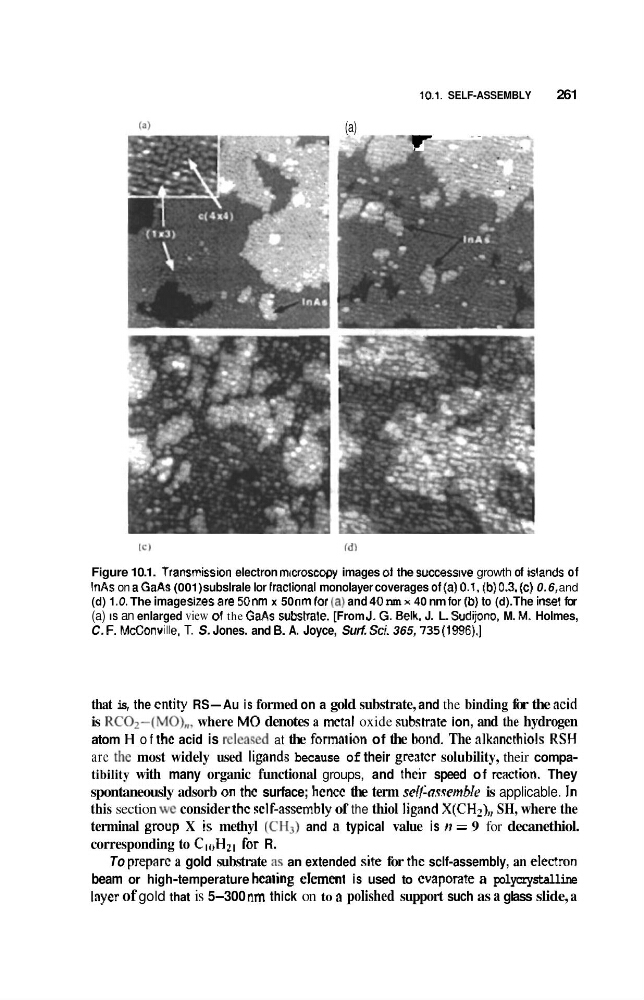
Figure 10.1. fransmission electron mrcroscqy images ol the successive growth of sslands of
InAs on aGaAs (001) subslrale lor fradional monolayer coverages of (a) 0.1, (b) 0.3. (c) 0.6, and
(d) 1 .O. The image sizes are 50nm x 50 nm l oor (a) and 41) nm x 40 nm for (b) to (d). The insel for
(a) IS an enlarged view of the GaAs substnale. [From J. €3. Belk. J. L. Sudijono, M. M. Holmes,
C. F. McCanville, T. S. Jones. and R. A. Joyce, Surf. Sci 365, 735 (1996).]
that is, the entity RS-Au is formed on a gold substrate, and the binding for the acid
is RCO?-(MO),,, where MO denotes a metal oxide substmte ion, and the hydrogen
atom H o f the acid is rcclcawd at the formalion of the h i i d . The alkancthiols RSH
are The most widely used ligands because of their greater solubility, their compatibility with many organic functional groups, and their speed of reaction. They
spontaneously adsorb QII thc surface; hence the term sefllnsrembk is applicable. In
this section we consider thc sclf-assembly of the thiol ligtlnd X(CH1),, SH, where the
terminal group X is methyl (CH3) and n typical value is 17 = 9 for decanethiol.
corresponding to CI&
for R.
To preparc a gold substrate as an extended siae for the sclf-assembly, an electron
beam or high-temperature healing elemcnt is used to maporate n polycrystalline
layer of gold that is 5-300 nrn thick on to n polished support such as a glass slide, a
261
= -
(a)
r
( L I
( d l
Figure 10.1. fransmission electron mrcroscqy images ol the successive growth of sslands of
InAs on aGaAs (001) subslrale lor fradional monolayer coverages of (a) 0.1, (b) 0.3. (c) 0.6, and
(d) 1 .O. The image sizes are 50nm x 50 nm l oor (a) and 41) nm x 40 nm for (b) to (d). The insel for
(a) IS an enlarged view of the GaAs substnale. [From J. €3. Belk. J. L. Sudijono, M. M. Holmes,
C. F. McCanville, T. S. Jones. and R. A. Joyce, Surf. Sci 365, 735 (1996).]
that is, the entity RS-Au is formed on a gold substrate, and the binding for the acid
is RCO?-(MO),,, where MO denotes a metal oxide substmte ion, and the hydrogen
atom H o f the acid is rcclcawd at the formalion of the h i i d . The alkancthiols RSH
are The most widely used ligands because of their greater solubility, their compatibility with many organic functional groups, and their speed of reaction. They
spontaneously adsorb QII thc surface; hence the term sefllnsrembk is applicable. In
this section we consider thc sclf-assembly of the thiol ligtlnd X(CH1),, SH, where the
terminal group X is methyl (CH3) and n typical value is 17 = 9 for decanethiol.
corresponding to CI&
for R.
To preparc a gold substrate as an extended siae for the sclf-assembly, an electron
beam or high-temperature healing elemcnt is used to maporate n polycrystalline
layer of gold that is 5-300 nrn thick on to n polished support such as a glass slide, a